Language, Form and Structure in A View from the Bridge
In A View from the Bridge, much of the tension develops through conversations, physical actions and changes in the relationships between characters. A repeated word, an unfinished sentence, a pause or a movement across the stage can reveal a great deal about what is happening beneath the surface.
Language, form and structure work closely together throughout the play. Language includes Alfieri’s role as narrator and chorus and the characters’ dialogue. Form includes the fact that this is a stage play and a modern tragedy, as well as Miller’s imagery. Structure relates to the way Miller arranges events across the two acts and purposefully develops the conflict towards its tragic conclusion.
It is important to include these perspectives in your Edexcel IGCSE English Literature essay. For more practise, our A View from the Bridge past exam questions give you a range of questions where you can practise applying AO2 analysis.
Language
Naturalistic and colloquial dialogue
Miller writes the characters dialogue in a style and language that suits the working-class Italian-American community of Red Hook. Their conversations contain contractions, informal expressions and grammatical patterns associated with everyday speech. Eddie, for example, speaks directly and conversationally throughout the play. Lines such as “I want my respect!” and “You’re stealin’ from me!” have an immediate quality because they emerge naturally from arguments and conversations.
This naturalistic dialogue allows the conflicts to develop within recognisable family exchanges. Eddie’s attempts to influence Catherine often begin with remarks about her clothes, her job or Rodolpho. As similar concerns are repeated with greater intensity as the seriousness of the conflict becomes clearer.
Rodolpho and Marco also have distinctive ways of speaking. Rodolpho is expressive and enthusiastic, while Marco tends to speak more sparingly. Their different speech patterns contribute to their characterisation before the conflict with Eddie becomes open.
Subtext and implied meaning
Subtext is especially important in A View from the Bridge because characters frequently talk around difficult subjects. Their speech carry implied meanings that are not always acknowledged. For example, Eddie repeatedly questions Rodolpho’s behaviour, masculinity and reasons for wanting to marry Catherine. He presents these objections as concern for Catherine, while Alfieri gradually directs attention towards Eddie’s own feelings.
During their first meeting, Alfieri asks him, “She can’t marry you, can she?” The question presents an idea within their conversation that Eddie has been unable to acknowledge nor express openly. Beatrice is also able to identify what Eddie avoids saying. Her final confrontation with him becomes much more direct when she tells him, “You want somethin’ else, Eddie, and you can never have her!”
Miller allows this tension to develop across much of the play before Beatrice finally states it. The audience has already gathered meaning from Eddie’s words and behaviour, so the revelation confirms something that has gradually become harder to ignore.
Subtext is therefore useful for analysing both language and structure. You can trace how an idea remains unspoken, becomes increasingly visible before it is finally expressed directly.
Repetition and increasing pressure
Repetition becomes particularly noticeable as Eddie’s concern with reputation intensifies. Near the end of the play he demands, “I want my respect!” and later, “I want my name!” Both statements reduce his concerns to a few forceful words. His repeated use of “my” also draws attention to the personal importance he attaches to respect, authority and public reputation.
The idea of his “name” becomes especially important after Marco accuses Eddie publicly of reporting the cousins to Immigration. Eddie becomes increasingly concerned with how the neighbourhood sees him, and his language becomes more insistent as the final confrontation approaches.
You can therefore describe the repetition to show how tension is built throughout the play. A repeated word or idea may become more significant as the character’s circumstances change.
Questions, interruptions and broken speech
Arguments in the play frequently contain questions, interruptions and unfinished sentences. These features help Miller create the rhythm of spontaneous speech while also emphasising changes in control. Eddie often questions Catherine and Rodolpho. His questions can place pressure on them or challenge what they say. Catherine gradually becomes more willing to answer back at him, as her independence develops. Eddie’s speech becomes less controlled at moments of emotional pressure. During his meetings with Alfieri, he moves between explanations, accusations and incomplete thoughts as he struggles to explain why Rodolpho troubles him.
When analysing dialogue, look at how a conversation transitions as well as the words being spoken. Interruptions, pauses and unfinished sentences can be described to show how tension develops between characters in real time.
Alfieri’s imagery
Alfieri’s language differs from the everyday dialogue of the other characters. His speeches contain more imagery because he is looking back on the events and interpreting their significance for the audience. One of the clearest examples is his description of Eddie’s eyes as being “like tunnels”. The image suggests a restricted field of vision and can be connected with Eddie’s increasing fixation on Catherine and Rodolpho.
Alfieri also introduces the story as one he was forced to watch run its “bloody course”. Before Eddie has even spoken, the language has placed his domestic story within a tragic framework.
Alfieri’s imagery is particularly useful in essays on tragedy, Eddie or dramatic structure as his words often connect individual moments with the larger pattern of the play.
Form
A Modern Tragedy
Miller wrote A View from the Bridge as a tragedy, adapting the Greek tragic form to a twentieth-century working-class community.
Eddie Carbone is a longshoreman whose concerns centre on his family, his home, his reputation and his place within the neighbourhood. His ordinary surroundings allow Miller to develop tragedy through domestic relationships and community pressures. The play also uses recognisable features of a tragic drama. Alfieri anticipates catastrophe, warnings are repeatedly given, conflicts become increasingly difficult to resolve and the play ends with the death of its central character.
Eddie continues to make poor choices as the tragedy develops, even though Alfieri advises him to accept Catherine’s independence, and he has several opportunities to withdraw from the conflict. His decision to report Marco and Rodolpho to Immigration changes the course of events decisively.
From this point, the consequences of the betrayal become increasingly difficult to reverse. Marco publicly identifies Eddie and he loses his standing within the neighbourhood. This leads to his demand to recover his “name” which ends in the final confrontation. Through this foretelling, Miller creates a strong sense of tragic inevitability while allowing the events to unfold as Eddie’s own decisions bring that tragedy about.
Alfieri as narrator and modern chorus
Alfieri performs several roles. He is a lawyer within the action, a narrator looking back on events and a modern version of the chorus found in classical tragedy. His direct addresses give the audience information that the other characters do not possess. At the beginning, he describes himself as “powerless” to stop the case he is about to recount. Later, he admits that he could see “every step coming, step after step”.
Because Alfieri is recounting events that have already happened, the audience knows from the beginning that the story will end badly. Within the action itself, however, Alfieri can only advise Eddie when Eddie comes to his office. This creates two perspectives on the same events. Alfieri can recognise the full pattern because he is remembering what happened, while Eddie experiences each decision without that knowledge of the eventual outcome. Alfieri’s appearances also give the audience moments of reflection between periods of domestic conflict.
Drama and Stagecraft
As a stage play, A View from the Bridge creates meaning through dialogue, movement, gesture, lighting and the positioning of characters. Marco’s chair lift is one clear example. Miller directs him to hold the chair “like a weapon over Eddie’s head”, turning a simple physical action into a warning at the end of Act One.
Lighting becomes particularly important before Eddie reports the cousins. While Alfieri warns him about the consequences of his behaviour, the telephone booth begins to glow with “a faint, lonely blue”. Eddie later appears beside it and makes the call to Immigration. Miller also uses the positioning and movement of groups on stage. When Marco publicly accuses Eddie after the raid, the stage direction tells us that “the crowd has turned to Eddie”. The family conflict has now become visible to the neighbourhood, and Eddie’s reputation has become part of the action.
When writing about stagecraft, use the detail Miller actually provides in the script. Stage directions, lighting, movement, entrances, exits and the position of characters can all give you precise AO2 evidence.
Structure
Alfieri frames the story
The play begins with Alfieri looking back on events that have already happened. Even before Eddie speaks, the audience has already been told that Alfieri was unable to prevent the case from running its “bloody course”. Miller therefore establishes the tragic direction from the beginning. The early scenes in the Carbone apartment may appear ordinary, but the audience already knows that the story will lead towards violence.
Alfieri returns at key points to comment on developments and advises Eddie. His appearances divide the action into stages and remind the audience of the perspective established from the opening scene. After Eddie’s death, Alfieri once again turns towards the audience. The ending therefore returns to the narrator who began the story, allowing him to reflect on the events the audience has just witnessed.
The Two-Act Structure
The division between the two acts occurs at an important point in the conflict. Act One ends after the boxing lesson and Marco’s chair lift. Eddie has hit Rodolpho during the boxing demonstration, and Marco responds by revealing his own strength. Miller brings down the curtain while Marco still holds the chair above Eddie. The confrontation remains unresolved, leaving the audience with an image of the now charged relationship between the two men.
Act Two develops the consequences of the tensions established earlier. Catherine decides to leave the Carbone home, Eddie confronts Catherine and Rodolpho physically, Alfieri gives Eddie another warning and Eddie calls Immigration. The two-act structure therefore helps Miller move from growing tension within the household towards decisions with much wider consequences.
Escalation and cause and effect
The events of the play develop through a clear chain of causes and consequences. Catherine’s relationship with Rodolpho increases Eddie’s uneasiness. When Eddie challenges Rodolpho during the boxing lesson and Marco responds with the chair lift this makes Catherine more determined to leave. Eddie’s confrontation with Catherine and Rodolpho fails to separate them, and he later reports Marco and Rodolpho to Immigration. The raid then allows Marco to identify Eddie publicly. Eddie’s concern with recovering his reputation leads into the final confrontation.
Tracing these connections gives you a strong way to discuss structure. You can explain how one decision affects the next and how the possibilities for resolution gradually narrow.
The telephone call is an especially important climax because Eddie turns his private family conflict into an action that has consequences for Marco, Rodolpho and the wider community. Once his betrayal becomes public, the tragedy moves much more decisively towards its ending.
From private to public conflict
The location and visibility of the conflict also change across the play. Much of the early tension occurs inside the Carbone apartment. Eddie questions Catherine, criticises Rodolpho and argues with Beatrice within the family home. The consequences gradually extend into the wider community. Eddie visits Alfieri, reports the cousins to Immigration and is publicly identified by Marco after the raid.
By the final confrontation, the dispute is taking place in the street before the neighbourhood. Eddie’s concern with Catherine has developed into a public conflict over betrayal, reputation and the loss of his “name”. This transition from the household into the open community is useful for questions on reputation, loyalty, betrayal and tragedy because it shows how the scale of the conflict grows across the duration and structure of the play.
Using Language, Form and Structure in an Essay
You do not need to identify a large number of techniques in an essay. Choose methods that help you explain the question you have been asked.
- For a question about Eddie and reputation, you could analyse the possessive language in “I want my name”, connect it with the stage direction that “the crowd has turned to Eddie”, and then explain how the movement from private conflict to public accusation changes his position within the play.
- For a question about tension, you might examine the dialogue between Eddie and Rodolpho, the physical stagecraft of the chair lift and its position at the end of Act One.
- For a question about tragedy, you could combine Alfieri’s foreknowledge, Eddie’s repeated opportunities to change direction and the structural importance of his telephone call to Immigration.
Try to move beyond just naming a technique. Explain what Miller has done, where it happens, how it affects the characters or audience, and why it matters to the question.
Language, form and structure frequently work together. Dialogue can lead into physical action, stage directions can alter the meaning of spoken words, and the position of a scene within the play can give an individual moment greater significance.
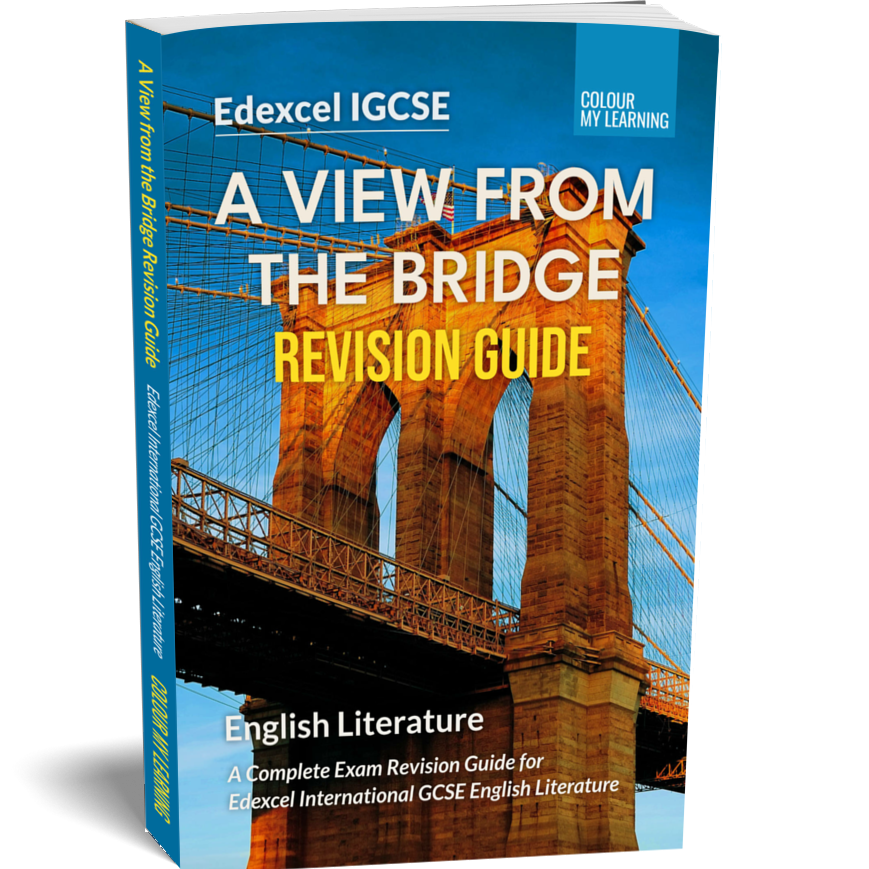
Revise A View from the Bridge with the complete revision guide
Essential Literature: A View from the Bridge brings together everything you need for Edexcel International GCSE English Literature, including characters, relationships, themes, symbolism, dramatic methods, key quotations, essay planning and exam practice.