How to Write a Strong Kindertransport Essay for Edexcel IGCSE
A strong Kindertransport essay answers the question directly, develops a clear argument and supports each point with relevant evidence from the play. It also discusses how Diane Samuels uses language, dramatic form and structure to create meaning and influence the audience.
In Section A of Edexcel IGCSE English Literature Paper 2, the Kindertransport essay is worth 30 marks:
- AO1: knowledge, understanding and a well-developed personal response
- AO2: analysis of language, form and structure
The strongest responses aim to accomplish these two assessment objectives. These essays would aim to explain what Samuels presents in the play and detail how her choices communicate those ideas. The outline below guides you through the steps to accomplish that.
For more essay writing practise visit our collection of Kindertransport past exam questions.
1. Identify the exact focus of the question
Begin by underlining the most important words in the question.
A question may focus on:
- a character
- a relationship
- a theme
- a symbol
- a setting
- a journey
- an emotion
- the ending of the play
The command word also guides your response.
- Explore asks you to examine how an idea is developed.
- Discuss asks you to consider its presentation and significance.
- How does Samuels present…? asks you to focus closely on the playwright’s choices.
- How far do you agree? asks you to reach a clear judgement and support it throughout the essay.
For example:
How does Samuels present the effects of separation in Kindertransport?
The focus is the effects of separation. A strong response could examine Eva’s departure from her parents, her changing identity and the lasting influence of separation on Evelyn’s relationship with Faith.
Our post on Kindertransport Plot Summary: Key Events and Time Shifts can help you locate relevant moments from across the play.
2. Form a clear argument
Before planning your paragraphs, decide what your overall answer will be.
Complete the sentence: Samuels presents…
For example:
Samuels presents separation as an experience that shapes Eva’s identity, relationships and adult life.
This sentence gives your essay a clear direction. Each paragraph can then develop one part of the argument.
For a character question, you might write:
Samuels presents Evelyn as controlled and emotionally guarded because her childhood experiences continue to influence her adult life.
For a relationship question:
Samuels presents the relationship between Helga and Eva as loving, painful and permanently shaped by separation.
The Main Themes in Kindertransport, Main Characters in Kindertransport and Key Relationships in Kindertransport resources can help you develop a clear and balanced interpretation.
3. Plan three or four well-developed points
A short plan helps you organise your ideas and select evidence efficiently. Choose moments from different stages of the play. This allows you to show how a character, relationship or theme develops.
For a question on separation, you could plan:
- Helga prepares Eva to leave Germany.
- Eva experiences fear and isolation during the journey.
- Eva adapts to England and gradually becomes Evelyn.
- Evelyn’s childhood separation affects Faith and the next generation.
Each paragraph should add something new to the argument.
A useful planning question is: What does the audience understand at this stage of the play?
This encourages you to think about the play’s development and dramatic effect on the audience.
4. Select precise evidence
Choose quotations and dramatic details that support your point clearly. Short quotations often work well because they allow close analysis.
For example:
“You have to be able to manage on your own.”
This quotation could support a discussion of:
- separation
- independence
- motherhood
- protection
- responsibility
- Eva’s development
Evidence also includes stagecraft:
- stage directions
- pauses and silence
- sound and music
- props and objects
- entrances and exits
- lighting
- simultaneous staging
- the appearance of the Ratcatcher
Samuels wrote Kindertransport for performance, so stage action can provide valuable evidence. Refer to our post on Keywords and Vocabulary enhance your knowledge of keywords and vocabulary directly related to Kindertransport.
5. Analyse Samuels’ methods
Every Kindertransport question requires analysis of language, form and structure.
Language
Language includes the words, images and patterns used in dialogue.
You might analyse:
- a significant word
- repetition
- metaphor
- imagery
- tone
- questions
- imperatives
- fragmented speech
In the Helga’s “You have to be able to manage on your own,” the phrase “on your own” emphasises the independence Eva needs even though she is only very young.
Form
Form refers to the play as a piece of drama.
You might analyse:
- dialogue
- stage directions
- performance
- sound
- music
- props
- symbolic figures
- audience response
The Ratcatcher can appear physically on stage, allowing Eva and Evelyn’s fears to become visible to the audience.
Structure
Structure refers to the way Samuels organises the play.
You might analyse:
- movement between past and present
- simultaneous staging
- delayed revelation
- repeated objects and images
- the contrast between Eva and Evelyn
- the placement of important scenes
- the open ending
The shifts between Eva’s childhood and Evelyn’s adult life show how the past continues to influence the present.
For further explanation and examples, read Language, Form and Structure in Kindertransport: How Samuels Creates Meaning.
6. Explain meaning and effect
A strong essay explains why a method, language choice or specific time line matters.
After identifying a word, image or dramatic device, consider:
- What does it reveal?
- What does it suggest?
- How does it connect to the question?
- What does the audience understand or feel?
- How does it develop a wider idea in the play?
For example:
The phrase “on your own” to emphasise Eva’s potential isolation and need for independence. Helga is preparing her daughter for life among strangers, and her firm instruction reflects the urgency of their situation. The practical sewing lesson also foreshadows the emotional independence that will be forced upon Eva after she leaves Germany.
This analysis moves from the quotation to character, dramatic situation and theme.
7. Write developed analytical paragraphs
PEEL or PETAL can help you organise your response.
PEEL
- Point – answer the question
- Evidence – include a quotation or dramatic detail
- Explanation – analyse meaning and effect
- Link – connect back to the question
PETAL
- Point – present a clear idea
- Evidence – select a relevant example
- Technique – identify Samuels’ method
- Analysis – explain how the method works
- Link – return to the essay argument
Use the structure that helps you write clearly. Each paragraph should remain focused on one main idea.
Sample paragraph
Question: How does Samuels present the effects of separation in Kindertransport?
Samuels presents separation as an experience that forces Eva into early independence. Before Eva leaves Germany, Helga tells her, “You have to be able to manage on your own.” The phrase “on your own” emphasises the isolation Eva will face in England without her parents. Helga’s firm tone shows her determination to prepare Eva for survival, while the domestic action of sewing a button gives the moment emotional significance. The play opens with this practical lesson to foreshadow the greater demands that will be placed on Eva after the Kindertransport. Her separation begins emotionally before the train journey itself.
This paragraph:
- answers the question
- uses a precise quotation
- analyses language
- refers to stage action
- comments on structure
- explains Samuels’ decisions and choices
8. Use precise analytical vocabulary
Clear vocabulary helps you express ideas with greater accuracy.
Useful words for Kindertransport include:
- displaced
- isolated
- protective
- conflicted
- repressed
- fragmented
- symbolic
- unresolved
- assimilated
- intergenerational
- non-linear
- emotionally guarded
For example:
Samuels presents Evelyn as emotionally guarded because she has repressed painful memories of separation. The non-linear structure reflects the fragmented nature of Evelyn’s memories.
Our Key Words for Kindertransport Essays resource explains useful terms and shows how to apply them in analytical sentences.
9. Refer to the play as a whole
Strong responses use moments from across the play.
Relevant stages may include:
- Eva’s preparation for leaving Hamburg
- the train journey
- her arrival in England
- her relationship with Lil
- her changing identity
- Faith’s discovery in the attic
- Helga’s visit to England
- the final Ratcatcher image
This allows you to show development and strengthens your understanding of the whole text.
For example in a question about fear, for example, you could trace the idea from Eva’s childhood story of the Ratcatcher to Evelyn’s final isolation in the attic.
Our Symbolism in Kindertransport: The Ratcatcher, Attic and Objects resource explores how repeated images and objects connect different stages of the play.
10. Keep context relevant
Although context is not a required Assessment Objective, it can support your interpretation when it helps explain a character’s situation or Samuels’ purpose.
You might briefly refer to:
- the Kindertransport
- Jewish persecution in Nazi Germany
- separation from parents
- displacement in Britain
- the experiences of child refugees
- the lasting effects of trauma
Keep the focus on the play.
For example:
Eva’s forced independence reflects the experiences of children sent away from their families on the Kindertransport.
Our Context in Kindertransport: What Students Need to Know provides the key background needed for informed analysis.
Writing a focused introduction
Your introduction can be concise.
Include:
- the writer and title
- a direct answer to the question
- your main argument
- the areas you will explore
Example:
In Kindertransport, Diane Samuels presents separation as an experience that continues to influence Eva throughout her life. Through Eva’s departure from Germany, her changing identity and her later relationship with Faith, Samuels explores the long-term effects of loss and displacement. The play’s time shifts, symbolic objects and simultaneous staging allow the past to remain active in the present.
Writing a clear conclusion
Your conclusion should bring the main argument together and return directly to the question.
Example:
Separation remains a strong influence on Eva’s identity, memories and relationships. The movement between Eva’s childhood and Evelyn’s adult life shows how the experience continues to affect her across time. Through the Ratcatcher, the attic, Evelyn’s relationships with Lil and Faith, and the unresolved ending, Samuels leaves the audience with a strong sense of the emotional consequences carried by survivors and their families.
Final essay checklist
Before finishing, check that your response:
- answers the exact question
- presents a clear argument
- includes three or four developed points
- uses precise quotations and dramatic evidence
- analyses language, form and structure
- explains meaning and audience effect
- refers to moments from across the play
- uses accurate analytical vocabulary
- links each paragraph to the question
- ends with a focused conclusion
Use our post Essential Quotes from Kindertransport for Edexcel IGCSE to help you build a flexible evidence bank and refer to our Kindertransport past exam questions collection to practise planning and writing responses.
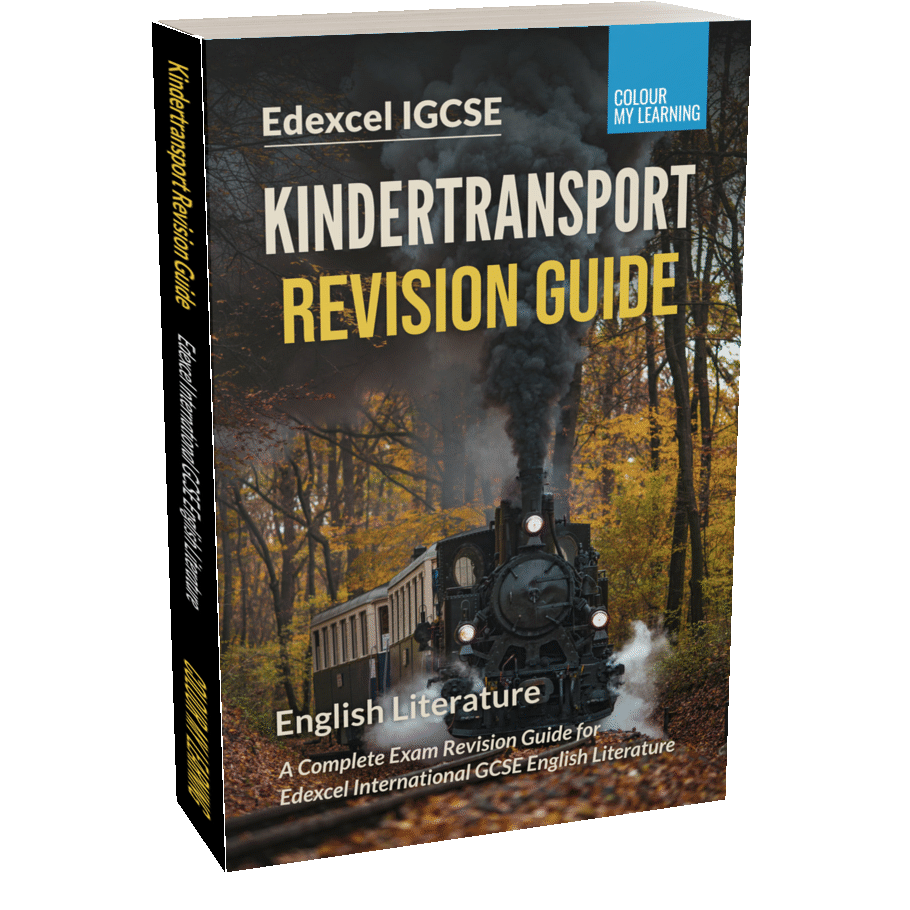
Revise Kindertransport with the complete revision guide
Essential Literature: Kindertransport brings together everything you need for Edexcel International GCSE English Literature, including characters, relationships, themes, symbolism, dramatic methods, key quotations, essay planning and exam practice.