IGCSE Physics Astrophysics Past Papers Exam Questions (Edexcel): 2023-24
Analysed the International GCSE past papers and grouped the questions by topic. Here, you will find questions relating to the topic – Astrophysics. Use these to familiarise, practice and prepare for your IGCSE Physics examination.
You can find other past years questions in Astrophysics below:
What you need to know
Use the list below as a quick recap for what you need to know before attempting the past year exam questions under this topic. This is based on Edexcel International GCSE in Physics (4PH1) specification with first teaching Sept 2017 and first examination June 2019.
Paper 1 and 2: (8) Astrophysics
Paper 1 covers all the topics except where it is marked “Paper 2 only” while Paper 2 covers all topics.
A. Units
- kilogram (kg), metre (m), metre/second (m/s), metre/second2 (m/s2), newton (N), second (s), newton/kilogram (N/kg)
B. Motion in the universe
- the universe is a collection of billions of galaxies
- a galaxy is a collection of billions of stars
- our solar system is in the Milky Way galaxy
- understand why gravitational field strength, g, varies, on other planets and moons
- explain that the gravitational force causes moon to orbit planets, planets to orbit the sun, artificial satellites to orbit Earth and comets to orbit the sun
- the differences in the orbits of comets, moons and planets
- the relationship between orbital speed, orbital radius and time period. v = (2 ×π × r)/ T
C. Stellar evolution
- understand how stars can be classified according to colour
- know that a star’s colour is related to its surface temperature.
- describe the evolution of stars with a mass similar to the Sun through stages: nebular, star (main sequence), red giant, white dwarf.
- describe the evolution of stars with a mass larger than the Sun
(Paper 2 only)
- understand how the brightness of a star at a standard distance can be represented using absolute magnitude
- draw the main components of the Hertzsprung-Russell diagram (HR diagram)
D. Cosmology (Paper 2 only)
- the past evolution of the universe and the main arguments in favour of the Big Bang Theory
- evidence for the Big Bang theory (red-shift and cosmic microwave background CMB radiation)
- describe that if a wave source is moving relative to an observer there is a change in observed frequency and wavelength
- know the equation relating the change in wavelength to the velocity of a galaxy
- change in wavelength/reference wavelength = velocity of a galaxy/speed of light, (λ−λ0)/λ0 =Δλ/λ0=v/c
- describe red-shift in light received from galaxies at different distances away from Earth
- be able to explain why red shift provides evidence for the expansion of the Universe.
January 2023 Paper 1P Q8
8 The table gives information about four stars.
| Star | Colour | Mass in solar masses |
| Sirius | blue-white | 2 |
| Polaris | yellow-white | 5 |
| Betelgeuse | red | 17 |
| Rigel | blue | 21 |
(a) Explain which of these stars has the highest surface temperature. (2)
(b) Discuss the evolution of the stars Rigel and Sirius. (6)
(Total for Question 8 = 8 marks)
January 2023 1PR Q2
2 The diagram shows the orbit of the Earth around the Sun.
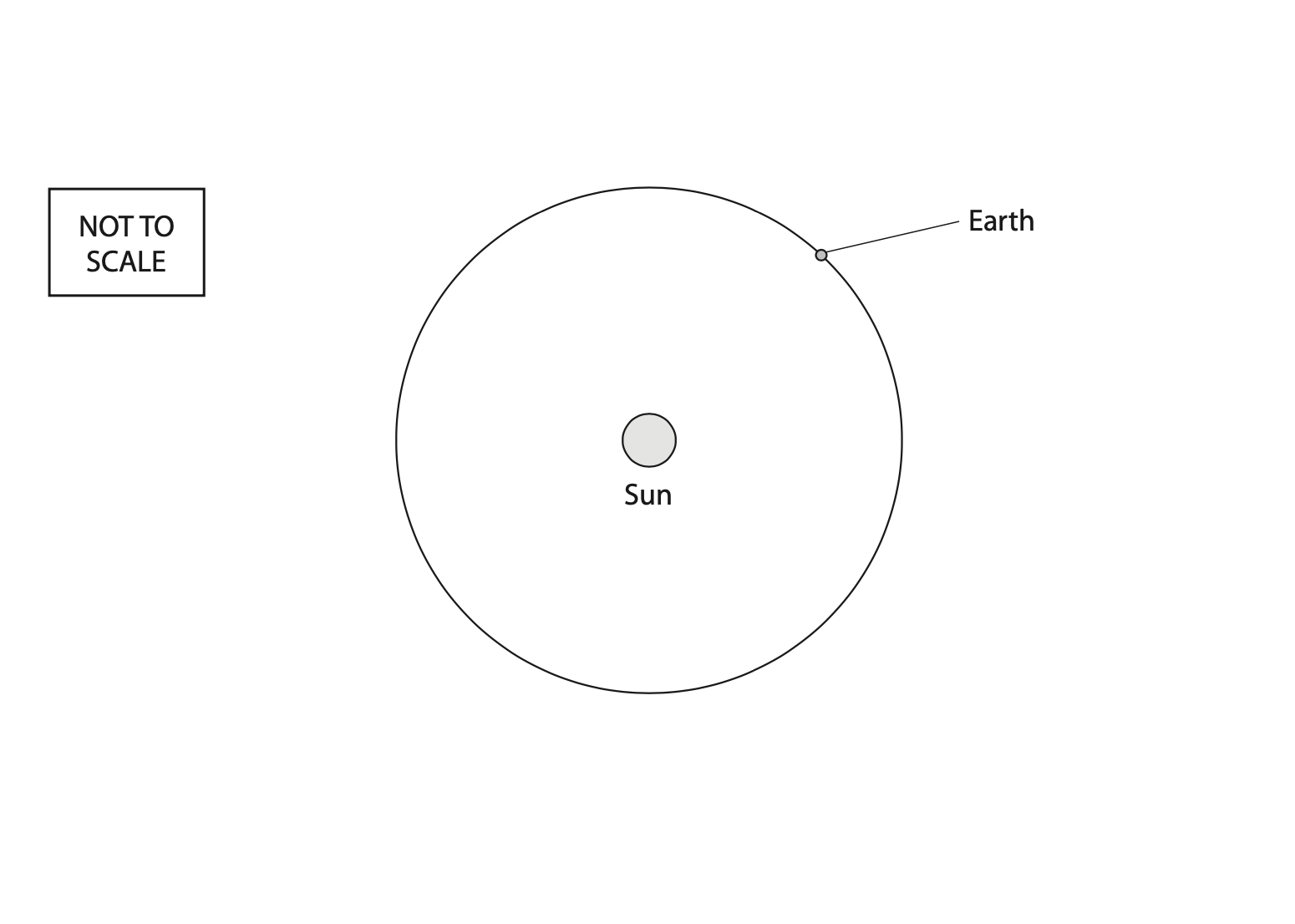
(a) (i) Draw the orbit of the Earth’s Moon on the diagram. (2)
(ii) Draw the orbit of a comet on the diagram. (2)
(b) Earth orbits the Sun in 365 days with an orbital radius of 150 000 000 km.
Calculate the Earth’s orbital speed in km/s. (3)
orbital speed = …………………………………………………….. km/s
(c) Which force keeps the Earth in orbit around the Sun? (1)
A electrostatic
B gravitational
C magnetic
D nuclear
(d) Describe the evolution of the Sun from the first stage of its evolution to the final stage of its evolution. (4)
(Total for Question 2 = 12 marks)
January 2023 Paper 2P Q8
8. A binary star system has two nearby stars, which orbit each other in a circular path around a common centre of gravity.
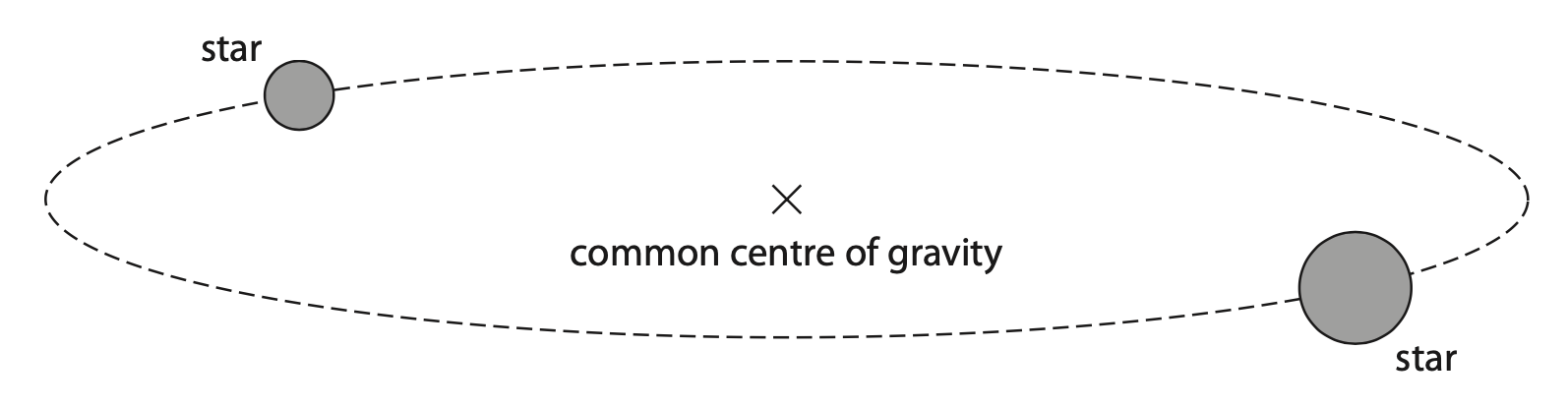
(a) In an eclipsing binary system, one star passes behind the other star in its orbit. This causes a decrease in the light intensity of the binary star system when viewed from Earth.
The graph shows how the light intensity of the binary star system changes with time.
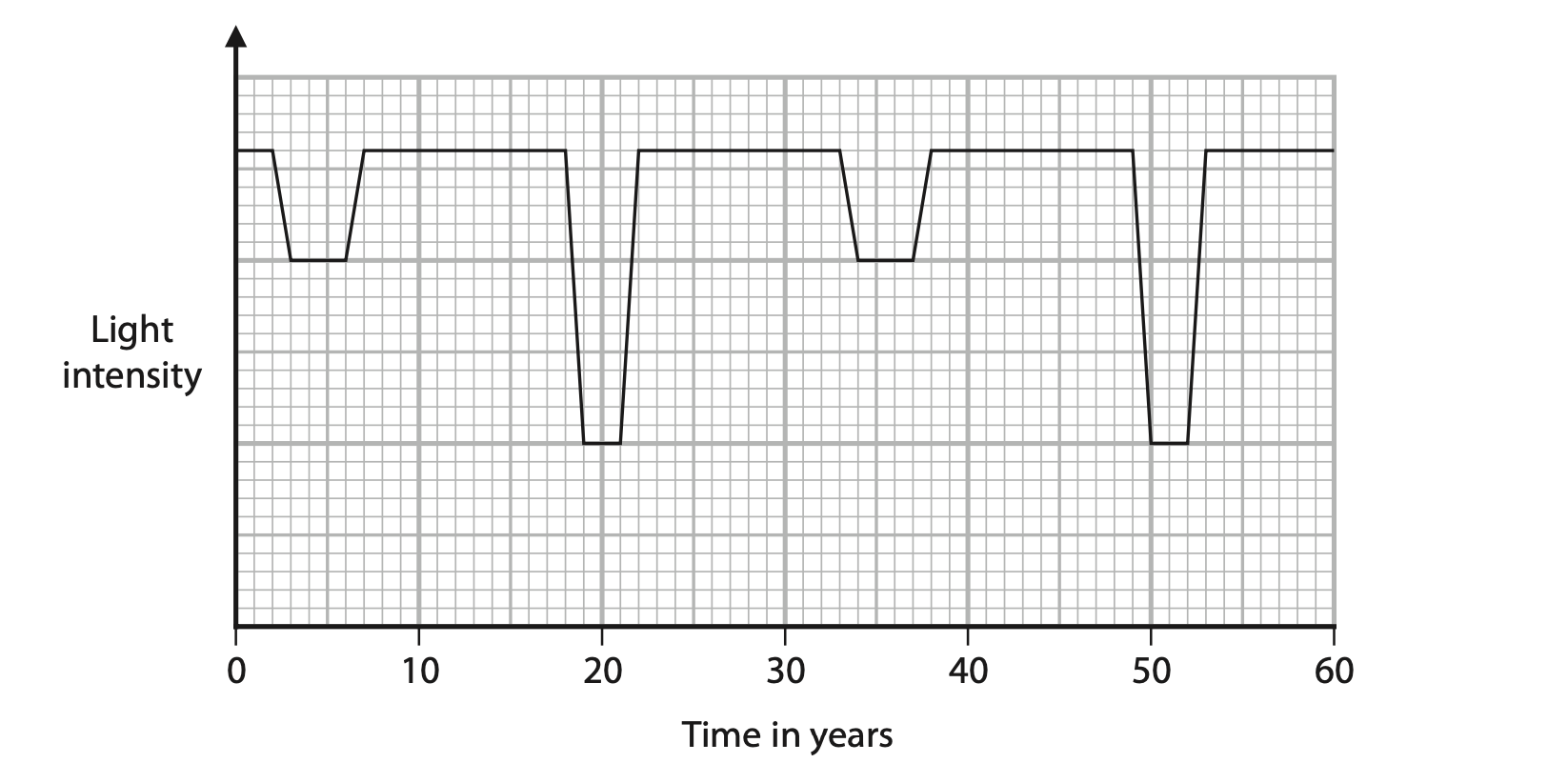
(i) Suggest why the decreases in light intensity are not all the same. (1)
(ii) Use the graph to determine the time period of the binary star system. (1)
time period = …………………………………………………….. years
(iii) One of the stars in this binary system has an orbital speed of 19 km/s. Calculate the orbital radius of this star. (4)
orbital radius = …………………………………………………….. km
(b) A different binary star system is in a distant galaxy.
When observed from the Earth, light from this galaxy has a longer wavelength than the wavelength of the light when it is emitted from the galaxy.
Explain why this gives evidence for the Big Bang theory. (3)
(Total for Question 8 = 9 marks)
January 2023 Paper 2PR Q1
1. The diagram is an incomplete Hertzsprung‐Russell diagram which astronomers use to compare stars.
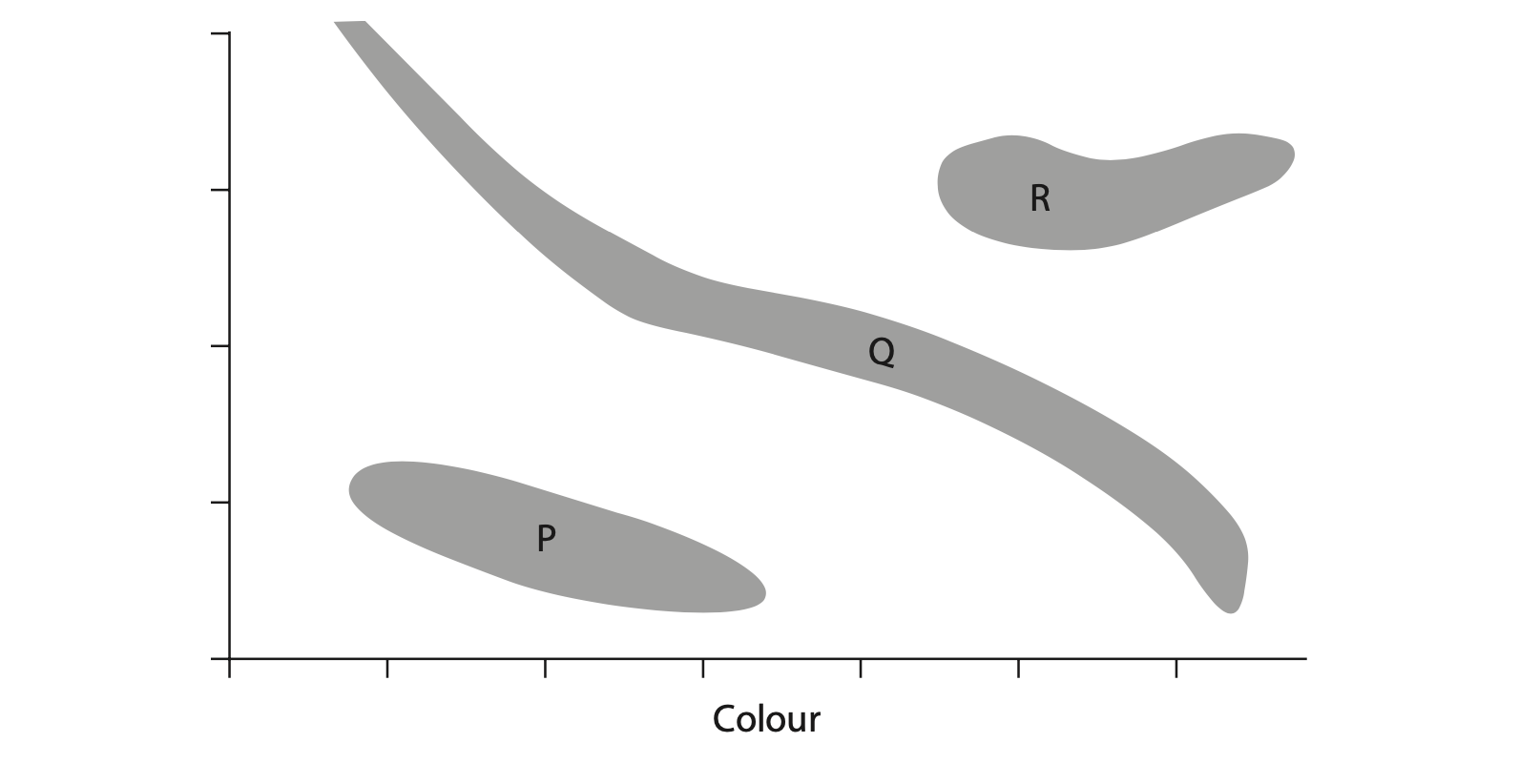
(a) The y‐axis label is missing.
Which of these is the correct label for the y‐axis? (1)
A absolute magnitude
B apparent magnitude
C scalar magnitude
D vector magnitude
(b) The box contains words to identify the shaded areas P, Q and R on the Hertzsprung‐Russell diagram.
| white dwarfs, main sequence, red giants, black holes, supernovae, dwarf planets |
Use words from the box to identify P, Q and R. (3)
P
Q
R
(c) Explain which side of the diagram contains stars with the highest surface temperature. (2)
(Total for Question 1 = 6 marks)
January 2023 Paper 2PR Q8
8. Between 1929 and 1931, physicists Hubble and Humason investigated the red‐shift of light from galaxies at different distances from the Earth.
The distance unit they used is the megaparsec (Mpc). (a) Describe what is meant by the term red‐shift. (2)
(b) The graph shows some of the results of their investigation.
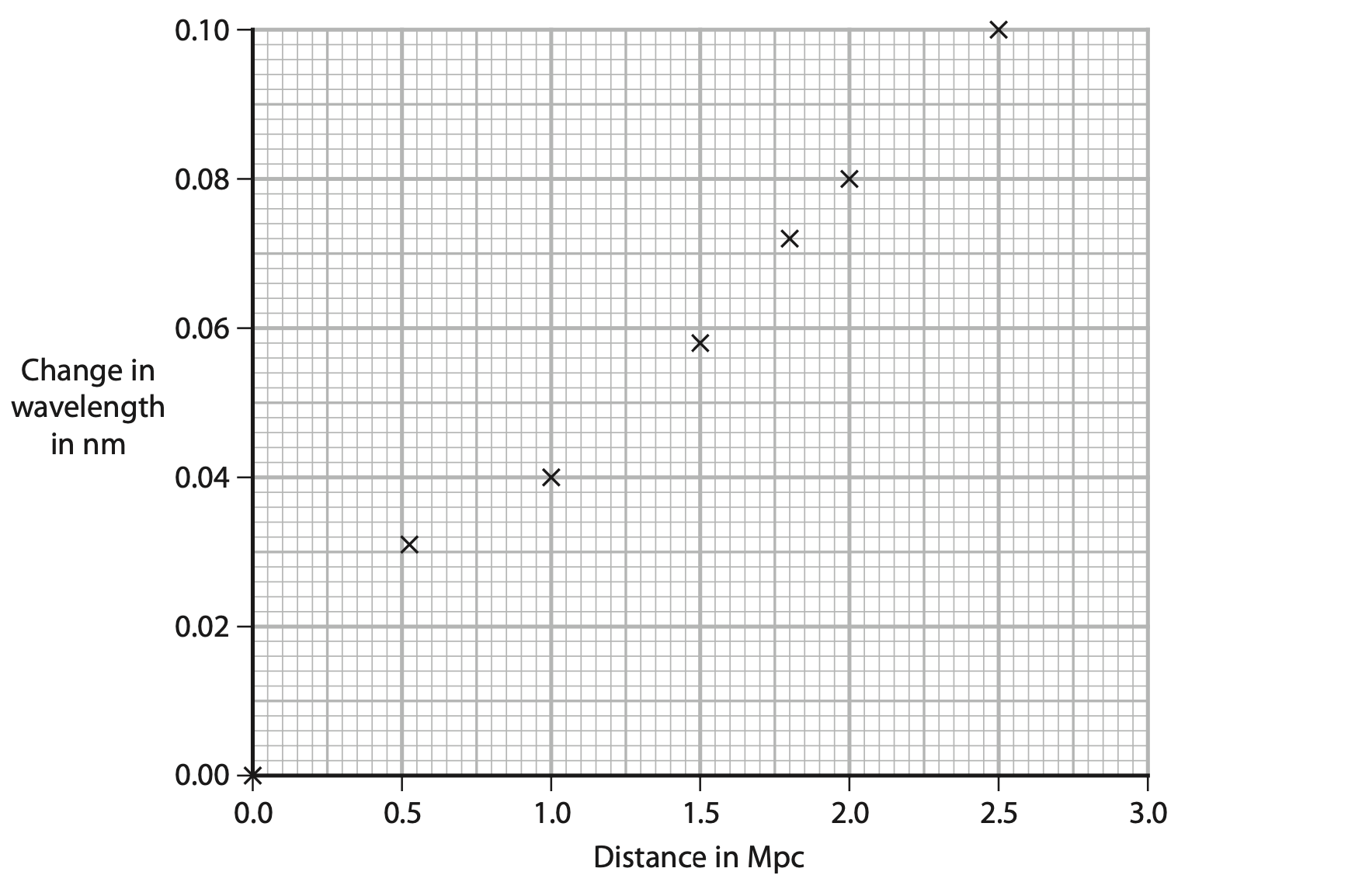
(i) Draw a circle to show the anomalous data point. (1)
(ii) Draw the line of best fit on the graph. (1)
(iii) The reference wavelength of the light used in this investigation is 660 nm.
Use information from the graph to determine the velocity of a galaxy at a distance of 0.75 Mpc.
[speed of light = 300 000 km/s] (3)
velocity = …………………………………………………….. km/s
(iv) Explain why the graph from Hubble’s investigation provides evidence for the expansion of the universe. (2)
(Total for Question 8 = 9 marks)
June 2023 Paper 1PR Q2
2 The photograph shows the International Space Station (ISS) in orbit around the Earth.
(a) The ISS orbits the Earth in a circular orbit. Which of these also orbits the Earth? (1)
A a comet
B Mars
C the Moon
D the Sun
(b) Which of these forces causes the ISS to orbit the Earth? (1)
A air resistance
B electrostatic
C friction
D gravitational
(c) The ISS completes one orbit of the Earth in a time period of 93 minutes.
(i) The orbital radius of the ISS is 6.8 × 10³ km.
Calculate the orbital speed of the ISS in km / s. (3)
orbital speed = …………………………………………………….. km/s
(ii) Show that the ISS completes approximately 15 orbits of the Earth each day. (2)
(Total for Question 2 = 7 marks)
June 23 Paper 2PR Q8
8 This question is about stars.
(a) The table gives some information about four stars.
| Star | Mass in solar masses | Colour | Absolute magnitude |
| A | 0.7 | orange | +7.5 |
| B | 1.0 | yellow | +4.8 |
| C | 2.0 | blue | +1.4 |
| D | 17.1 | blue | –16.8 |
(i) Star C is much more powerful than star A.
Stars A and C appear to have the same brightness when viewed from Earth.
Suggest how this is possible. (1)
(ii) Using information from the table, explain which star is in the supernova stage of its evolution. (3)
(b) Explain how a main sequence star evolves into a supernova. (3)
(c) Astronomers have used supernovas in distant galaxies to investigate the expansion of the universe.
(i) Light emitted from a supernova at a wavelength of 7.774 × 10⁻⁷ m was detected at Earth with a wavelength of 7.780 × 10⁻⁷ m.
Calculate the speed at which the galaxy containing this supernova was moving away from the Earth. (4)
[speed of light = 3.0×10⁸ m/s]
speed = …………………………………………………….. m/s
(ii) The astronomers investigated supernovas that showed a red-shift in the wavelengths detected in different galaxies.
The astronomers discovered that the red-shifted light detected from supernovas in nearby galaxies had shorter wavelengths than the red-shifted light detected from supernovas in galaxies further away.
Explain how this discovery supports the Big Bang theory. (4)
(Total for Question 8 = 15 marks)
November 2023 Paper 1P Q1
1 This question is about astrophysics.
(a) Which of these is a large collection of billions of galaxies? (1)
A Milky Way
B nebula
C solar system
D universe
(b) Which of these is a correct unit for gravitational field strength, g? (1)
A kilogram (kg)
B newton (N)
C newton kilogram (N kg)
D newton per kilogram (N/kg)
(c) Which statement explains why the gravitational field strength on the Moon is less than the gravitational field strength on Earth? (1)
A the Moon is further away from the Sun than the Earth
B the Moon has less atmosphere than the Earth
C the Moon has less mass than the Earth
D the Moon has a greater density than the Earth
(d) Describe the differences between the orbit of the Moon and the orbit of a comet. You may include a diagram to support your answer. (2)
(Total for Question 1 = 5 marks)
November 2023 Paper 1P Q8
8. A star has a circular orbit around the centre of a galaxy.
(a) The diagram shows an outline of the galaxy and the star’s position in the galaxy.
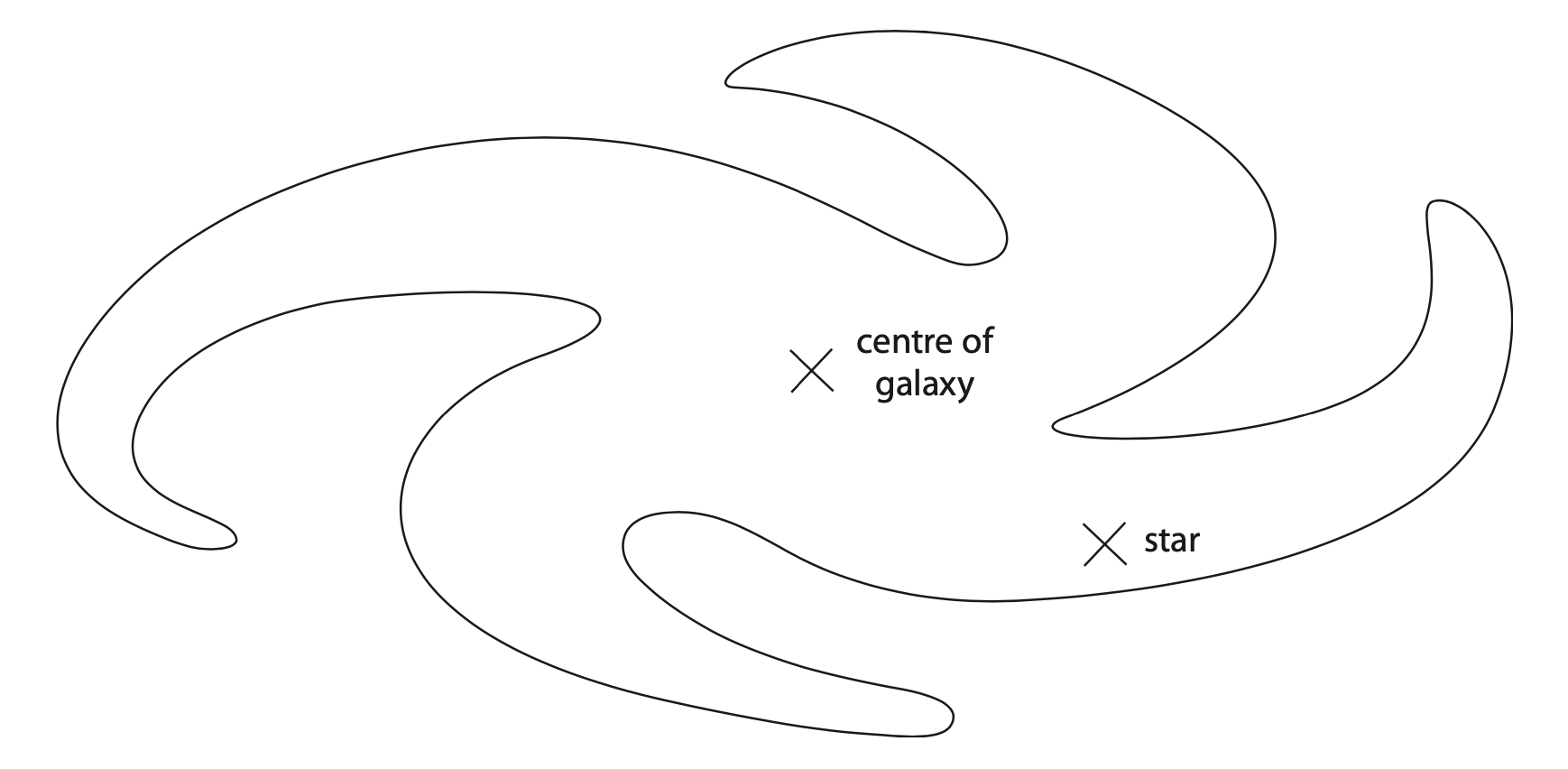
Draw an arrow on the diagram to show the force on the star that keeps the star in a circular orbit. (1)
(b) (i) The speed of light is 3.0 × 10⁸ m/s.
One light year is the distance light travels in one year.
Show that one light year is approximately 1016 m. [one year = 3.2 × 10⁷ s] (2)
(ii) The star is 29 000 light years away from the centre of the galaxy and has an orbital speed of 220 km/s.
Calculate the time period of the star’s orbit around the centre of the galaxy.
Give your answer in standard form. (3)
time period = …………………………………………………….. s
(Total for Question 8 = 6 marks)
November 2023 Paper 2P Q8
8 This question is about red-shift.
(a) The diagram shows two identical stars, A and B, orbiting each other.
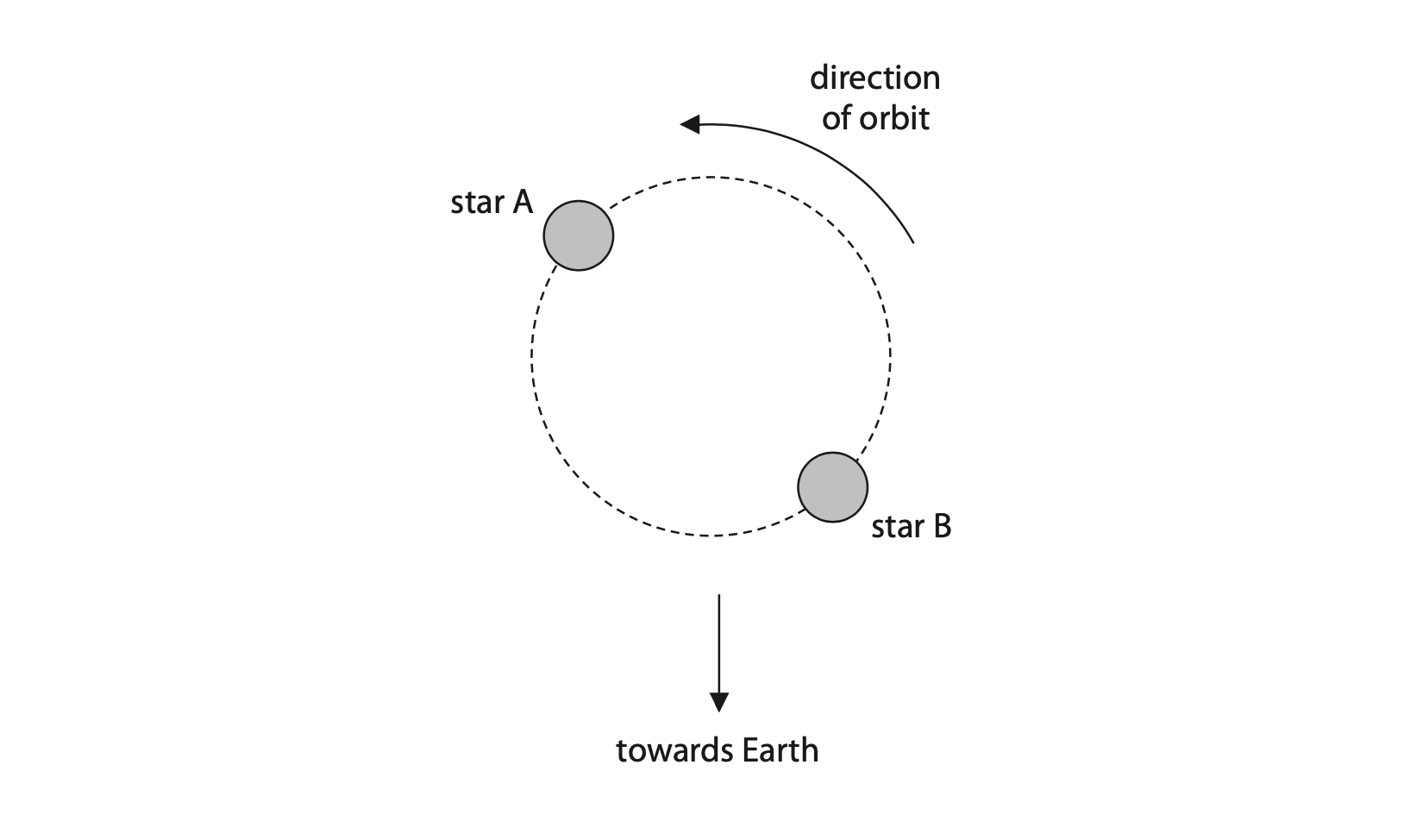
Light from each star arrives at Earth.
As the stars move in their orbit, the wavelength of the light observed at Earth changes due to the Doppler effect.
Add an X to the diagram to show the position of star B when the light emitted from it shows maximum red-shift when detected on Earth. (1)
(b) Light is received on Earth from a distant galaxy.
The longest wavelength of light arriving at Earth from the galaxy is 561 nm.
A lamp on Earth produces the same light with a wavelength of 550 nm.
Calculate the velocity of the galaxy. (4)
[speed of light = 3.0 × 10⁸ m/s]
velocity = …………………………………………………….. m/s
(Total for Question 8 = 5 marks)
June 2024 Paper 1P Q4
This question is about the evolution of a star.
(a) A main sequence star is created in a collapsing region of a nebula.
The table gives different energy stores for the gases in the collapsing nebula, from when the nebula starts to collapse to just before the main sequence star is created.
Complete the table by placing ticks (ü) to show whether each energy store increases, decreases or stays the same. (4)
| Energy Store | Increases | Decreases | Stays the Same |
| Chemical | |||
| Gravitational potential | |||
| Nuclear | |||
| Thermal |
(b) At the end of the main sequence stage of a star’s evolution, the star can become a red giant or a red supergiant.
Give the property of a star that determines whether it becomes a red giant or a red supergiant. (1)
(c) A red giant star eventually becomes a white dwarf star.
Discuss the differences between a red giant star and a white dwarf star. (4)
(Total for Question 4 = 9 marks)
June 2024 Paper 2P Q1
1 The Hertzsprung-Russell (HR) diagram shown can be used to classify stars.
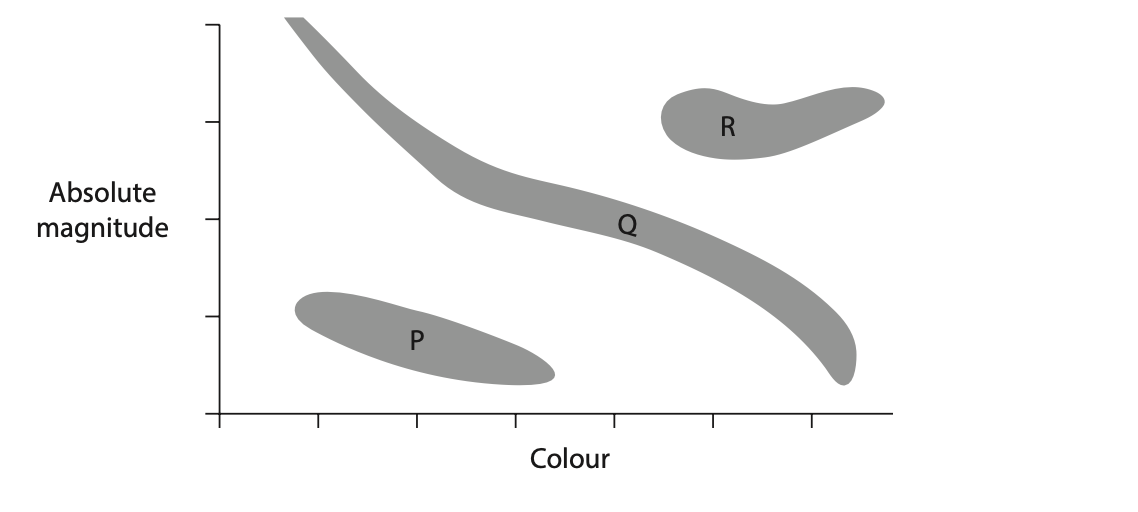
The boxes show the three regions and different astronomical objects.
Draw a straight line from each region to the type of astronomical object contained in that region. (3)
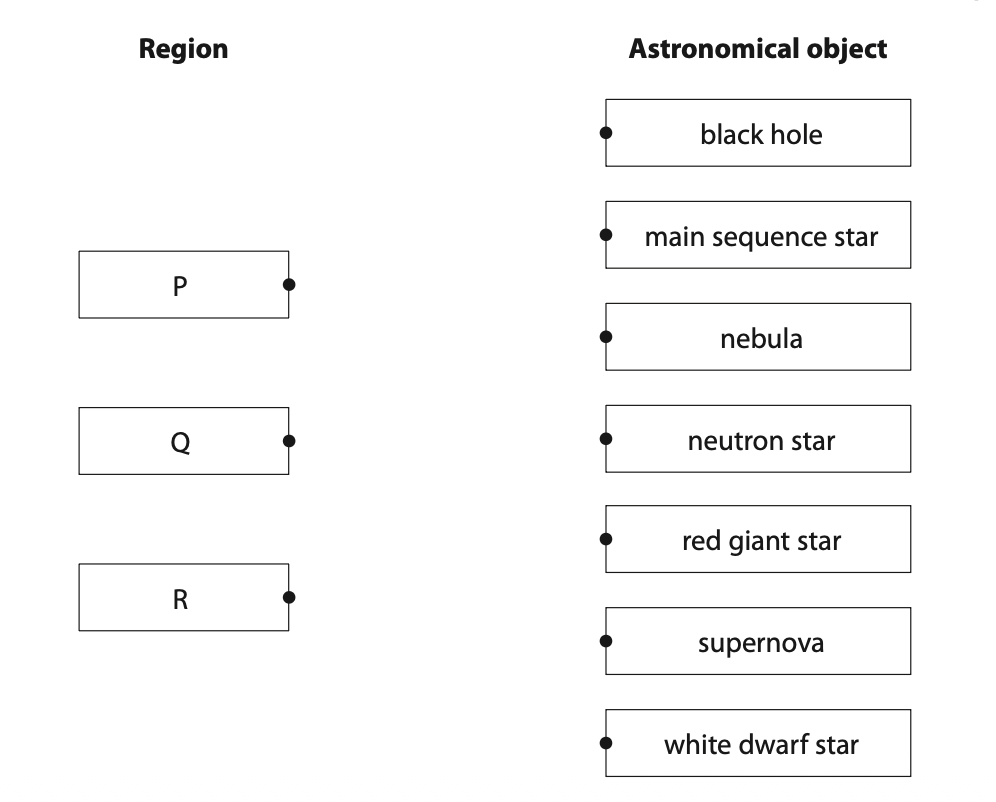
(b) Define the term absolute magnitude. (2)
(Total for Question 1 = 5 marks)
June 2024 Paper 1PR Q4
4 This question is about the Sun.
(a) The table shows the different stages in the evolution of stars of different masses.
Complete the table by adding ticks (ü) to show which stages of evolution occur in the life cycle of the Sun. (4)
| Stage of evolution | Occurs in the life cycle of the Sun |
| black hole | |
| main sequence | |
| nebula | |
| neutron star | |
| red giant | |
| red supergiant | |
| supernova | |
| white dwarf |
(b) When viewed from Earth, the surface of the Sun is yellow in colour.
The surface of another star, Betelgeuse, is red in colour.
Explain the difference between the Sun and Betelgeuse, based on the different colours of their surfaces. (2)
(c) The Sun transfers energy to the Earth by radiation.
(i) Give a reason why energy is not transferred from the Sun to the Earth by conduction or convection. (1)
(ii) A satellite orbiting the Earth contains sensitive equipment that can be damaged if it gets too hot.
Explain which colour would be most appropriate for the outer surface of the satellite to protect the equipment. (2)
(Total for Question 4 = 9 marks)
June 2024 Paper 2PR Q1
1 This question is about stars.
The diagram shows an incomplete Hertzsprung-Russell (H-R) diagram.
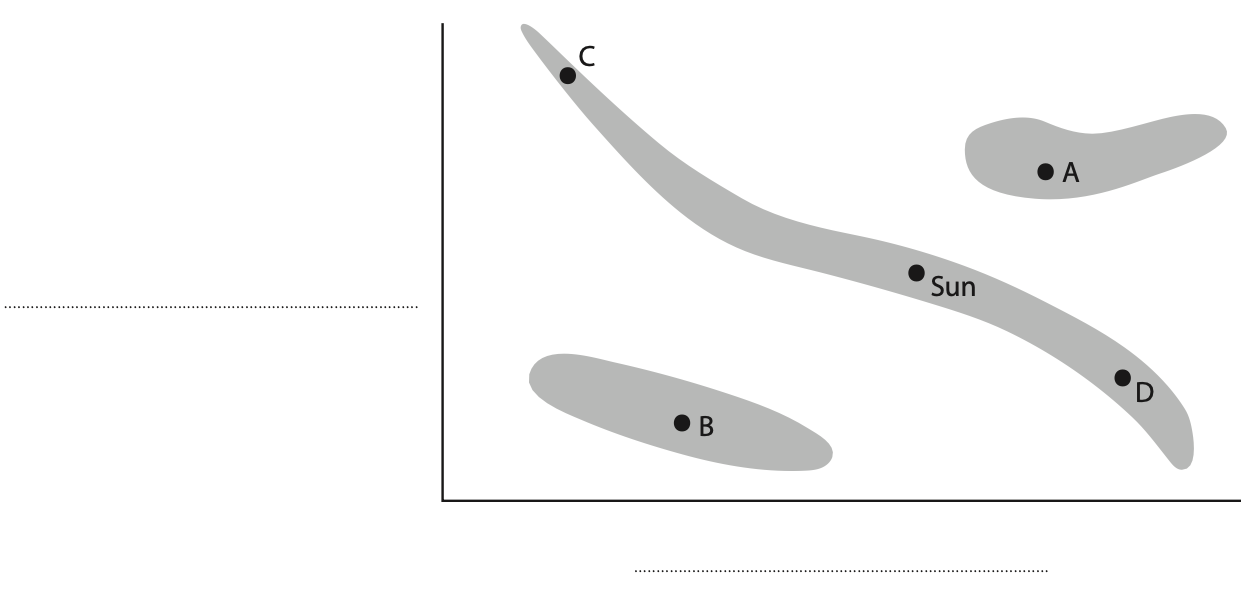
(a) Label the axes on the diagram. (2)
(b) There are three shaded areas on the diagram.
State the name of the shaded area that contains the Sun. (1)
(c) Which star is a white dwarf? (1)
A
B
C
D
(d) At a standard distance from the Earth, which star is brighter than the Sun and has a greater surface temperature than the Sun? (1)
A
B
C
D
(Total for Question 1 = 5 marks)
November 2024 Paper 1P Q10
11 (a) Which of these is the main source of energy in stars? (1)
A alpha decay
B beta decay
C nuclear fission
D nuclear fusion
(b) The table lists the stages of development of a star that has a very much larger mass than the Sun.
Give the stages in the correct order, using numbers 1 to 5. (4)
| Stages of development | Order number |
| a black hole is formed | |
| heavy elements are made in the core of the star | |
| the star becomes a red supergiant | |
| the star explodes in a supernova | |
| the core of the star runs out of hydrogen |
(Total for Question 11 = 5 marks)
November 2024 Paper 2P Q4
4 Diagram 1 shows a Hertzsprung–Russell (HR) diagram.
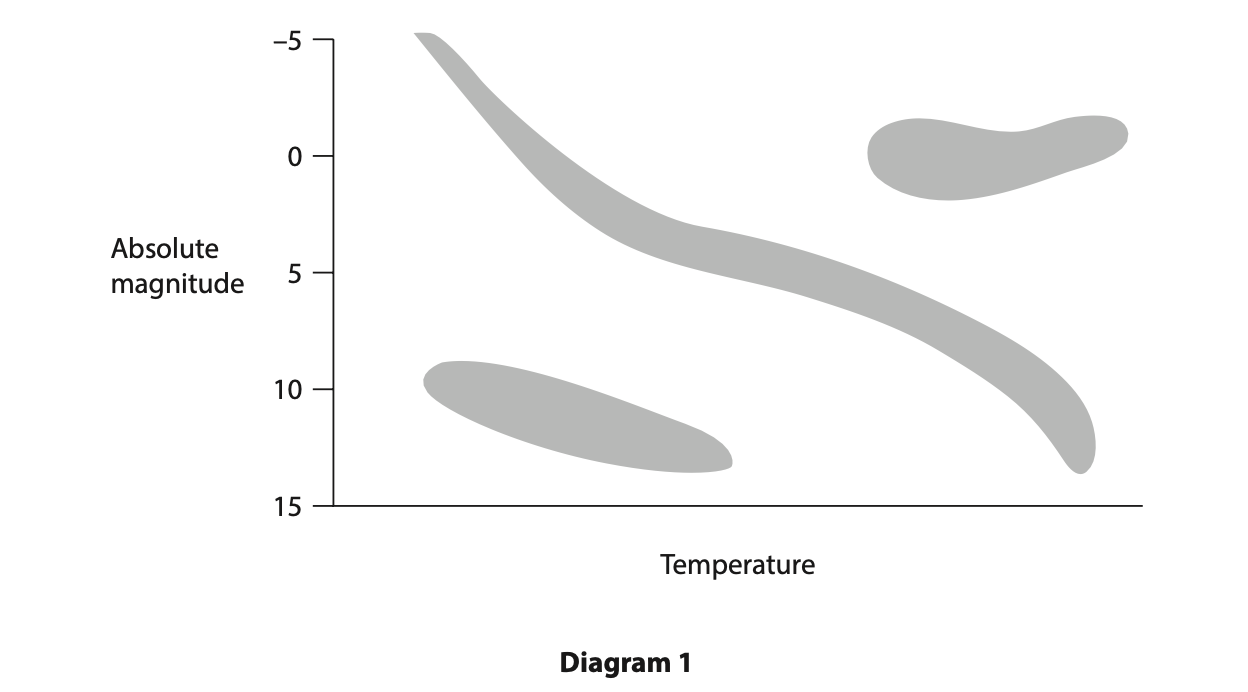
(a) (i) Draw a cross to show the position of the Sun on the HR diagram. (1)
(ii) In approximately 4 billion years, the Sun will enter the next stage of its evolution.
Draw a circle on the HR diagram around the area that will include the Sun in the next stage of its evolution. (1)
(b) Describe the stars that are in the top left corner of the HR diagram. (2)
(c) Diagram 2 shows how the brightness of two stars, star A and star B, changes with time.
These stars are called Cepheid variables.
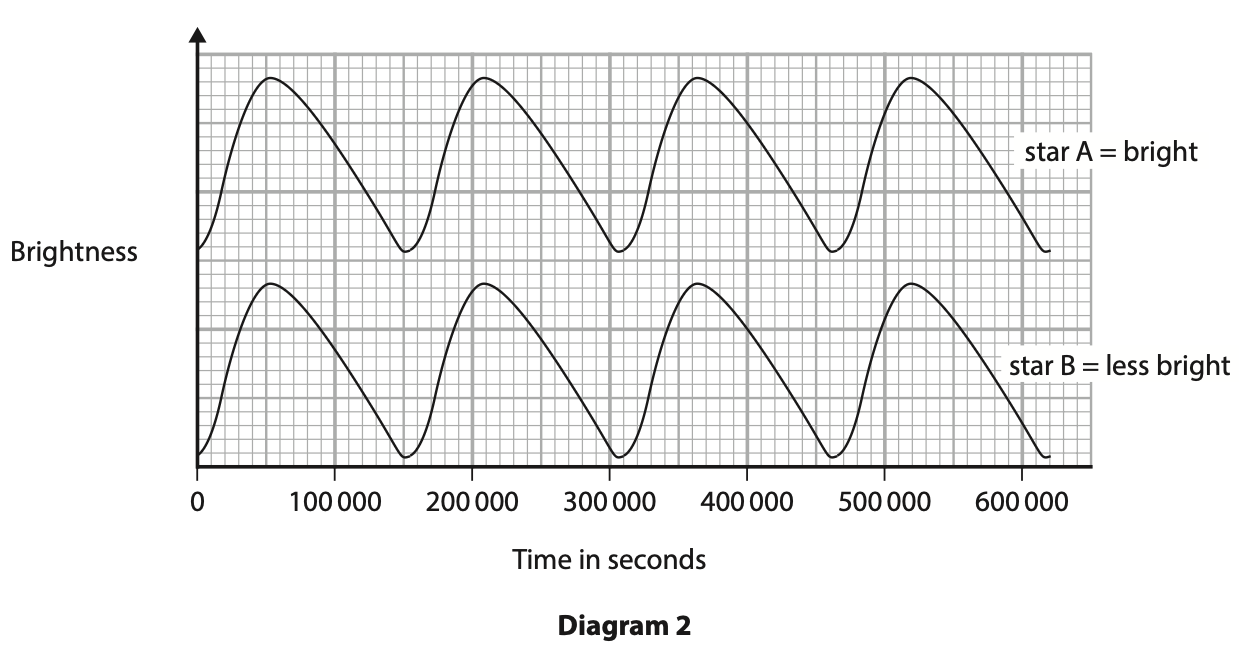
(i) Determine the period of the variation in brightness for these stars. (2)
period = …………………………………………………….. s
(ii) Calculate the frequency of the variation in brightness for these stars. (2)
frequency = …………………………………………………….. Hz
(iii) State what is meant by the term absolute magnitude. (1)
(iv) Star A and star B have the same absolute magnitude but star A is always brighter than star B in the night sky.
Explain how this is possible. (2)
(Total for Question 4 = 11 marks)