Main Themes in A View from the Bridge
A View from the Bridge brings together a number of closely connected ideas about family, loyalty, reputation, masculinity, love and justice. These themes develop through the relationships between the characters and through the values of the Red Hook community in which they live.
The themes in the play often overlap. For example, Eddie’s concern with Catherine involves family, love, masculinity and authority, while, Marco’s response to Eddie’s betrayal involves family loyalty, honour and justice and Alfieri’s role brings questions of law and responsibility into the tragic structure of the play. For the exam, it is often useful to trace a theme across the whole play and consider how Miller develops it through characters, dialogue, stage directions and dramatic structure.
Practise with Past Exam Questions: Theme-based questions appear regularly in the Edexcel IGCSE English Literature exam, sometimes through broad ideas such as loyalty or honour and sometimes through more specific areas such as marriage, violence, truth, expected behaviour or choices. You can use our collection of A View from the Bridge past exam questions for Edexcel IGCSE English Literature to practise writing your essay outlines and full answers alongside this revision series.
Family and Loyalty
Family is central to the play from its opening scenes. Eddie and Beatrice have raised Catherine as part of their household, while Marco travels to America because his wife and children in Italy depend on the money he can earn.
Marco’s responsibilities are obvious when he arrives at the Carbone home. He immediately asks about sending money to his wife: “My wife – I want to send right away maybe twenty dollars –”. His decision to leave Italy is tied to providing a better life for his family.
Eddie also places great importance on family loyalty. Before Marco and Rodolpho arrive, he explains that their presence must remain secret. His story about Vinny Bolzano establishes the consequences of breaking that code. Eddie tells Catherine that “you can quicker get back a million dollars that was stolen than a word that you gave away”.
This warning becomes significant later when Eddie himself contacts the Immigration Bureau. The early conversation gives the audience a clear point of comparison with his later decision.
Loyalty is also clearly presented within the Carbone household. Beatrice remains concerned about Eddie even when she disagrees with him, while Catherine has to decide how far Eddie’s opinions should influence her adult life. Miller therefore presents family loyalty through several relationships and through them offers different perspectives of loyalty depending on circumstance.
Honour and Reputation
Reputation matters throughout the Red Hook community. The characters are aware of how their behaviour will be seen and judged by neighbours, relatives and other members of the community.
Eddie introduces this idea early through Vinny Bolzano. His question, “How’s he gonna show his face?”, shows that public reputation can have serious consequences. Vinny’s punishment does not come through the legal system. It comes from his family and community.
Eddie’s own concern with reputation becomes more explicit in Act Two. After Marco publicly accuses him, Eddie repeatedly demands his “respect” and later insists, “I want my name!”
The word “name” represents more than Eddie’s literal identity. It refers to the reputation he believes he has lost after Marco identifies him as the person responsible for the Immigration raid. By the final scene, restoring that reputation has become Eddie’s immediate concern.
Marco also has a strong idea of honour, although his priorities are to his brother and family. After his arrest, he has difficulty accepting that honour and loyalty have no place within the American justice system. The final conflict therefore brings together different understandings of honour, reputation and public responsibility.
Masculinity and Gender Expectations
Ideas about how men and women are expected to behave are reinforced throughout the play. Eddie has clear expectations about masculinity, and Rodolpho frequently falls outside them.
Eddie repeatedly comments on Rodolpho’s singing, sewing, cooking and appearance. During the boxing scene, he remarks, “He sings, he cooks, he could make dresses . . .” The list brings summarises activities that Eddie associates with femininity and he uses them to question Rodolpho’s masculinity.
However, Rodolpho does not appear troubled by these interests or accusations. He sings openly, cooks well and speaks enthusiastically of his plans. Catherine also sees these qualities positively. This difference in attitude allows Miller to present different expectations of male behaviour.
Marco offers yet another version of masculinity. He is physically strong and works hard on the docks. His chair-lifting action at the end of Act One becomes an important physical moment. Miller describes the chair being raised “like a weapon over Eddie’s head”, enabling the actors’ physical appearance and positions on stage to communicate the tension between them.
Gender expectations also affect Catherine and Beatrice. Catherine’s transition into employment and adult relationships changes her position within the household, while Beatrice speaks openly about her role as Eddie’s wife. These different relationships show how expectations about gender operate both inside the home and within the wider community.
Love, Desire and Relationships
Several forms of love operate within A View from the Bridge: marital love, romantic love, family affection and the bond between brothers.
Catherine and Rodolpho’s relationship develops soon after his arrival. As Eddie questions Rodolpho’s motives, this causes Catherine to doubt herself. She later asks whether Rodolpho would still marry her if they had to live in Italy. Rodolpho acknowledges his desire to remain in America while also reassuring Catherine that he loves her.
Beatrice and Eddie’s marriage presents another intimate form of relationship. Beatrice asks, “When am I gonna be a wife again, Eddie?”, revealing that their relationship has changed over time. Her question brings the private state of their relationship directly into the open.
Eddie’s feelings towards Catherine are more difficult to define. He has helped raise her and initially presents his concerns in terms of protection. However, Alfieri recognises that these protective feelings have become problematic and warns Eddie that there can be “too much love” between a father and daughter or an uncle and niece.
Miller leaves much of this tension to emerge through dialogue, pauses, physical action and the responses of other characters. Beatrice finally tells Eddie, “You want somethin’ else, Eddie, and you can never have her!” Her statement brings into the open an underlying issue that has been present throughout the play.
Law and Justice
The difference between law and personal ideas of justice is one of the play’s central concerns. Alfieri is especially important here because he works as a lawyer while also understanding the Italian-American community’s values in Red Hook.
Eddie first approaches Alfieri because he wants to stop Catherine and Rodolpho’s relationship. Alfieri explains that the law cannot help him. Catherine is free to marry Rodolpho, and Rodolpho has committed no crime by having a relationship with her.
The one legal issue available to Eddie concerns Marco and Rodolpho’s immigration status. Eddie later uses this knowledge when he reports them.
Marco experiences the limits of the law from the opposite position. After Eddie reports him, Marco believes that Eddie deserves punishment. American law offers him no legal action against Eddie. His response, “The law? All the law is not in a book”, expresses his belief that written law does not cover every form of wrongdoing.
Through Eddie and Marco, Miller presents two characters who are dissatisfied with the answers given by the legal system. Alfieri stands between written law and the personal codes of justice followed by the community.
Betrayal and Revenge
Vinny Bolzano’s story establishes how betrayal is dealt with and gives the audience a clear understanding of how seriously the Red Hook community views the act of reporting an illegal immigrant.
Eddie later does exactly the same thing that he has warned Catherine against. His phone call to the Immigration Bureau changes his relationships with Catherine, Beatrice, Marco and the neighbourhood.
Marco’s response is immediate and public. During the arrest he points towards Eddie and declares, “That one! I accuse that one!” His accusation identifies Eddie in front of the community.
After his arrest, Marco desperately wants Eddie to face consequences for what he has done, but Alfieri asks him to respect American law and to promise that he will not harm Eddie. Marco agrees, but the dispute between the two men remains unresolved.
The theme of revenge therefore is closely connected with the theme of justice. Although Marco believes a serious wrong has been committed, Alfieri insists that revenge and retaliation cannot replace the law. Eddie’s and Marco’s disagreement contribute to the events of the final scene.
Tragedy and Fate
Miller wrote A View from the Bridge as a modern tragedy, and Alfieri establishes this form from the very beginning. He tells Eddie’s story retrospectively, forewarning the audience that the events are moving towards a serious, tragic ending.
After Eddie’s first visit to his office, Alfieri says that he could see “every step coming, step after step”. His knowledge creates a sense of forewarning throughout the play.
At the same time, Eddie continues to make choices that lead to his tragic end. He challenges Rodolpho, returns to Alfieri, contacts Immigration and later insists on confronting Marco. The tragic structure therefore develops through the relationship between Alfieri’s sense of what is coming and the decisions Eddie makes as events unfold.
The final confrontation completes the tragic pattern established at the beginning. Eddie continues to demand his “name”, attacks Marco with a knife and is fatally wounded.
Alfieri’s final speech reminds the audience of his reflective narrative at the opening. He acknowledges Eddie’s actions and still says that he mourns him “with a certain… alarm”. The tragedy closes without reducing Eddie to a simple moral lesson. Alfieri continues to question what it is about Eddie that affects him so strongly.
How the Themes Connect
The main themes in A View from the Bridge are closely linked together. Eddie’s relationship with Catherine connects family, love, masculinity and authority. His decision to report Marco and Rodolpho connects loyalty with betrayal, law and reputation. Marco’s response brings family responsibility, honour, justice and revenge together. This overlap is useful to know in the exam. A question about masculinity may lead you to discuss reputation or expected behaviour. A question about family may involve loyalty, love or sacrifice. A question about justice may require you to consider Alfieri, Marco, Eddie and the community’s unwritten rules.
Knowing the play’s themes alongside detailed character profiles will allow you to understand how a character’s actions, decisions and desires inform and contribute to the themes.
Strong responses follow the idea through the play and choose moments that show how it develops. Quotes are important, but stage directions, physical action, character relationships and Alfieri’s narration can provide equally useful evidence.
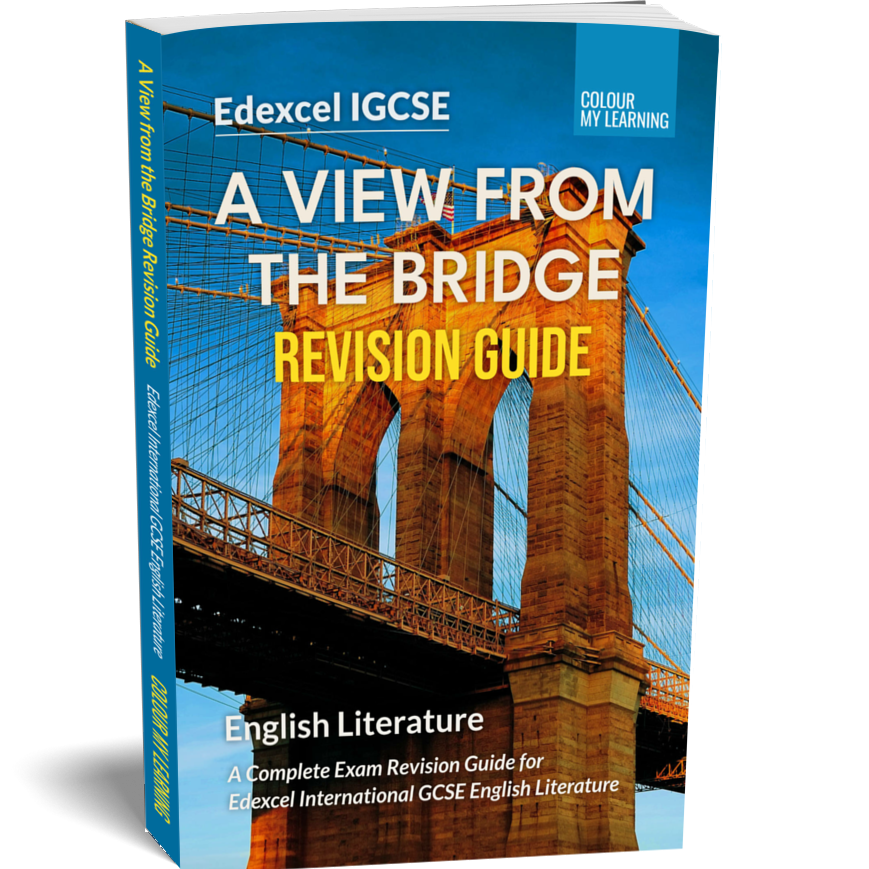
Revise A View from the Bridge with the complete revision guide
Essential Literature: A View from the Bridge brings together everything you need for Edexcel International GCSE English Literature, including characters, relationships, themes, symbolism, dramatic methods, key quotations, essay planning and exam practice.