Essential Quotes from Kindertransport
Diane Samuels’ Kindertransport contains many powerful lines that reveal character, develop relationships and connect to the play’s central themes. Choosing flexible quotations can help you write focused essays on separation, identity, memory, survival, family and responsibility.
This guide brings together a selection of useful quotations from across the play. Each one includes a brief explanation of its meaning, an important word or technique to analyse, and the question areas it may support.
Aim to become familiar with a small group of quotations that you can apply confidently. Knowing who says each line, when it appears and why it matters will help you select evidence quickly and develop your analysis more clearly.
For further exam practice, use these quotations when you practise planning or writing essays from our collection of Kindertransport past exam questions.
“You have to be able to manage on your own.”
Helga to Eva: Helga says this while teaching Eva how to sew on a button before she leaves Germany. On the surface, she is teaching her daughter a practical skill, however, she is also preparing Eva for the much greater challenge of living without her parents.
The phrase “on your own” emphasises Eva’s isolation. It also introduces the contradiction at the centre of Helga’s decision: she protects Eva by forcing her to become independent at a very young age before she is emotionally ready.
Useful for: separation, motherhood, protection, responsibility and Eva’s development.
“There’s no ‘later’ left, Eva.”
Helga to Eva: This quote reveals the urgency of the family’s situation. Eva wants to delay her sewing, but Helga knows that their remaining time together is running out.
The word “later” usually suggests that there will be another opportunity. Helga’s statement removes that possibility and foreshadows the permanent separation that follows.
Useful for: time, separation, loss, danger and dramatic tension.
“Only by sending you away.”
Helga to Eva: Eva asks whether her parents can protect her. Helga’s reply captures the painful contradiction of the Kindertransport: Eva can only be kept safe if she is separated from the people who love her.
The adverb “only” suggests that Helga has no real alternative. Samuels therefore avoids presenting her choice as either simply right or wrong. It is an act of love that also causes lasting emotional damage.
Useful for: parental sacrifice, protection, separation, survival and Helga’s intentions.
“We all die one day, but jewels never fade or perish. Through our children we live.”
Helga to Eva: Helga connects children with jewels, presenting them as precious and as carriers of family identity. The metaphor suggests that parents invest their hopes, memories and future in the next generation.
However, the quote becomes increasingly complicated as the play develops. Eva survives, but much of her connection to her family, language and Jewish identity is lost. Survival continues the family line, but it does not preserve everything unchanged.
Useful for: survival, family, inheritance, identity, motherhood and symbolism.
“I will take the heart of your happiness away.”
The Ratcatcher: The Ratcatcher threatens to take the children of Hamelin. His words also reflect what happens to Eva and her family: their separation removes the centre or “heart” of their happiness.
Samuels uses the Ratcatcher as a symbol of Nazi persecution, separation, fear and the guilt that continues to haunt Evelyn. The future tense “will take” embodies a sense of threat and inevitability.
Useful for: the Ratcatcher, fear, symbolism, separation and stagecraft.
“I don’t want to wear these anymore.”
Eva to Lil: Eva decides that she no longer wants to keep the jewellery and Star of David that Helga placed in her shoes. These objects connect her to her parents, her Jewish identity and the life she had in Germany.
Her rejection of them marks an important turning point. Eva begins to distance herself from the identity she has associated with loss and abandonment. The simple language makes the moment appear calm, but its symbolic meaning is much greater.
Useful for: identity, assimilation, belonging, loss and symbolic objects.
“She just wanted to make a fresh start.”
Lil about Evelyn: Lil tries to explain (to Faith) why Eva changed her name and birthday. The phrase “fresh start” suggests hope and reinvention, but it also hides the emotional cost of Evelyn’s transformation.
Becoming Evelyn allows Eva to build a secure life in England. At the same time, the change involves suppressing her German Jewish past. Samuels shows that starting again can be both necessary and painful.
Useful for: identity, change, adaptation, secrecy and Eva becoming Evelyn.
“You’re a survivor.”
Lil to Evelyn: Lil reassures Evelyn after Faith discovers her hidden papers. It recognises Evelyn’s strength and her determination to continue living despite what she has experienced.
However, the play questions whether survival alone is enough. Evelyn has created a stable life, but she remains affected by fear, memory and unresolved anger. The noun “survivor” therefore carries both admiration and emotional complexity.
Useful for: survival, resilience, trauma, Lil and Evelyn’s relationship.
“Other feelings displace the original ones.”
Evelyn to Faith: Evelyn tries to explain why she can no longer clearly remember loving her parents. The verb “displace” is especially significant. Eva was physically displaced from Germany, but her original emotions of joy, happiness, contentment and security have also been pushed aside by anger, fear and abandonment.
The quote suggests that memory and identity can be altered by later experiences. Evelyn has not simply forgotten her childhood; new feelings have taken the place of earlier ones.
Useful for: memory, trauma, displacement, identity and Evelyn’s relationship with her parents.
“One prick, Faith, and I might bleed forever.”
Evelyn to Faith: Evelyn compares discussing her childhood to breaking the surface of a wound. The metaphor of bleeding suggests that her memories remain painful and dangerous, even though many years have passed.
The word “forever” shows how permanent the emotional effects of separation feel to her. It also helps explain why Evelyn tries to control what Faith knows.
Useful for: memory, secrecy, trauma, emotional repression and the Evelyn–Faith relationship.
“Home is inside you. Inside me and you. It is not a place.”
Helga to Eva/Evelyn: Helga argues that home comes from family and shared identity rather than from a physical location. The repetition of “inside” reinforces home as something carried emotionally between mother and daughter.
For Evelyn, however, England has become home. The disagreement reveals how differently the two women understand belonging after years of separation.
Useful for: home, belonging, identity, displacement and the Helga–Eva relationship.
“I never wanted to live without you and you made me.”
Eva/Evelyn to Helga: This is one of the most poignant lines in the play. Evelyn finally expresses the contradiction at the centre of her feelings towards Helga. She understands that her mother sent her away to save her, but she also feels that Helga forced her to experience life without her parents.
The accusation lies at the heart of Evelyn’s grief is impossible for her to express clearly. It contains anger, grief, frustration and love at the same time. Samuels portrays how Eva’s survival cannot be separated from the pain of what she believes is abandonment.
Useful for: separation, motherhood, survival guilt, love, anger and the relationship between Helga and Eva/Evelyn.
How to use these quotations in an essay
Avoid placing a quotation into a paragraph without expanding on it. After using the evidence, you can focus on one or two important words and connect them to the question.
For example: Helga tries to prepare Eva for independence and separation when she tells her, “You have to be able to manage on your own.” The phrase “on your own” emphasises the need for Eva to be mature and independent in England. Although Helga is trying to protect her daughter, Samuels also presents the heavy emotional cost of parenting and letting go.
This response:
- answers the question
- uses a relevant quotation
- analyses a specific phrase
- explains Samuels’ presentation
- connects the moment to a wider theme
Final revision advice
Choose quotations that are flexible. For example, “Only by sending you away” could support an essay on Helga, motherhood, separation, protection, sacrifice or survival.
Aim to know:
- who says the line
- when it appears
- what it suggests
- one important word or technique to analyse
- two or three questions it could help answer
You do not need to use every quotation in an essay. Just select the evidence that responds most directly to the question.
Also read Key relationships in Kindertransport to better understand the connections and contradictions between the characters.
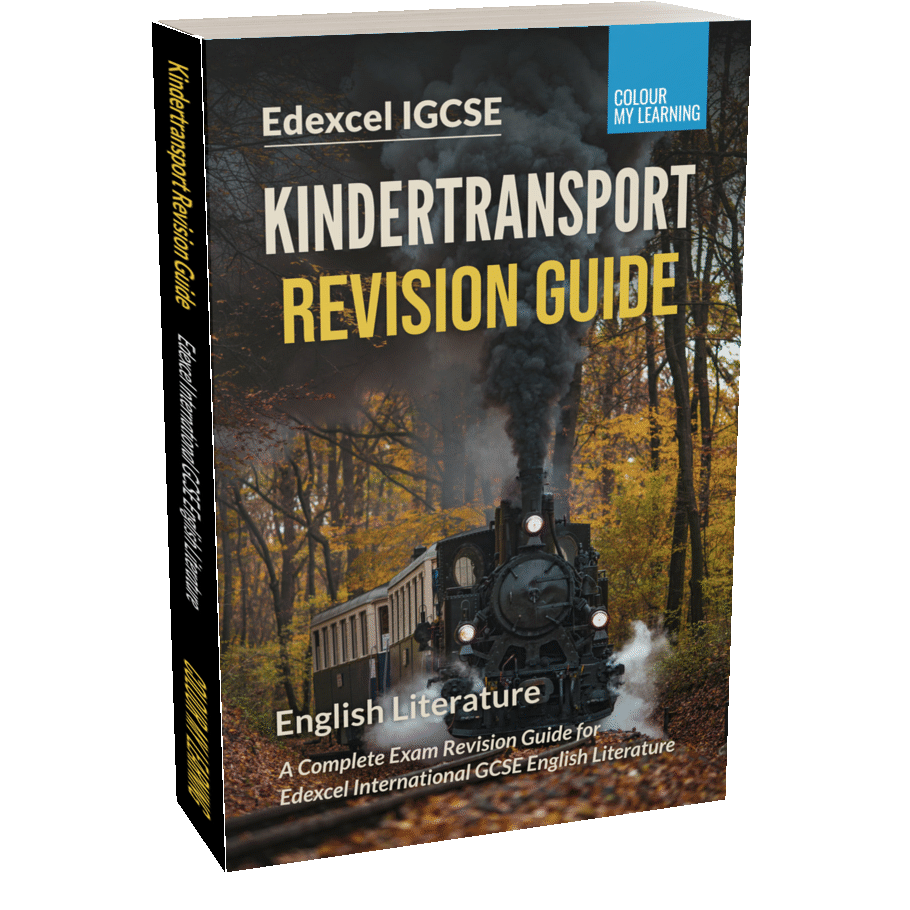
Revise Kindertransport with the complete revision guide
Essential Literature: Kindertransport brings together everything you need for Edexcel International GCSE English Literature, including characters, relationships, themes, symbolism, dramatic methods, key quotations, essay planning and exam practice.