IGCSE Physics Past Papers Exam Questions (Edexcel) 2024 on Waves
Here, you will find questions relating to the topic – Waves. Use these to familiarise, practice and prepare for your IGCSE Physics examination.
You can find earlier below:
- IGCSE Physics Past Year Questions on Waves from 2019 to 2020
- IGCSE Physics Past Year Questions on Waves from 2021 to 2022
- IGCSE Physics Past Year Questions on Waves from 2023 to 2024
What you need to know
Use the list below as a quick recap for what you need to know before attempting the past year exam questions under this topic. This is based on Edexcel International GCSE in Physics (4PH1) specification with first teaching Sept 2017 and first examination June 2019.
Paper 1 and 2: (3) Waves
Paper 1 covers all the topics except where it is marked “paper 2 only” while Paper 2 covers all topics.
A. UNITS
- degree (°), hertz (Hz), metre (m), metre/second (m/s) and second (s)
B. PROPERTIES OF WAVES
- explain differences between longitudinal and transverse waves.
- definitions of amplitude, wavefront, frequency, wavelength and period of a wave.
- waves transfer energy and information without transferring matter.
- the relationship between wave speed, wavelength and frequency. v=f×λ
- the relationship between frequency and time period. f=1/T
- use the relationships above in different contexts
- the Doppler effect: change in observed frequency and wavelength when its source is moving relative to observer
- that all waves are reflected and refracted
C. THE ELECTROMAGNETIC SPECTRUM
- that light is part of a continuous electromagnetic spectrum: radio, microwave, infrared, visible, ultraviolet, x-ray, gamma ray.
- that all these waves travel at the same speeds in free space
- the order of electromagnetic spectrum by wavelength and frequency (decreasing wavelengths, increasing frequency, colours of visible spectrum)
- explain the uses of electromagnetic radiations: radio waves (broadcasting, communications), microwaves (cooking, satellite transmissions), infrared (heaters, night vision), visible light (optical fibres, photography), ultraviolet (fluorescent lamps), x-ray (observe internal structure, medical), gamma rays (sterilising food, medical equipment)
- explain the detrimental effects of the electromagnetic waves: microwave (internal heating of body tissue), infrared (skin burns), ultraviolet (damage to surface cells and blindness), gamma ray (cancer, mutation). Describe protective measures.
D. LIGHT AND SOUND
- that light waves are transverse waves and can be reflected and angle of refracted
- use the law of reflection. (angle of incidence = angle of reflection)
- draw ray diagrams to show reflection and refraction
- investigate the refraction of light
- the relationship between refractive index and the angle of incidence and angle of refraction. n = sin i / sin r
- investigate the refractive index using glass block
- describe the role of total internal reflection in optical fibres and prisms
- explain the meaning of critical angle, c
- relationship between critical angle and refractive index. sin c = 1 / n
- sound waves are longitudinal and can be reflected and refracted
(paper 2 only)
- range of human hearing 20-20000Hz
- investigate the speed of sound in air
- how an oscilloscope and a microphone can display sound waves
- investigate the frequency of sound with an oscilloscope
- that pitch of sound relates to frequency of the source vibration
- that loudness relates to the amplitude of the source vibration
June 2024 Paper 1P Q8
8 The diagram shows two rays of light, A and B, incident on the boundary between air and water.

The refractive index of water is 1.33
Explain the paths of the two rays of light after they strike the boundary between air and water.
Include calculations in your answer and draw on the diagram to support your answer.
(Total for Question 8 = 6 marks)
June 2024 Paper 1PR Q1
1 The table shows an incomplete electromagnetic spectrum.

Two parts of the electromagnetic spectrum are missing.
The missing parts are labelled A and B.
(a) (i) Name the part labelled A. (1)
(ii) Name the part labelled B. (1)
(b) (i) Give a use of microwaves. (1)
(ii) Give a use of gamma rays. (1)
(Total for Question 1 = 4 marks)
June 2024 Paper 2P Q5
5 This question is about sound.
(a) State which wave property determines the pitch of a sound. (1)
(b) The bar chart shows the maximum frequency of sound heard by four animals and a human.
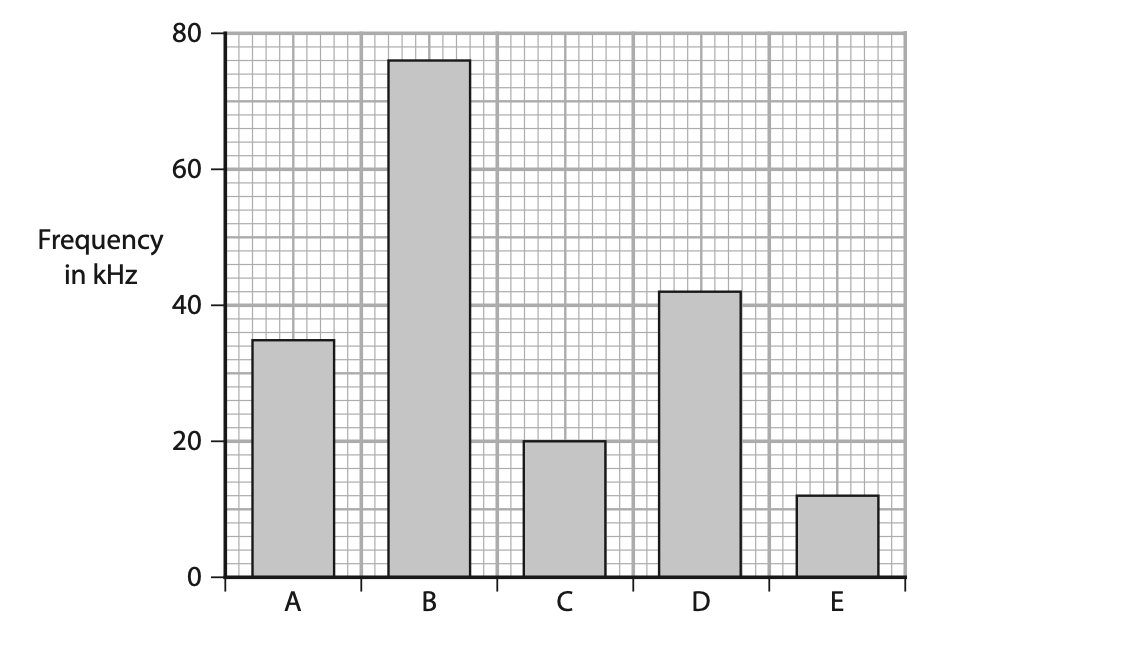
Explain which of the bars is most likely to show the results for a human. (2)
(c) A sound wave has a frequency of 500 Hz.
(i) Show that the time period of the sound wave is 2.0 ms. (3)
(ii) The diagram shows the screen of an oscilloscope.
The timebase of the oscilloscope is 0.50 ms per square.
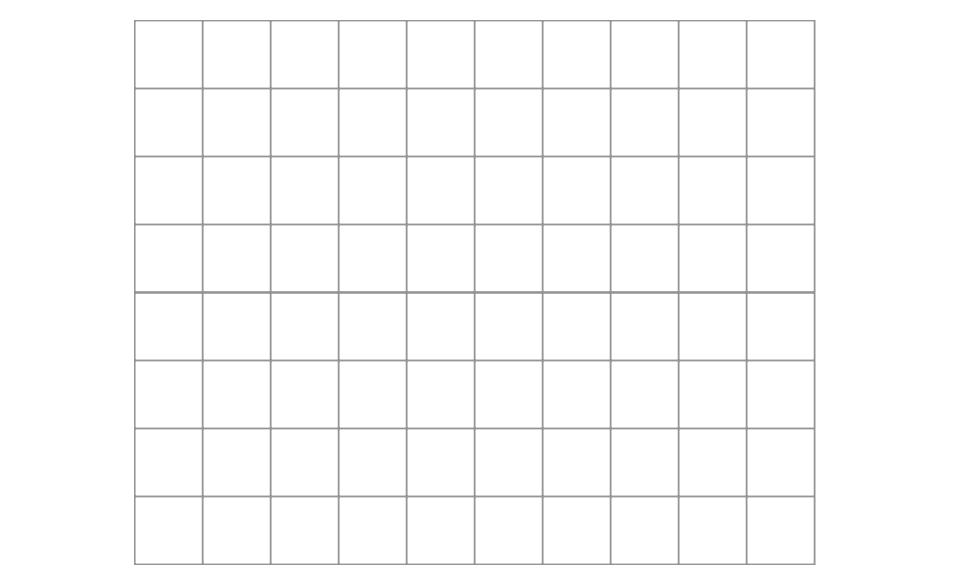
Draw the trace on the oscilloscope screen when the sound wave is detected. (2)
(Total for Question 5 = 8 marks)
June 2024 Paper 1PR Q6
6 The diagram shows two rays of green light entering a semicircular glass block.
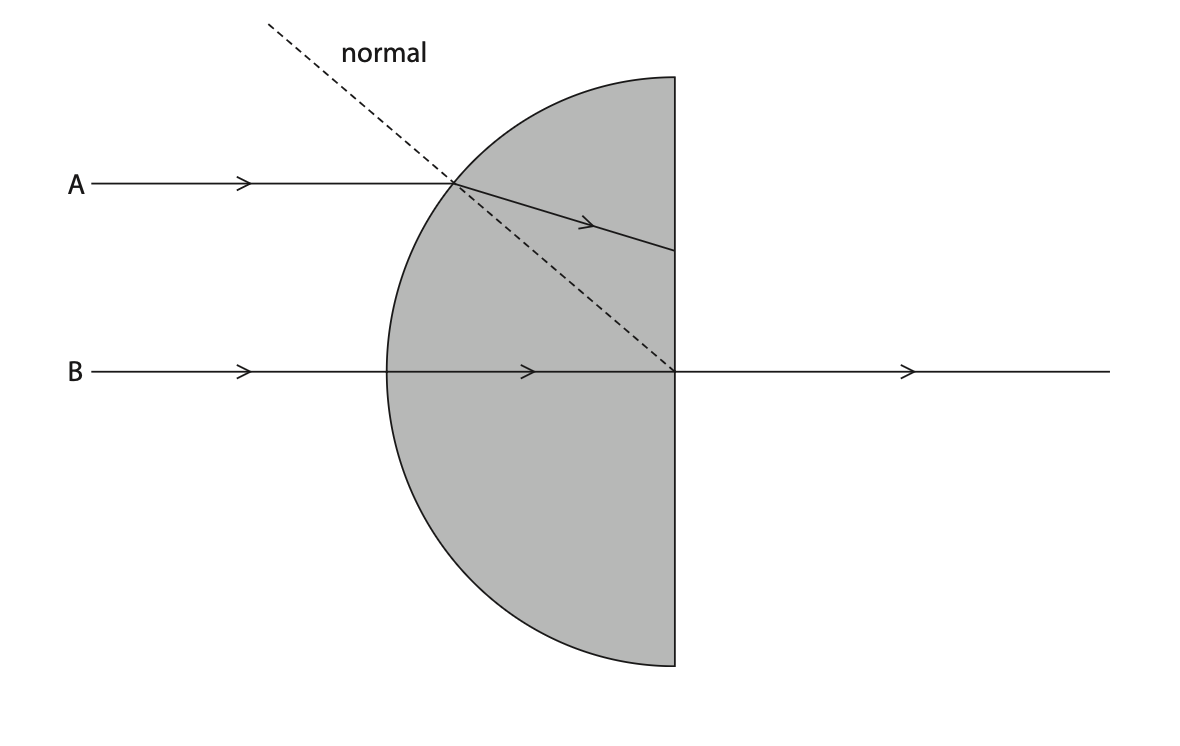
(a) (i) Measure the angle of incidence and the angle of refraction for ray A as it enters the glass block. (2)
angle of incidence = …………………………………………………….. degrees
angle of refraction = …………………………………………………….. degrees
(ii) State the formula linking refractive index, angle of incidence and angle of refraction. (1)
(iii) Calculate the refractive index of the glass. (3)
refractive index = ……………………………………………………..
(b) (i) Complete the path of ray A until it crosses ray B.
Label the point where the rays cross with the letter F. (2)
(ii) The refractive index of glass for red light is lower than for green light.
Explain what would happen to point F if red light were used instead of green light.
You may draw a diagram to help your answer. (3)
(Total for Question 6 = 11 marks)
June 2024 Paper 2PR Q7
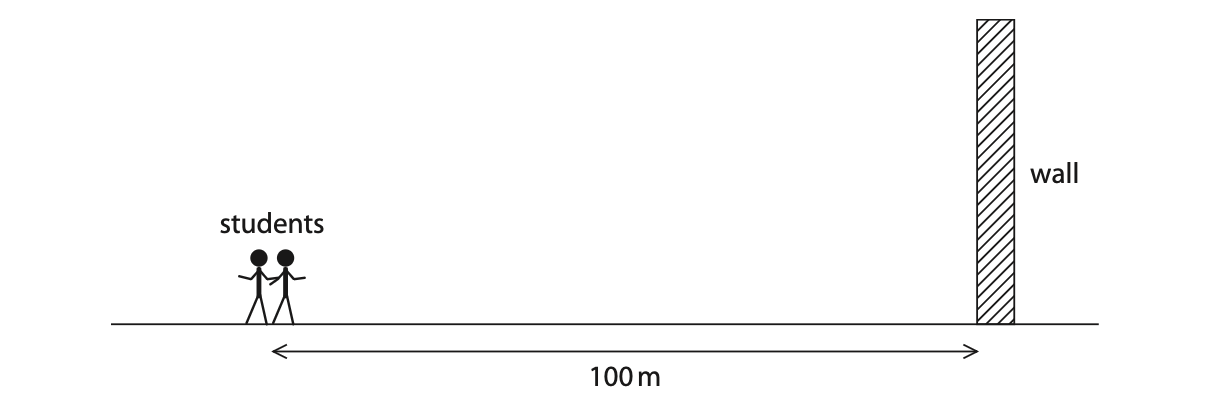
7 The diagram shows two students doing an experiment to measure the speed of sound in air.
This is their method.
- both students stand 100 m away from a large flat wall
- student A makes a sound by hitting two blocks of wood together
- the sound waves travel to the wall and reflect back to the students as an echo
- student A hits the blocks together again when the echo is heard
- student A continues to hit the blocks together every time an echo is heard
- student B starts a timer when the blocks are hit together and stops the timer when the blocks have been hit together 20 more times
(a) Give a reason why the students do not stand nearer to the wall. (1)
(b) The students repeat their method five times.
The table shows the students’ results.
| Time between starting and stopping timer in seconds | |||||
| test 1 | test 2 | test 3 | test 4 | test 5 | mean |
| 11.80 | 11.18 | 11.76 | 11.75 | 11.72 | |
(i) The students decide that one of their tests shows an anomalous result.
Circle the anomalous result in the table. (1)
(ii) Suggest a reason for the anomalous result. (1)
(iii) Calculate the mean time between starting and stopping the timer.
Give your answer to a suitable number of decimal places. (3)
mean time = …………………………………………………….. s
(iv) The speed of sound in air can be calculated using the formula

Use the students’ results to calculate a value for the speed of sound in air. (3)
speed of sound = …………………………………………………….. m / s
(Total for Question 7 = 9 marks)
June 2024 Paper 2PR Q9
9 An oscilloscope can be used to determine the frequency of a sound wave.
(a) Give the name of the piece of apparatus that must be connected to the oscilloscope to detect the sound wave. (1)
(b) The diagram shows the screen of the oscilloscope and the oscilloscope settings.
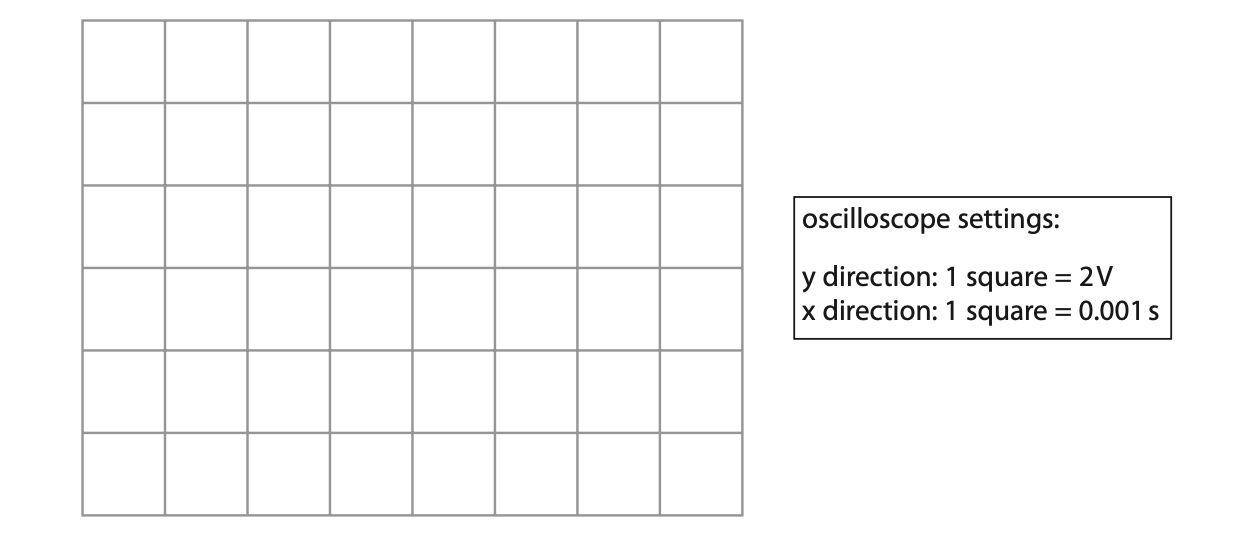
A sound wave of frequency 250 Hz is detected.
The sound wave produces a trace on the oscilloscope of amplitude 4 V.
Complete the diagram by drawing the trace of this sound wave on the oscilloscope screen. (5)
(c) The graph shows how the wavelength of sound waves in air varies with their frequency.
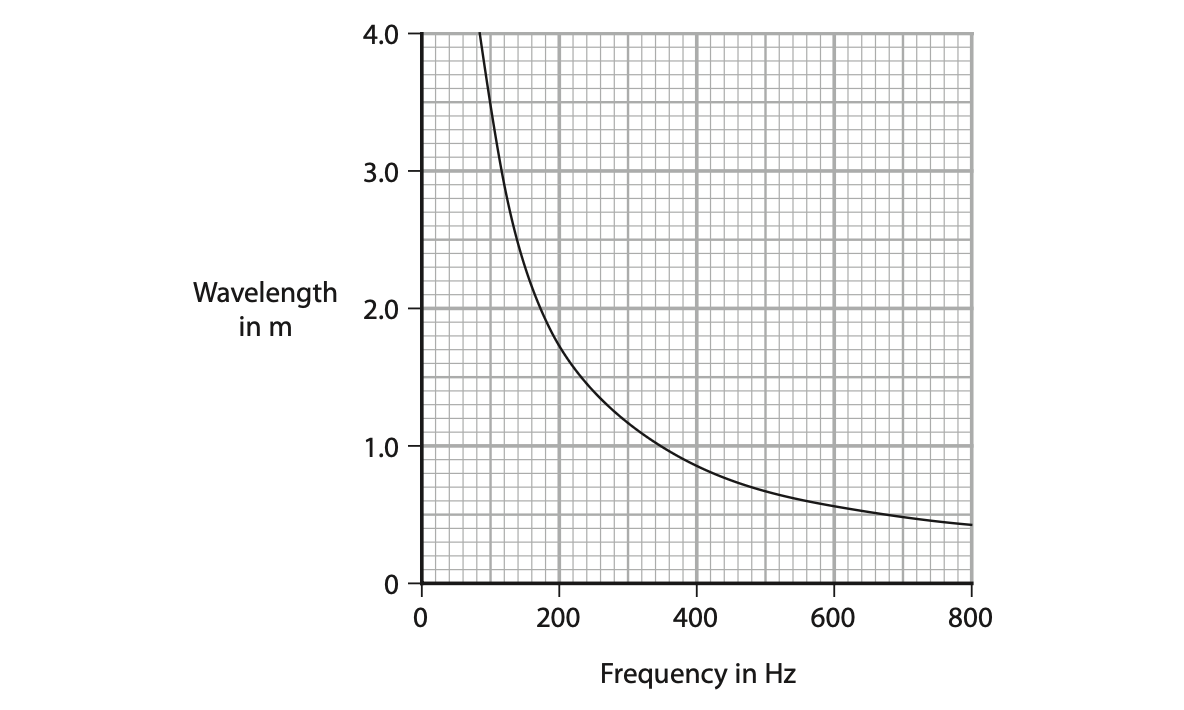
If wavelength and frequency are inversely proportional, then
wavelength × frequency = constant
Using the graph, evaluate whether the wavelength of sound waves in air is inversely proportional to their frequency. (3)
(Total for Question 9 = 9 marks)
November 2024 Paper 1P Q6
6 A student does an investigation to determine the refractive index of a rectangular block of transparent material.
The student uses this equipment in their investigation.
· ray box
· rectangular transparent block
· protractor
· pencil
· paper
· ruler
This is the formula linking refractive index, angle of incidence and angle of refraction.

(a) Describe a method to determine the refractive index of the material.
You may draw a diagram to help your answer. (5)
(b) The refractive index of the material is 1.2
(i) State the formula linking the refractive index and the critical angle of a material. (1)
(ii) Calculate the critical angle of this material. (2)
critical angle = …………………………………………………….. degrees
(iii) Describe what is meant by the term total internal reflection. (2)
(c) The diagram shows a ray of light entering a prism made of the same material as the rectangular block used in the student’s investigation.
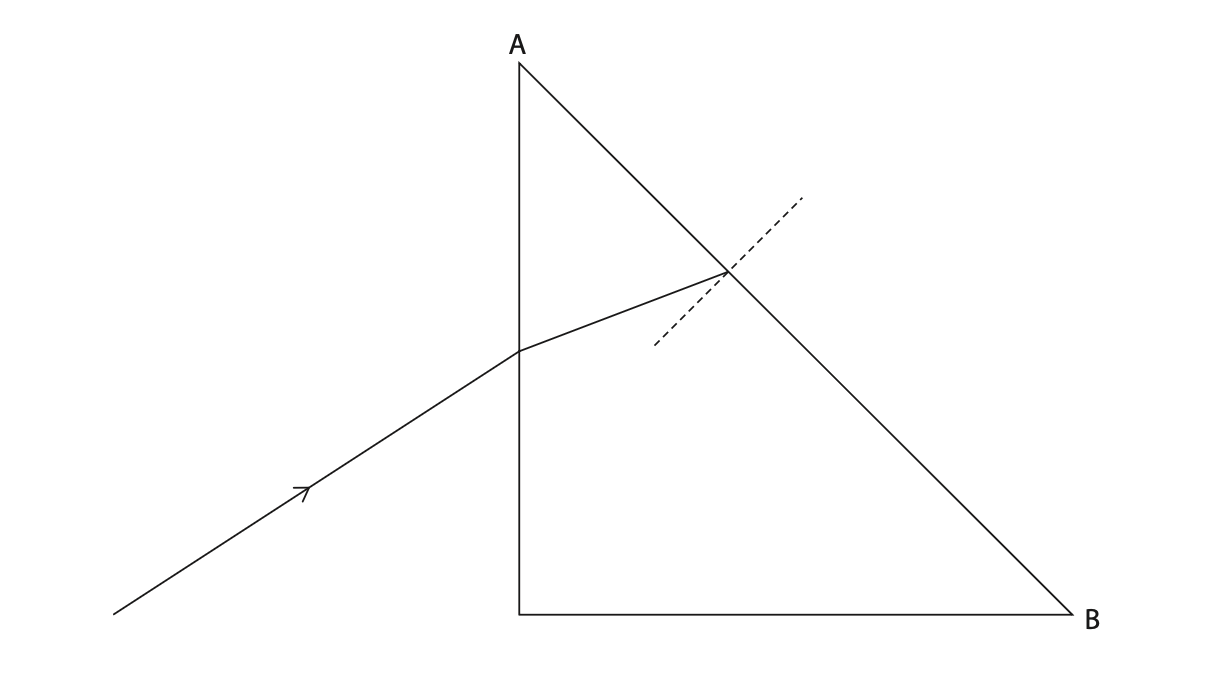
(i) Use a protractor to determine the angle of incidence at the point where the ray of light is incident on side AB of the prism. (1)
angle of incidence = …………………………………………………….. degrees
(ii) Complete the path of the ray of light. (2)
(Total for Question 6 = 13 marks)
November 2024 Paper 1P Q8
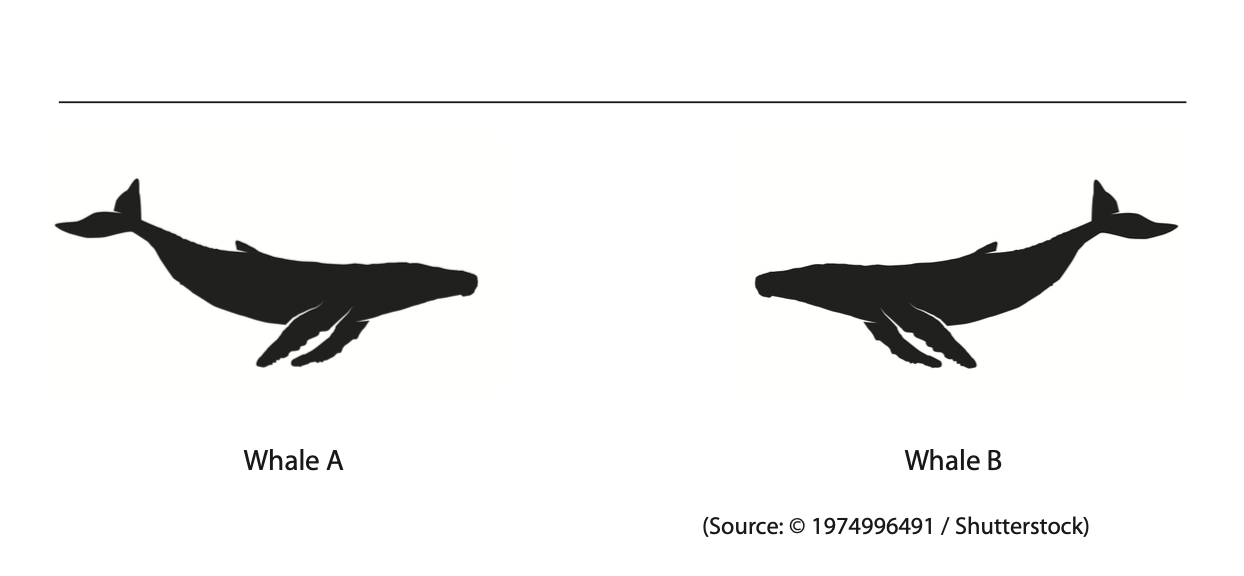
8 The diagram shows two whales in the sea.
Some species of whale communicate with sound signals and visual signals.
(a) Describe the difference between the motion of particles in a transverse wave and the motion of particles in a longitudinal wave.
You may use a diagram to help your answer. (2)
(b) Whale A makes a sound with a constant frequency. This sound is detected by whale B.
When whale A swims towards whale B, the frequency of the sound detected by whale B increases.
This is known as the Doppler effect.
Explain how the Doppler effect causes the frequency of sound detected by whale B to increase. (3)
(c) Visible light from the Sun reaches whale B.
The wavelength of this light is 5.4 × 10⁻⁷m.
Calculate the frequency of this light.
[speed of light = 3.0 × 10⁸m/s] (3)
frequency = …………………………………………………….. Hz
(Total for Question 8 = 8 marks)
November 2024 Paper 2P Q8
8 A student investigates the speed of sound by making a loud sound in front of a large wall a long distance away.
The diagram shows the positions of the student and the wall.
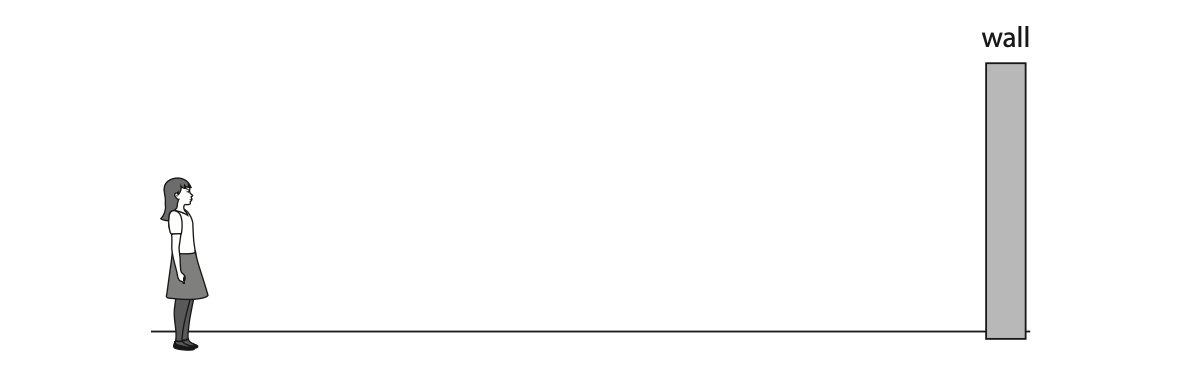
The sound reflects off the wall and back to the student.
(a) Give an appropriate method for measuring the distance between the student and the wall. (2)
(b) The student uses a stopwatch to determine the time taken for the sound to travel from them to the wall and back again.
The distance from the student to the wall is 65 m.
The student measures a time of 0.35 seconds when the sound has travelled to the wall and back again.
Calculate the speed of sound from the student’s data. (3)
speed of sound = …………………………………………………….. m/s
(c) Evaluate this method for determining an accurate value for the speed of sound. (4)
(d) Explain an improvement to the student’s method. (2)
(Total for Question 8 = 11 marks)