IGCSE Physics Past Papers Exam Questions (Edexcel) 2024 on Forces and Motion
We collated all the past papers exam questions on the topic of Forces and Motion.
For more past years exam questions on Forces and Motion see below:
- IGCSE Physics Past Years Exam Questions: Forces and motion 2019-22
- IGCSE Physics Past Years Exam Questions: Forces and motion 2023-24
What you need to know
Use the list below as a quick recap for what you need to know before attempting the past year exam questions under this topic. This is based on Edexcel International GCSE in Physics (4PH1) specification with first teaching Sept 2017 and first examination June 2019.
Paper 1 and 2: (1) Forces and motion
Paper 1 covers the all the topics below except where marked “Paper 2 only”. Paper 2 covers all topics.
A. Units
- kilogram (kg), metre (m), metre/second (m/s), metre/second2 (m/s2), newton (N), second (s) and newton/kilogram (N/kg)
- newton metre (Nm), kilogram metre/second (kg m/s)
B. Movement and position
- be able to plot and explain distance-time graphs
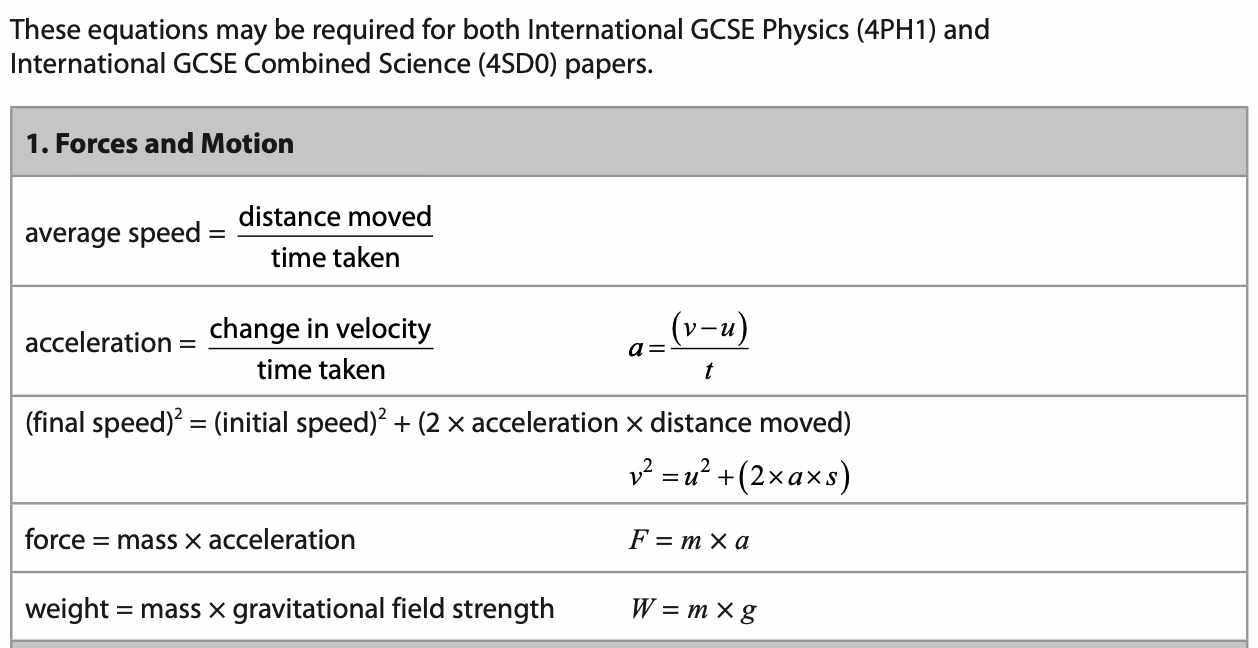
- the relationship between average speed, distance and time. average speed = distance moved / time taken
- practical: investigate motion of everyday objects such as toy cars or tennis balls
- the relationship between acceleration, change in velocity over time taken. a = (v − u)/ t
- plot and explain velocity-time graphs, use them to calculate acceleration (gradient) and distance travelled (area under line)
- the relationship between final speed, initial speed, acceleration and distance moved. v2 =u2 +(2×a×s)
C. Forces, movement, shape and momentum
- describe the effects of forces that act on bodies.
- identify different types of forces. (gravitational or electrostatic)
- difference between vector quantities and scalar quantities.
- force is a vector quantity.
- be able to calculate resultant force that act along a line.
- know that friction is a force that opposes motion.
- relationship between unbalanced force, mass and acceleration. F=m×a
- relationship between weight, mass and gravitational field strength. W=m×g
- stopping distance of a car is the sum of thinking and braking distances
- describe the factors that affect stopping distance (speed, mass, road condition, reaction time)
- describe the forces that act on falling objects
- explain why a falling object reaches terminal velocity
- practical: investing how extension varies with applied force for helical springs, metal wires and rubber bands
- Hooke’s Law and elastic behaviour. (ability to recover its original shape)
(Paper 2 Only)
- the relationship between momentum, mass and velocity. p=m×v
- use the idea of momentum to explain safety features
- use the conservation of momentum to calculate mass, velocity and momentum
- the relationship between force, change in momentum and time taken. F = (mv − mu)/ t
- Newton’s Third Law
- Moment = force x perpendicular distance from the pivot
- weight of an object acts through its centre of gravity
- use principle of moments to analyse the parallel forces acting in one plane
- how upward forces on a light beam, supported at its ends, vary with the position of a heavy object placed on the beam.
June 2024 Paper 1P Q1
1 This question is about the motion of objects in the solar system.
(a) (i) Draw a labelled diagram showing the Moon orbiting the Earth.(2)
(ii) Give the name of the force that causes the Moon to orbit the Earth.(1)
(iii) Give the name of another object that orbits the Earth.(1)
(b) A planet and a comet both orbit a star.
Give a difference between the orbit of a planet and the orbit of a comet.(1)
(Total for Question 1 = 5 marks)
June 2024 Paper 1P Q5
5 (a) A metal spring obeys Hooke’s law.
Sketch a graph to show that the spring obeys Hooke’s law as it is stretched.
You should label both axes with appropriate physical quantities.(3)
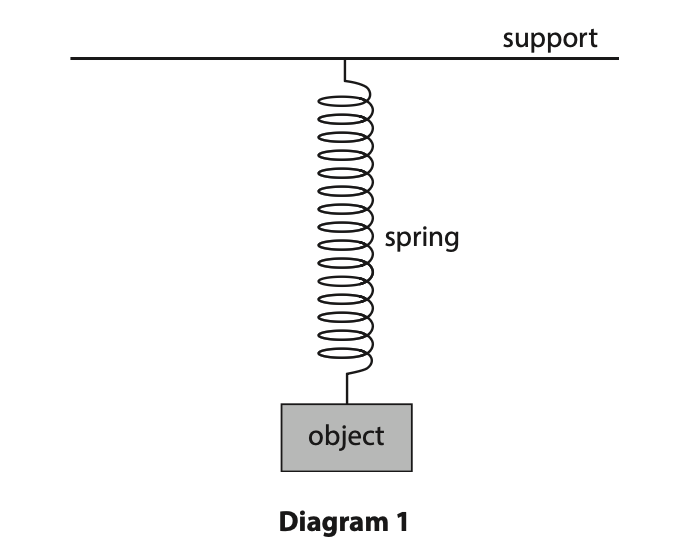
(b) Diagram 1 shows an object suspended from a support using a metal spring.
The object is initially at rest.
(i) The object is pulled down and then released.
Diagram 2 shows the forces acting on the object at the instant it is released.
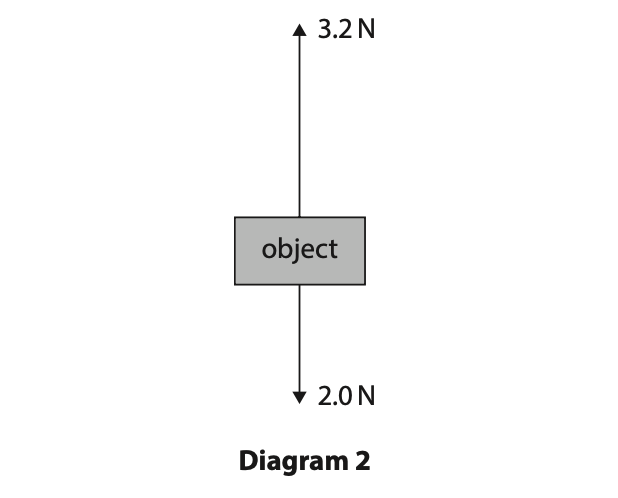
Determine the magnitude and direction of the resultant force acting on the object.(2)
magnitude of resultant force = …………………………………………………….. N
direction of resultant force = ……………………………………………………..
(ii) The object has a mass of 0.20 kg.
Calculate the acceleration of the object at the instant it is released.(3)
acceleration = …………………………………………………….. m/s2
(iii) Explain how the magnitude of the acceleration of the object changes, from the instant the object is released until the first time the object returns to its initial resting position.
You should refer to the forces acting on the object in your answer.(3)
(Total for Question 5 = 11 marks)
June 2024 Paper 1P Q10
10 Diagram 1 shows the apparatus a student uses to investigate the bending of a wooden strip.
Part of the wooden strip is clamped to a table.
A load is fixed to the free end of the wooden strip, causing it to bend.
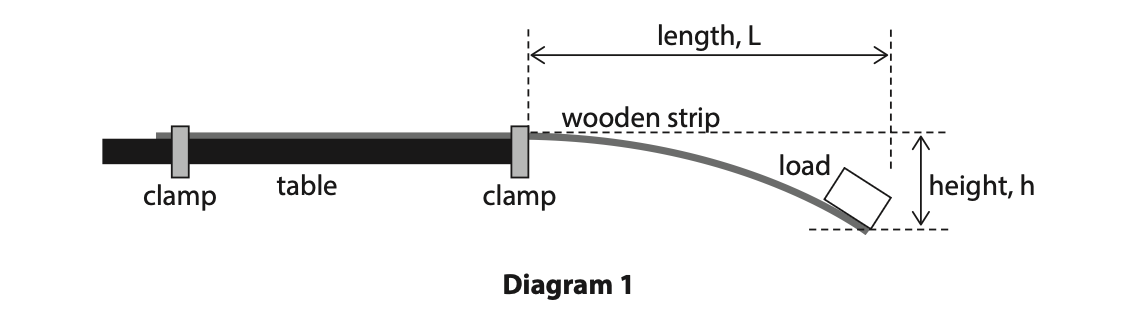
The weight of the load causes the end of the wooden strip to move down through a height, h.
A student investigates how the length, L, affects the height, h.
(a) The load has a mass of 250 g.
Calculate the weight of the load.(2)
Use the formula
weight = mass × gravitational field strength, g
weight = …………………………………………………….. N
(b) This is the student’s method for the investigation.
- clamp the wooden strip so that L = 20 cm
- fix the load to the end of the wooden strip, as shown in diagram 1
- measure the height, h
The student repeats this method for different values of L.
(i) Give the independent and dependent variables in the investigation.(2)
independent variable
dependent variable
(ii) Give two control variables in the investigation.(2)
1
2
(iii) Suggest how the student could accurately measure the height, h.(2)
(c) The table shows the results of the investigation.
| Length (L) in cm | Height (h) in cm |
| 20 | 2 |
| 40 | 8 |
| 60 | 18 |
| 80 | |
| 100 | 53 |
| 120 | 71 |
(i) Diagram 2 shows the wooden strip when L = 80 cm.
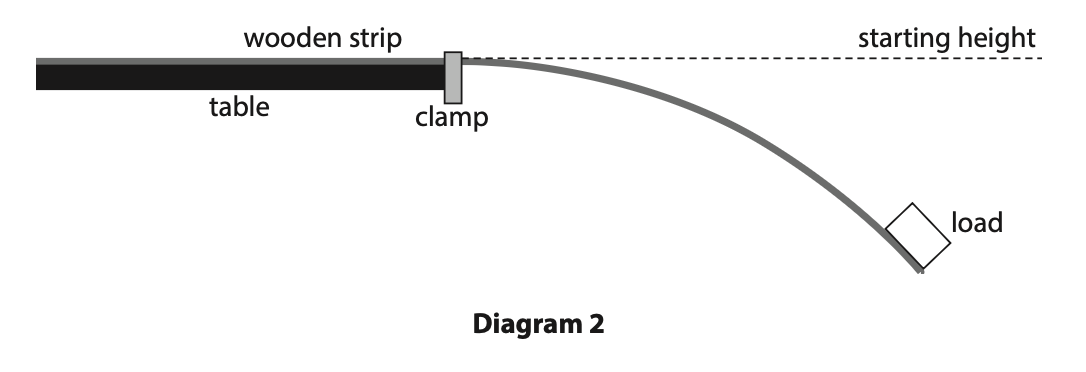
Using diagram 2, determine the height, h, in the laboratory.
[1 cm on the diagram = 10 cm in the laboratory](2)
height, h = …………………………………………………….. cm
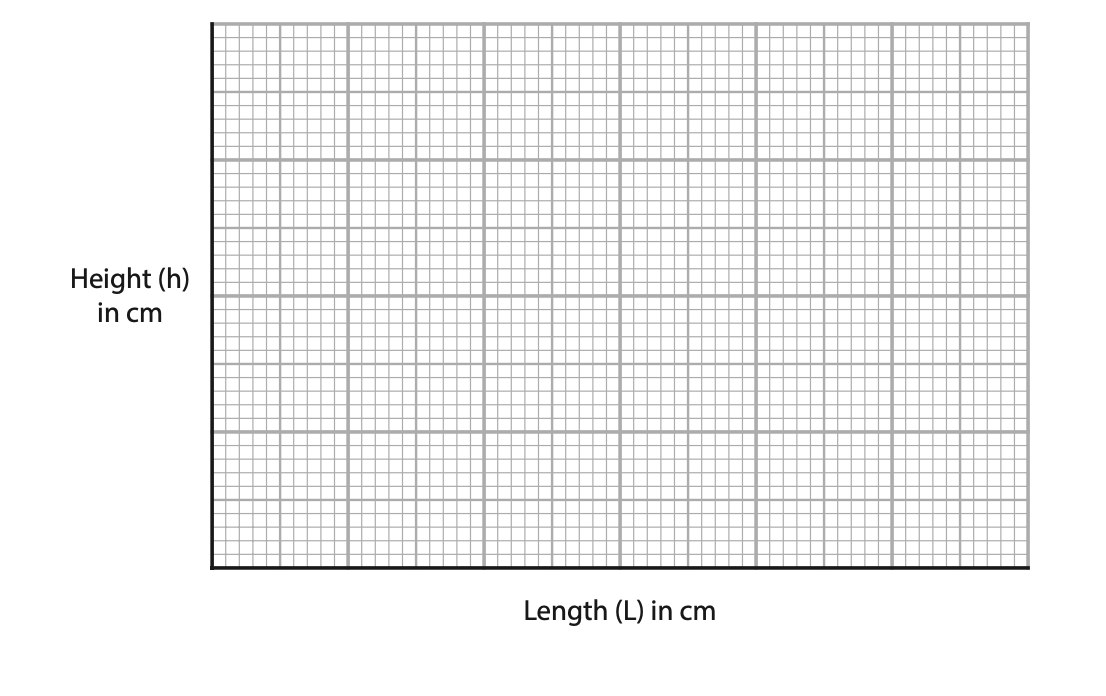
(ii) Plot a graph of the student’s results.(2)
(iii) Draw the curve of best fit.(1)
(iv) The student concludes that h is directly proportional to L.
Evaluate the student’s conclusion. (2)
(Total for Question 10 = 15 marks)
June 2024 Paper 1P Q12
12 A car accelerates with a constant driving force along a horizontal road and reaches its maximum speed.
This is the velocity-time graph for the car’s journey.
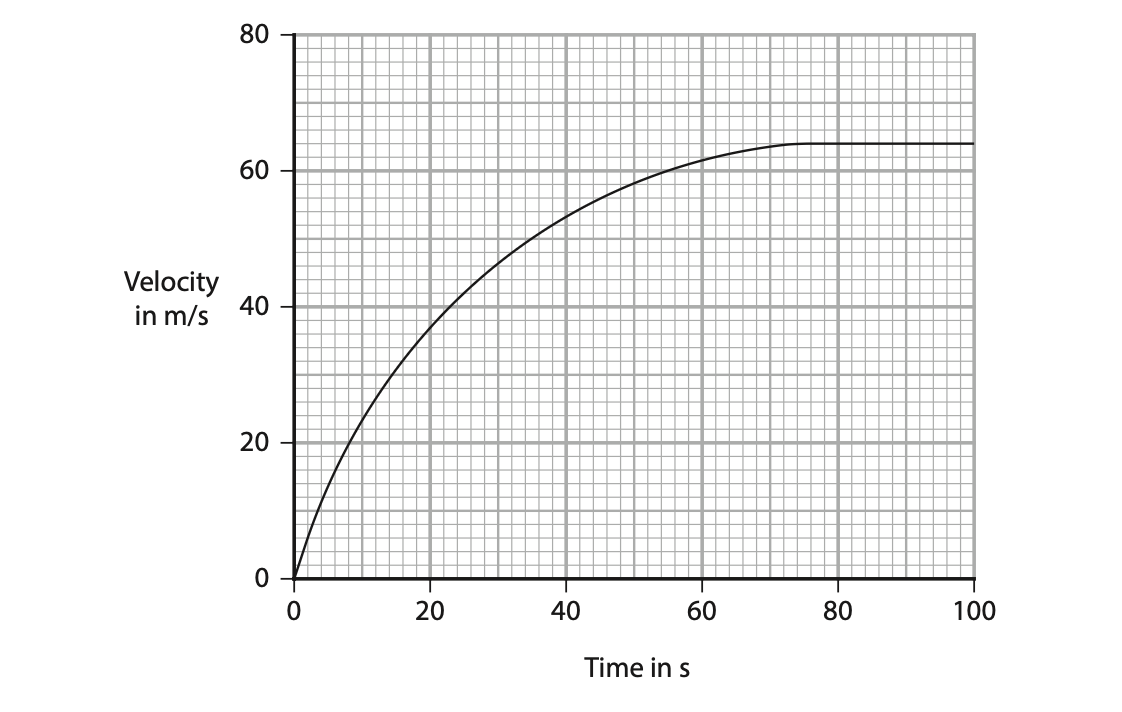
(a) By drawing a tangent to the curve, determine the acceleration of the car at a time of 20 s.(4)
acceleration = …………………………………………………….. m/s2
(b) Determine the distance travelled by the car during the first 80 s of its journey.(5)
distance = …………………………………………………….. m
(c) Explain the motion of the car after 80 s. (3)
(Total for Question 12 = 12 marks)
June 2024 Paper 2P Q2
2 A wrench is used to turn a nut.
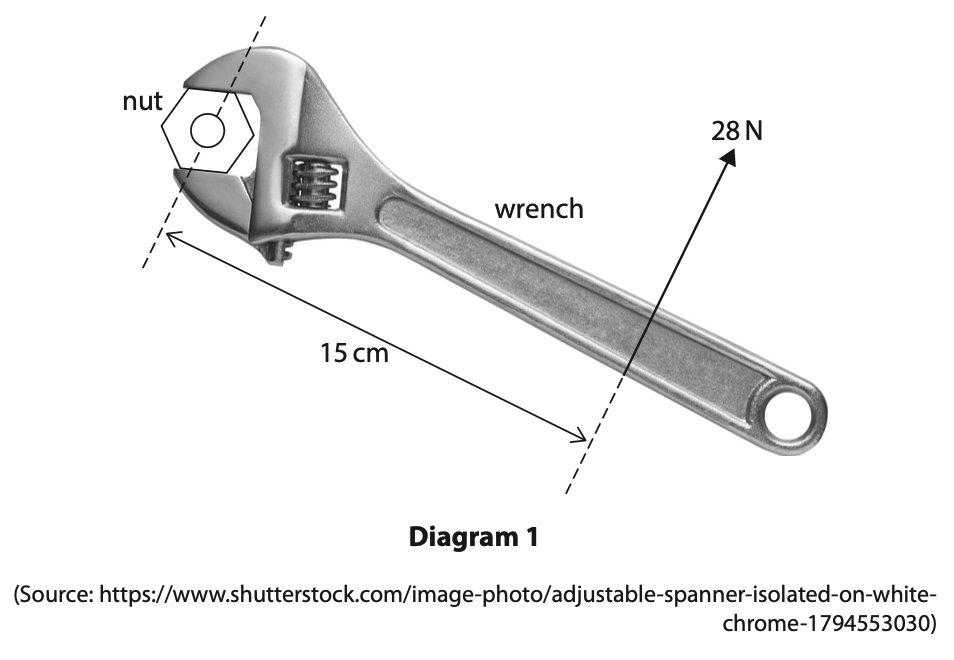
(a) The force applied to the wrench is 28 N.
Calculate the moment applied by the wrench on the nut.
Give a suitable unit. (3)
moment = …………………………………………………….. unit = ……………………………………………………..
(b) State two changes that could be made to increase the size of the moment applied to the nut. (2)
1
2
(c) Diagram 2 shows the wrench as it is turned through 90°
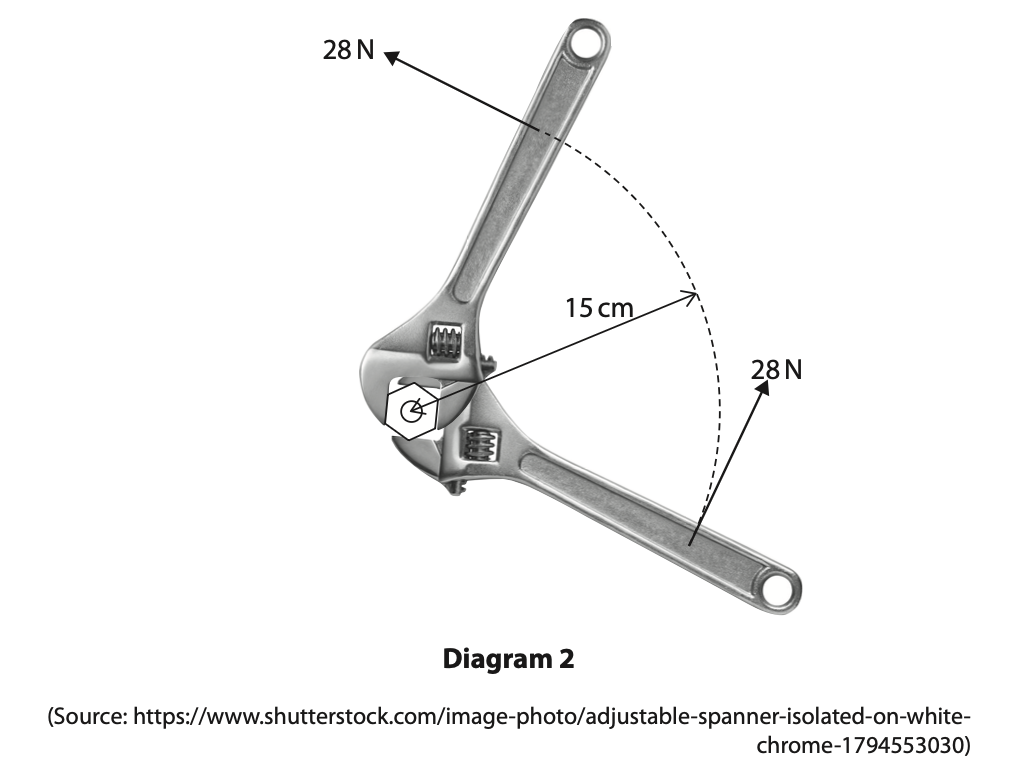
(i) The force is applied over a distance that is equal to a quarter of the circumference of a circle.
The circle has a radius of 15 cm.
Calculate the distance over which the force is applied.
[circumference of circle = 2×π×radius] (2)
distance = …………………………………………………….. cm
(ii) Calculate the work done by the force as the wrench is turned through a quarter of the circumference of the circle. (3)
work done = …………………………………………………….. J
(Total for Question 2 = 10 marks)
June 2024 Paper 1PR Q3
3 In 1947, the Railton Mobil Special was the first ground vehicle to achieve a speed of more than 400 miles per hour.
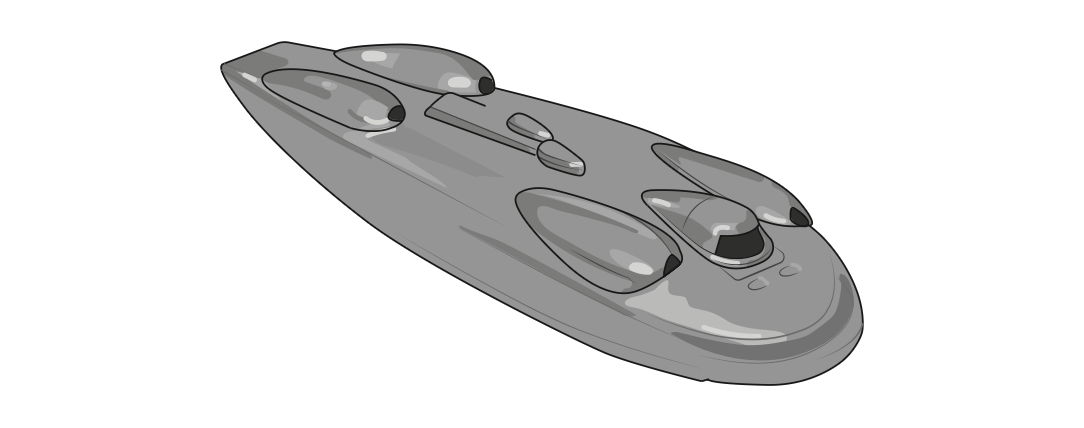
a) During a test, the vehicle travelled at a speed of 403 miles per hour.
(i) Calculate a speed of 403 miles per hour in metres per second (m / s).
[1 mile = 1600 m] (2)
speed = …………………………………………………….. m / s
(ii) During the test, the vehicle travelled past two markers.
The markers were placed a known distance apart.
Describe how these markers could be used to determine the speed of the vehicle. (3)
(b) The diagram shows the vehicle travelling at a constant speed.
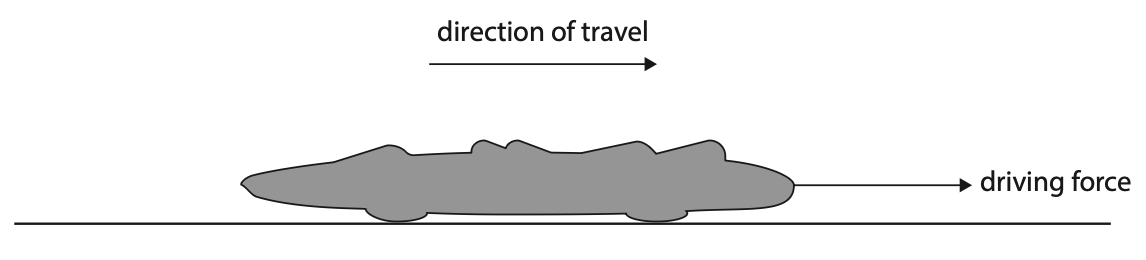
One of the horizontal forces acting on the vehicle has been drawn.
Complete the diagram by drawing a labelled arrow for the other horizontal force acting on the vehicle. (3)
(Total for Question 3 = 8 marks)
June 2024 Paper 2PR Q5
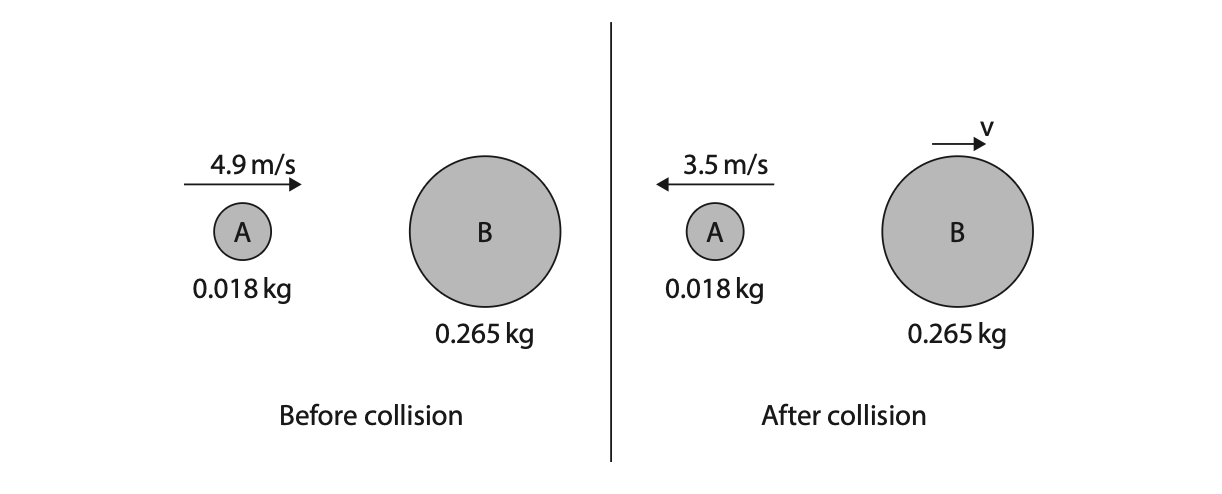
5 The diagram shows the collision between two balls, A and B.
The masses and velocities of both balls are shown before and after the collision.
Ball B is stationary before the collision.
(a) When the balls collide, ball B applies a force on ball A, which causes the velocity of ball A to change.
Ball A also applies a force on ball B during the collision.
Describe how the force applied on ball A compares with the force applied on ball B during the collision. (2)
(b) Calculate the momentum of ball A before the collision. (2)
momentum of ball A before collision = …………………………………………………….. kg m / s
(c) Show that the velocity, v, of ball B after the collision is about 0.6 m / s. (4)
(d) A collision is considered elastic if the total kinetic energy before the collision is equal to the total kinetic energy after the collision.
Using data from the diagram, deduce whether this collision is elastic. (4)
(Total for Question 5 = 12 marks)
November 2024 Paper 1P Q1
1 Diagram 1 shows a planet orbiting a star, and a moon orbiting a planet.
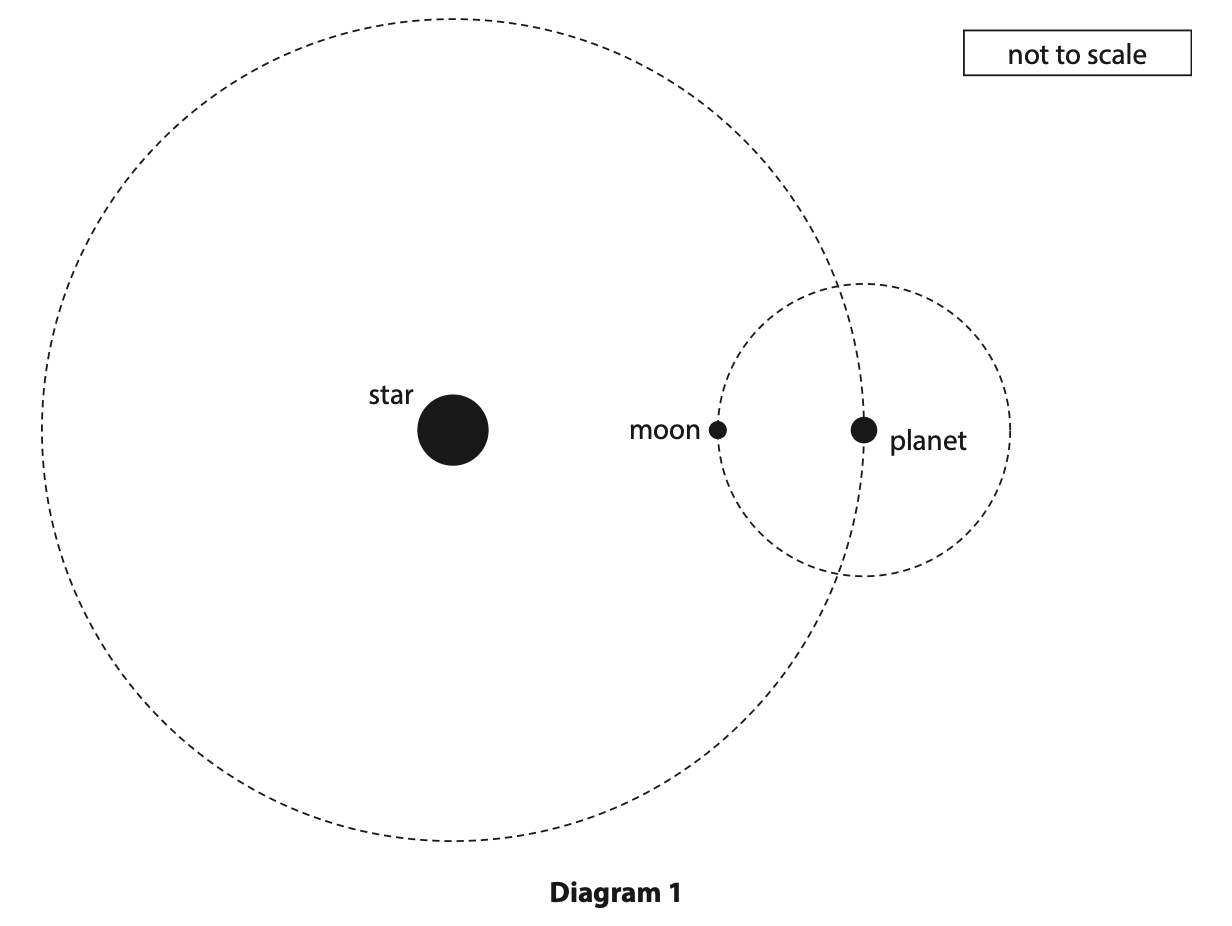
(a) On Diagram 1, draw the orbit of a comet around the star. (2)
(b) (i) On Diagram 1, draw an arrow to show the force the planet exerts on the moon. (1)
(ii) What type of force does the planet exert on the moon? (1)
A electric
B gravitational
C magnetic
D nuclear
(c) The planet completes one orbit of the star in a time of 2.5×10⁸ s.
The radius of the planet’s orbit is 8.7 × 10¹⁰ m.
Calculate the orbital speed of the planet.
Give your answer to two significant figures. (3)
orbital speed = …………………………………………………….. m/s
(d) Diagram 2 shows the region around the Sun, a yellow star, where liquid water can exist on the surface of planets. This is because the surface temperature of the planet is between 0°C and 100°C.

Explain what would happen to the position of the liquid water region if the Sun was replaced with a blue star of the same size. (2)
(Total for Question 1 = 9 marks)
November 2024 Paper 1P Q7b
Forces and Motion + Solids, Liquids, Gases
7 The diagram shows a submarine at rest underwater.
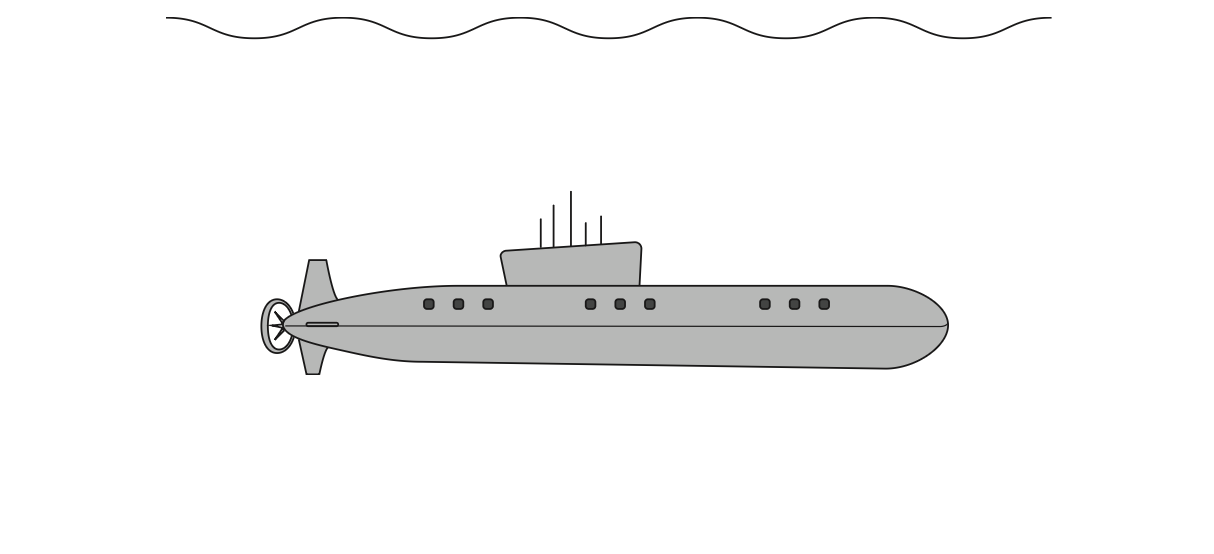
(a) There are two vertical forces acting on the submarine.
(i) One of the forces is called upthrust.
Give the name of the other force. (1)
(ii) Draw two arrows on the diagram to represent the vertical forces acting on the submarine. (2)
(b) (i) State the formula linking pressure, density, gravitational field strength and height. (1)
(ii) Calculate the pressure from the water at a point 38 m below the surface of the water.
[density of sea water = 1030 kg/m3] (2)
pressure = …………………………………………………….. kPa
(c) To rise back to the surface, air is pumped into a storage tank inside the submarine.
(i) Explain how the air exerts pressure on the walls of the storage tank. (3)
(ii) The air in the storage tank starts at a pressure of 410 kPa.
As the submarine rises, the air in the storage tank increases in temperature from 2.5°C to 18°C. The volume of the storage tank remains constant.
Calculate the pressure of the air in the storage tank at 18°C. (4)
pressure = …………………………………………………….. kPa
(Total for Question 7 = 13 marks)
November 2024 Paper 1P Q3
3 (a) State the principle of conservation of momentum. (1)
(b) The diagram shows object A and object B moving in opposite directions.
The arrows show the direction of the velocities of the two objects.
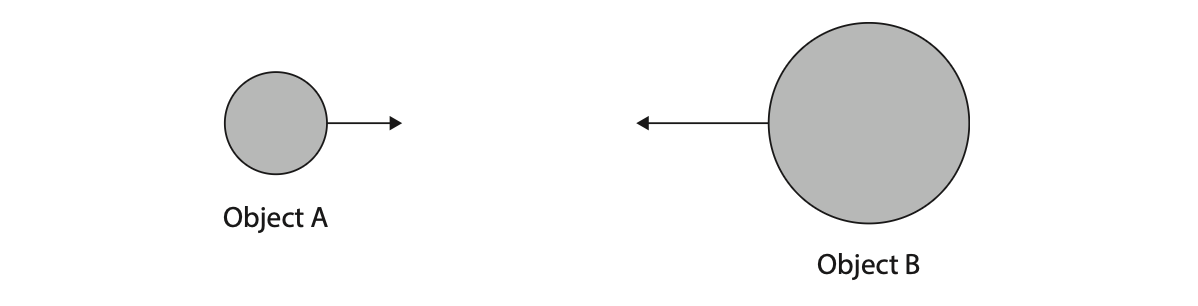
Before the collision object A has a momentum of 39 kg m/s.
After the collision object A and object B stick together and stop moving.
(i) State the magnitude of the momentum of object B before the collision. (1)
momentum = …………………………………………………….. kg m/s
(ii) State the formula linking momentum, mass and velocity. (1)
(iii) The mass of object A is 8.1 kg.
Calculate the velocity of object A before the collision. (2)
velocity = …………………………………………………….. m/s
(iv) The time taken for the collision is 0.56 s.
Calculate the average force on object A. (2)
force = …………………………………………………….. N
(v) Give the direction and magnitude of the force on object B from object A. (2)
magnitude = …………………………………………………….. N
direction = ……………………………………………………..
(Total for Question 3 = 9 marks)