IGCSE Physics Past Papers Exam Questions (Edexcel) 2024 on Energy Resources & Energy Transfers
Here, you will find questions relating to the topic – Energy Resources and Energy Transfers from 2024 exam papers. Use these to familiarise, practice and prepare for your IGCSE Physics examination.
You can find earlier papers below:
- IGCSE Physics Past Papers Exam Questions on Energy resources and energy transfers 2019-20.
- IGCSE Physics Past Papers Exam Questions on Energy resources and energy transfers 2021-22.
- IGCSE Physics Past Papers Exam Questions on Energy resources and energy transfers 2023-24.
What you need to know
Use the list below as a quick recap for what you need to know before attempting the past year exam questions under this topic. This is based on Edexcel International GCSE in Physics (4PH1) specification with first teaching Sept 2017 and first examination June 2019.
Paper 1 and 2: (4) Energy resources and energy transfers
Paper 1 covers all the topics except where it is marked “paper 2 only” while Paper 2 covers all topics.
A. UNITS
- kilogram (kg), joule (J), metre (m), metre/second (m/s), metre/second2 (m/s2), newton (N), second (s) and watt (W)
B. ENERGY TRANSFERS
- describe energy transfers from one energy store to another. Energy stores: chemical, kinetic, gravitational, elastic, thermal, magnetic, electrostatic, nuclear. Energy transfers: mechanical, electrical, heating, radiation (light and sound).
- principle of energy conservation.
- relationship between efficiency, useful energy output and total energy input. efficiency=useful energy transferred (output)/total energy supplied (input) ×100%
- describe a variety of everyday and scientific devices and situations for the transfer of the input energyincluding their representation by Sankey diagrams.
- describe how thermal energy transfer may take place by conduction, convection and radiation.
- explain the role of convection in everyday phenomena.
- explain how emission and absorption of radiation are related to surface and temperature.
- investigate thermal energy transfer by conduction, convection and radiation.
- explain ways of reducing unwanted energy transfer such as insulation
C: WORK AND POWER
- relationship between work done, force and distance moved in the direction of force. W=F×d
- work done is equal to energy transferred.
- use the definitions of work and power.
- the relationship for gravitational potential energy, mass, gravitational field strength and height. GPE = m × g × h
- the relationship for kinetic energy. kinetic energy = 1/2 × mass × speed2 (KE = 1/2 ×m×v2)
- how conversation of energy produces a link between gravitational potential energy, kinetic energy and work.
- describe power as rate of transfer of energy or the rate of work
- relationship between power, work done (energy transferred) and time. P = W/t
(paper 2 only)
D. ENERGY RESOURCES AND ELECTRICITY GENERATION
- describe the energy transfers involved in generating electricity (wind, water, geothermal, solar heating, solar cells, fossil fuels, nuclear)
- describe the advantages and disadvantages of large-scale electricity production from various renewable and non-renewable resources.
June 2024 Paper 1P Q3
3 The photograph shows infrared heating lamps being used to harden fresh paint on a car.
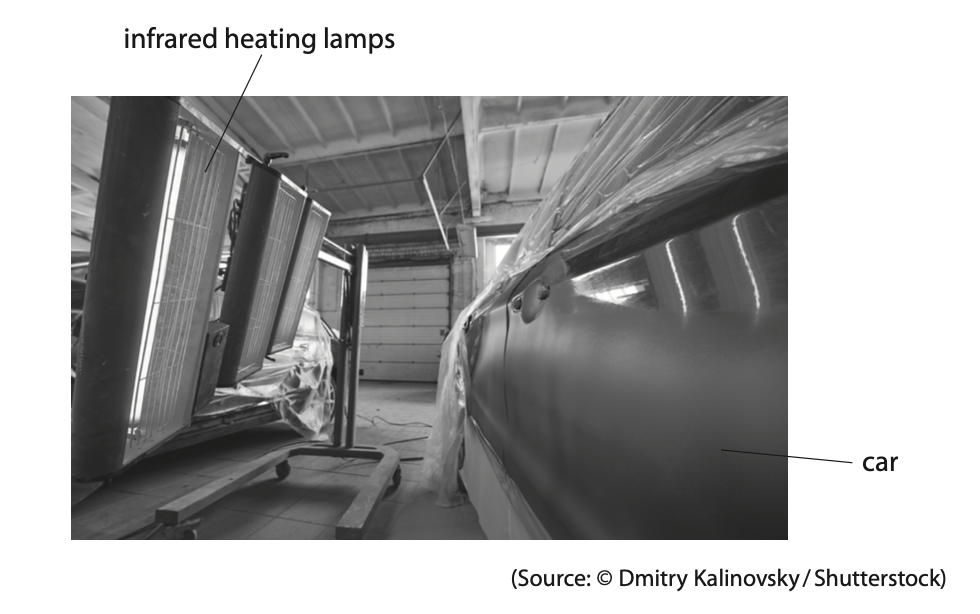
(a) Give a harmful effect of infrared waves. (1)
(b) The heating lamps produce visible light waves in addition to infrared waves.
(i) Give two similar properties of visible light waves and infrared waves. (2)
1
2
(ii) Give two differences between the properties of visible light waves and infrared waves. (2)
1
2
(c) The infrared heating lamps are placed 1.5 m from the car.
Calculate the time taken for infrared waves emitted from a lamp to reach the car.(3)
[for infrared waves, speed = 3.0 × 10⁸ m/s]
time taken = …………………………………………………….. s
(d) Paint takes less time to harden when it absorbs more energy from infrared radiation.
A technician observes that white paint takes more time to harden than black paint.
Explain this observation. (2)
(Total for Question 3 = 10 marks)
June 2024 Paper 2P Q3
3 A student investigates how much infrared radiation is absorbed by different surfaces.
(a) The photograph shows some of the equipment available to the student.
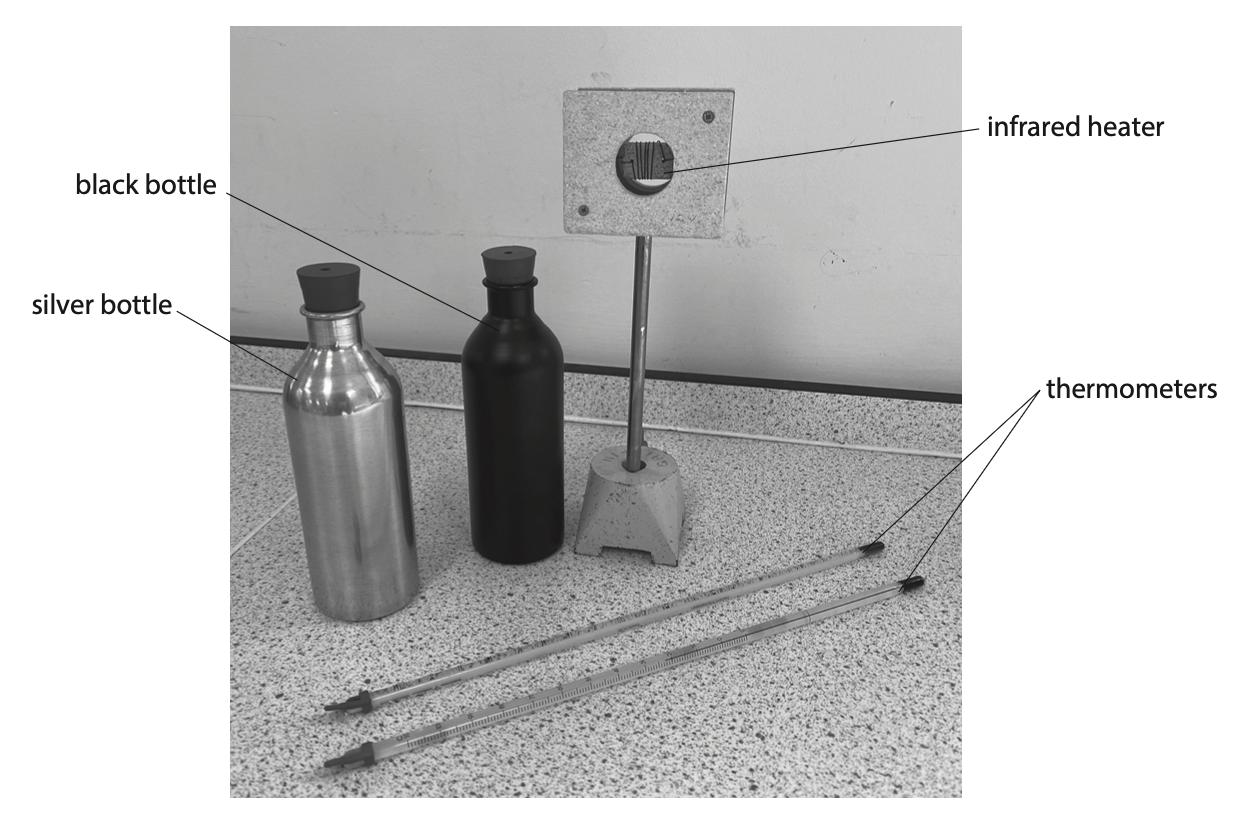
The student pours some water into each bottle.
Describe a method the student could use to investigate how the colour of the bottle affects the amount of infrared radiation absorbed by the bottle.
You may draw a diagram to help your answer. (6)
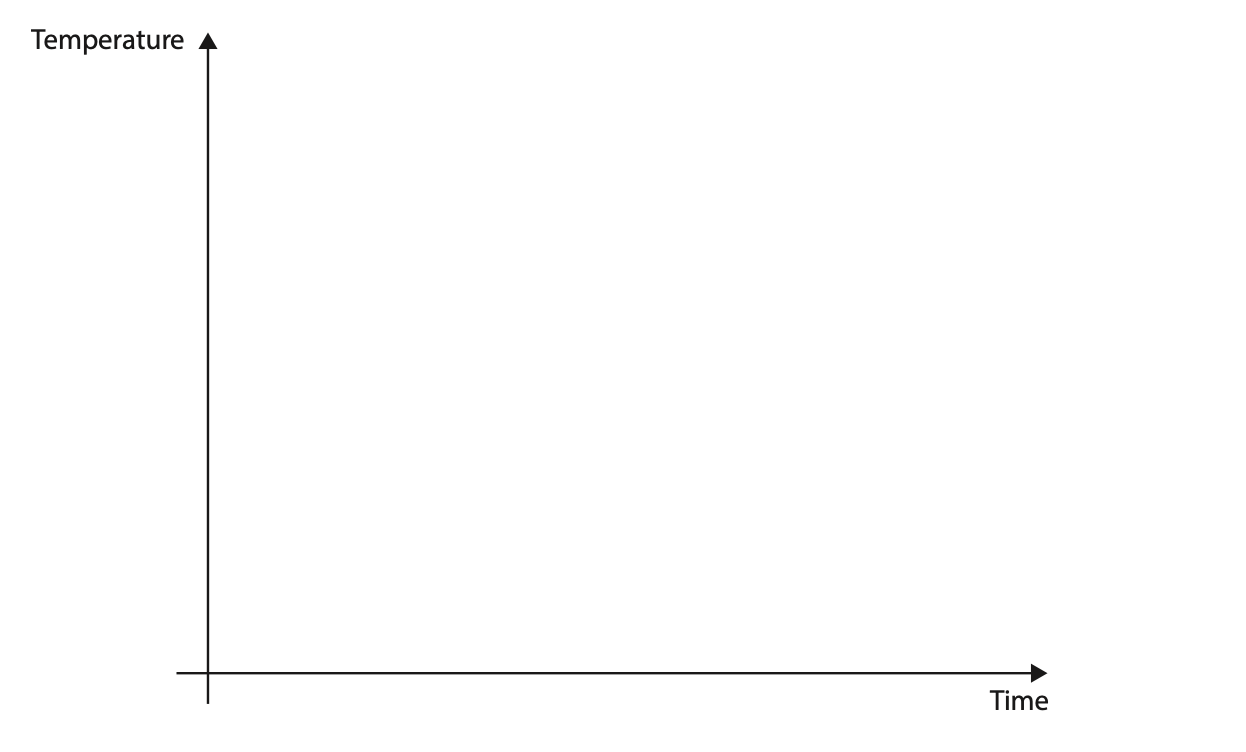
(b) The student plots a graph to show how the temperature of the water in each bottle varies with time.
Draw two curves to show the expected variation in temperature of the black bottle and the silver bottle during the investigation.
Label your curves with the colour of each bottle. (2)
(Total for Question 3 = 8 marks)
June 2024 Paper 2P Q7
7 A hydroelectric power (HEP) station generates electricity from renewable energy resources.
(a) State what is meant by the term renewable energy resource. (1)
(b) The diagram shows the design of a HEP station.
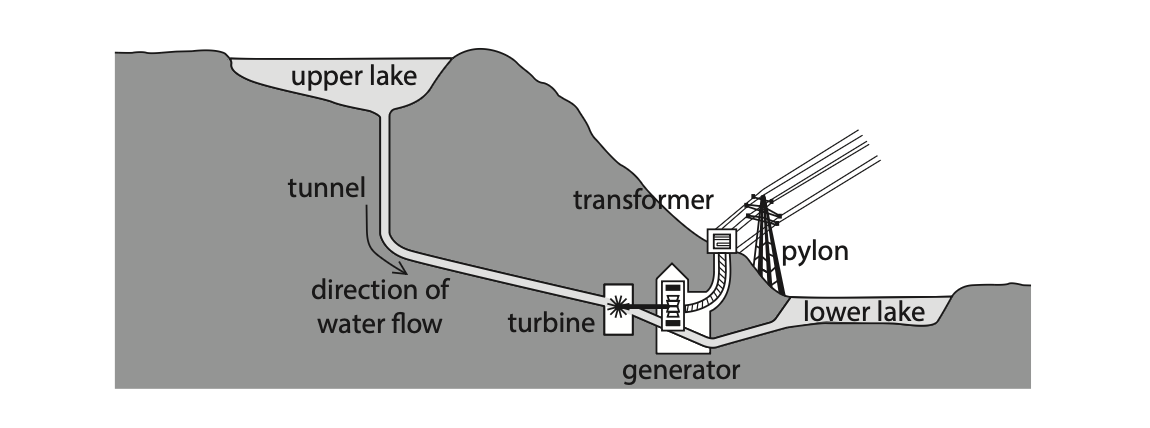
Water flows from the upper lake to the lower lake through the turbine.
The turbine is connected to a generator, which generates electricity.
Describe the energy transfers involved in generating electricity in the HEP station. (4)
(c) The HEP station is located near a large wind farm.
(i) Give one advantage of generating electricity using the HEP station rather than the wind farm. (1)
(ii) Give one disadvantage of generating electricity using the HEP station rather than the wind farm. (1)
(iii) The HEP station has an electric pump that can pump water from the lower lake back to the upper lake.
The pump can be powered using electricity generated by the wind farm.
Explain how the HEP station and wind farm can be used together to maximise the effectiveness of generating electricity. (3)
(Total for Question 7 = 10 marks)
June 2024 Paper 1PR Q9
9 A student stretches a rubber band.
(a) The photographs show a rubber band before and after it has been stretched.
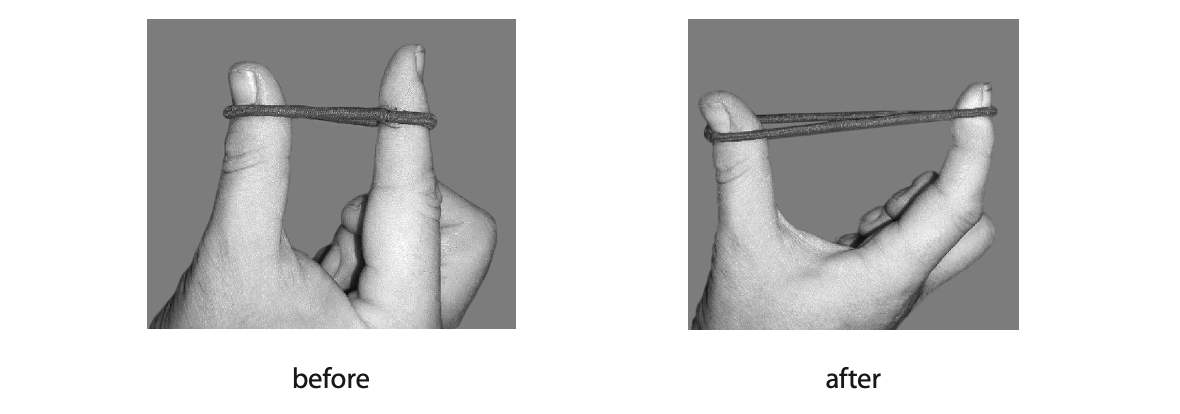
(i) State which energy store increases in the rubber band after it has been stretched. (1)
(ii) State the main method of energy transfer when the rubber band is stretched.(1)
(iii) State the source of the energy transferred to the rubber band.(1)
(b) The diagram shows a force-extension graph for a rubber band.
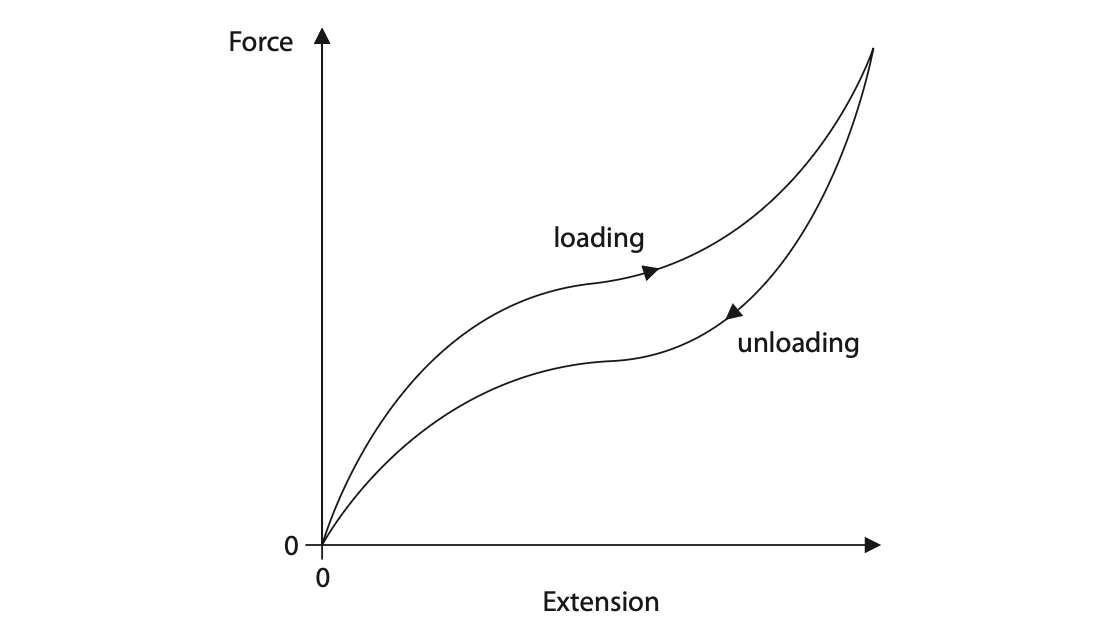
(i) State how the graph shows that the rubber band does not obey Hooke’s law. (1)
(ii) Explain how the graph shows that the rubber band is elastic. (2)
(c) The student stretches the rubber band and then releases it. The band moves vertically upwards.
(i) The band travels with an initial speed of 13 m / s.
When the band reaches its maximum height above the student’s hand, the band has a speed of 0 m / s.
Calculate the maximum height that the band reaches.
Give your answer to 2 significant figures.
[acceleration due to gravity = −10 m / s2] (4)
maximum height = …………………………………………………….. m
(ii) The band reaches its maximum height.
Explain the motion of the band as it falls from its maximum height to the ground. (5)
Refer to forces in your answer.
You may assume
- the band does not rotate
- the band does not reach terminal velocity
(Total for Question 9 = 15 marks)
June 2024 Paper 1PR Q12
12 Air is trapped in a boiling tube by sealing the boiling tube with a rubber bung.
The boiling tube is placed in a beaker containing hot water.
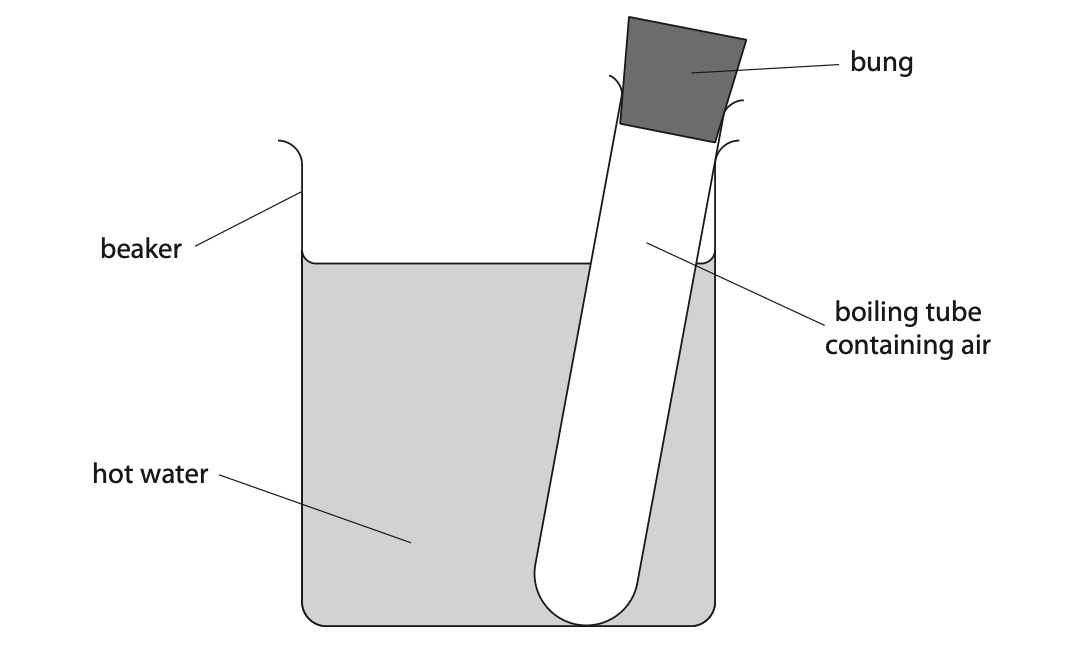
(a) Energy is transferred from the thermal store of the water to the thermal store of the air in the boiling tube with an efficiency of 16%.
The air in the boiling tube gains 1800 J of energy during this process. This is defined as the useful energy transfer.
Calculate the amount of energy wasted during this process. (4)
energy wasted = …………………………………………………….. J
(b) Give two ways that the apparatus could be modified to improve the efficiency of the energy transfer. (2)
(Total for Question 12 = 6 marks)
June 2024 Paper 2PR Q6
6 This question is about generating electricity from renewable energy resources.
(a) Photograph 1 shows a solar farm in the United Kingdom and photograph 2 shows a geothermal power station in Iceland.
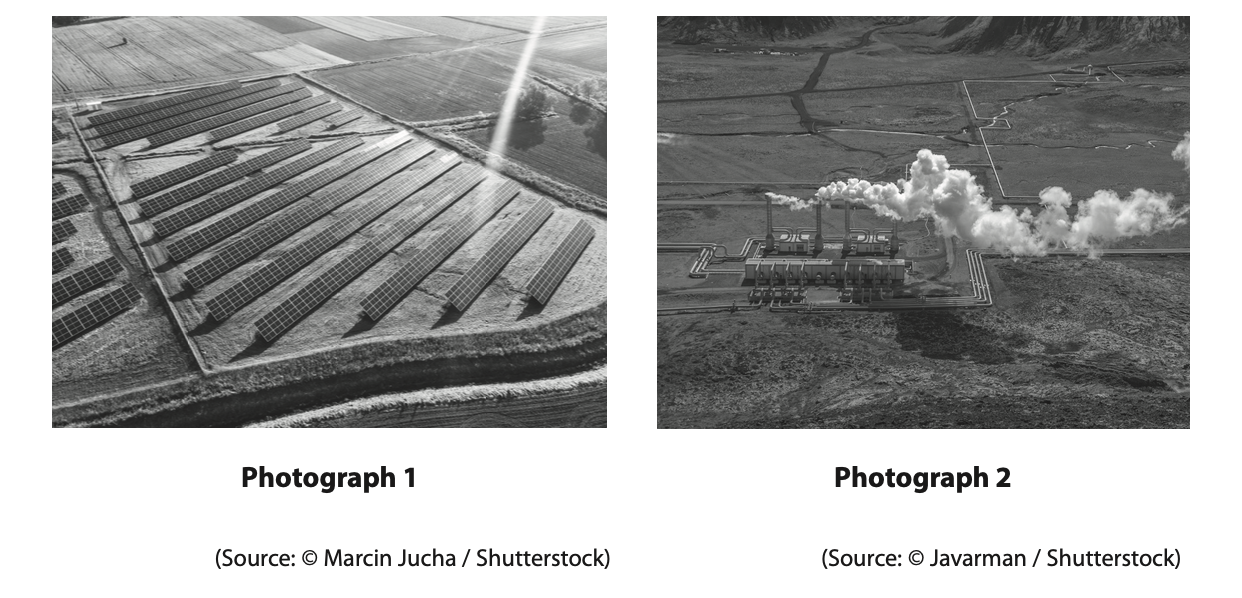
Discuss the advantages and disadvantages of generating electricity using solar power and geothermal resources. (4)
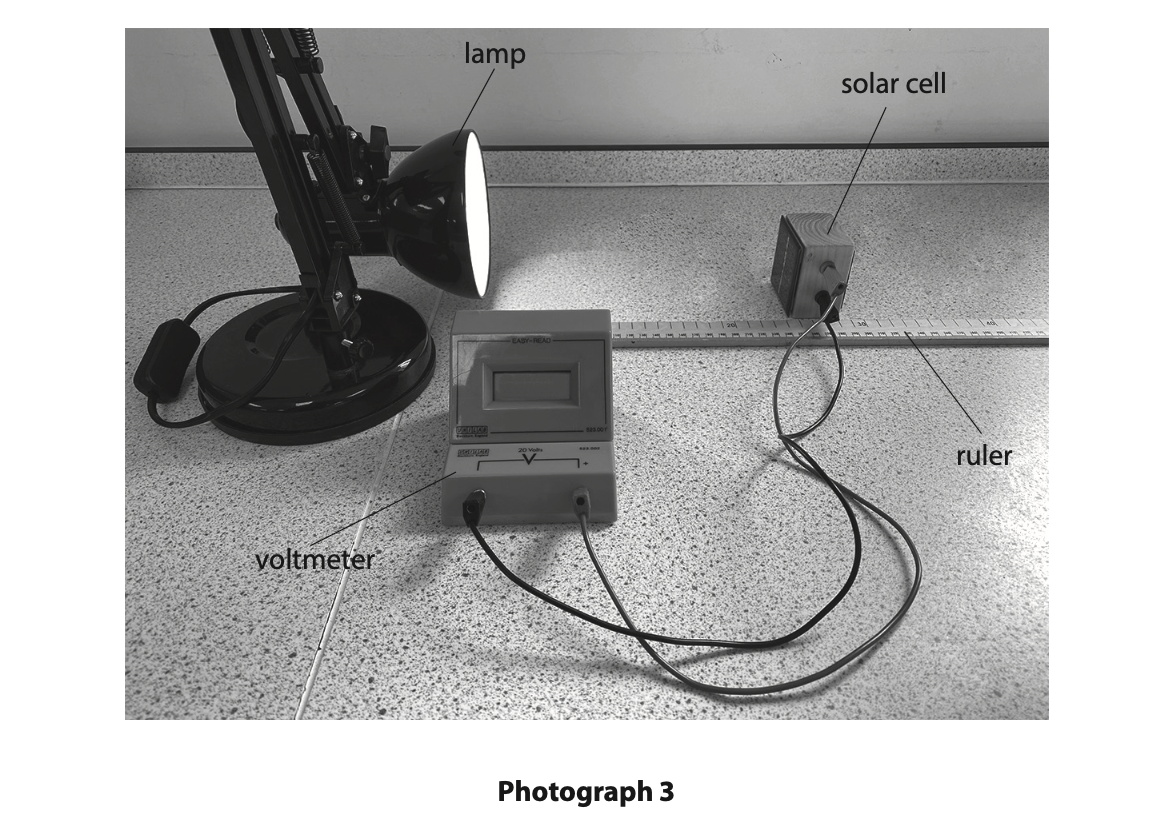
(b) A student investigates how the amount of light affects the output voltage of a solar cell.
Photograph 3 shows how the student sets up their equipment.
The student’s results are shown below.
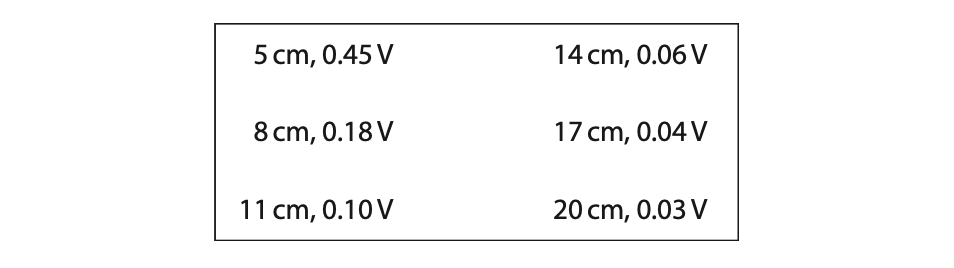
Draw a table showing the student’s results. (3)
(ii) Give a control variable for the student’s investigation. (1)
(iii) The student states that the solar cell could be used as a power source for the lamp.
They suggest that this would work if
- the solar cell is connected directly to the lamp
- the light from the lamp is used to produce the output power from the solar cell
Explain, with reference to the principle of conservation of energy, why the student’s suggestion would not work. (2)
(Total for Question 6 = 10 marks)
November 2024 Paper 1P Q2
2 An athlete jumps vertically from the ground.
(a) The athlete has a mass of 85 kg, and leaves the ground with an upwards velocity of 4.5 m/s.
(i) State the formula linking kinetic energy, mass and speed. (1)
(ii) Calculate the athlete’s kinetic energy at a speed of 4.5 m/s. (2)
kinetic energy = …………………………………………………….. J
(iii) At the maximum height of the jump, the athlete has a speed of 0 m/s.
State the increase in the amount of energy in the athlete’s gravitational potential energy store from the ground to the maximum height of the jump. (1)
increase in gravitational potential energy = …………………………………………………….. J
(iv) State the formula linking gravitational potential energy, mass, gravitational field strength and height. (1)
(v) Calculate the maximum height of the athlete’s jump. (3)
height = …………………………………………………….. m
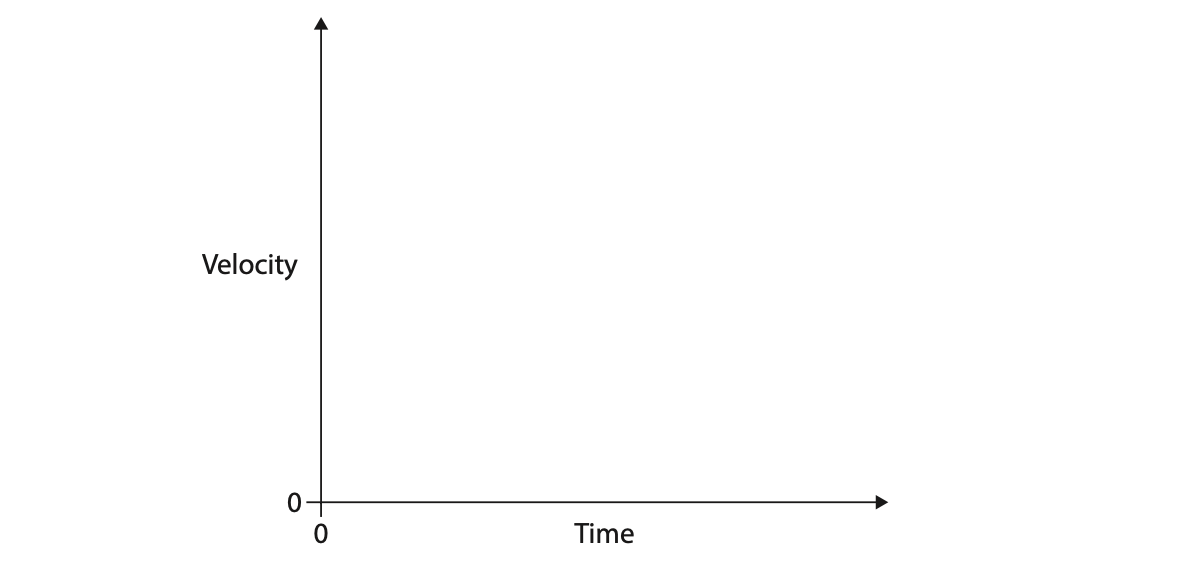
(b) (i) Sketch a velocity‑time graph for the athlete’s jump from the ground to the maximum height of the jump. No numbers are required.
Assume there is no air resistance. (3)
(ii) What feature of the velocity‑time graph gives the acceleration due to gravity? (1)
A area under the line
B gradient
C x‑axis
D y‑axis
(iii) Explain why the gravitational field strength on the Moon is different from the gravitational field strength on the Earth. (2)
(Total for Question 2 = 14 marks)
November 2024 Paper 1P Q10
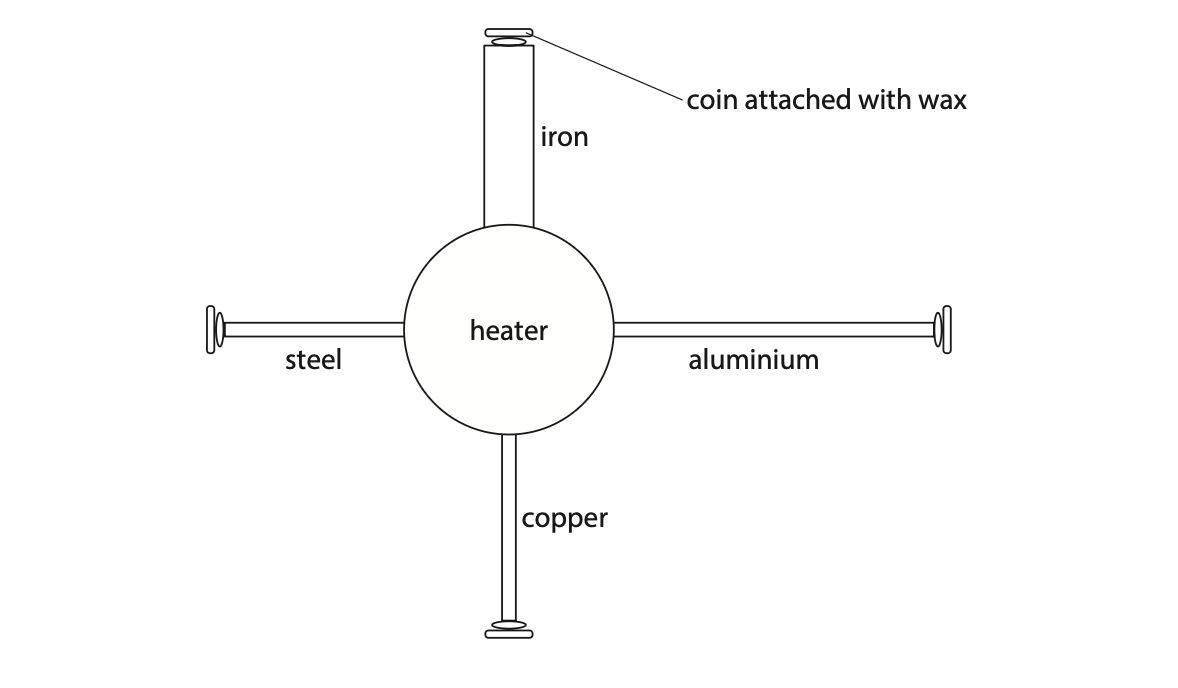
10 A student investigates energy transfer by conduction in different metals.
The student uses wax to attach one coin to each of four different metal rods, and connects the rods to a heater.
When the heater is on, energy is transferred through the metal rods. This melts the wax and causes the coins to fall.
The diagram shows the student’s equipment viewed from above.
(a) This is the student’s method.
Step 1 switch on the heater and start a stopwatch
Step 2 record the time taken for the coin to fall from each metal rod
(i) Give the independent variable in this investigation. (1)
(ii) Give the dependent variable in this investigation. (1)
(iii) A teacher tells the student that their investigation is not valid (a fair test).
Give two ways to improve the validity of the student’s investigation. (2)
1
2
(iv) The student improves the validity of their investigation.
Describe what the student should do to improve the reliability of their results. (2)
(b) The table gives the student’s results.
| Material | Time for coin to drop in seconds |
| iron | 180 |
| steel | 230 |
| aluminium | 140 |
| copper | 90 |
(i) Plot a bar chart of the results on the grid. (3)

(ii) State why a bar chart is a better choice than a line graph for this investigation. (1)
(Total for Question 10 = 10 marks)
November 2024 Paper 2P Q7
7 The photograph shows a wind turbine used for supplying energy on a large scale.
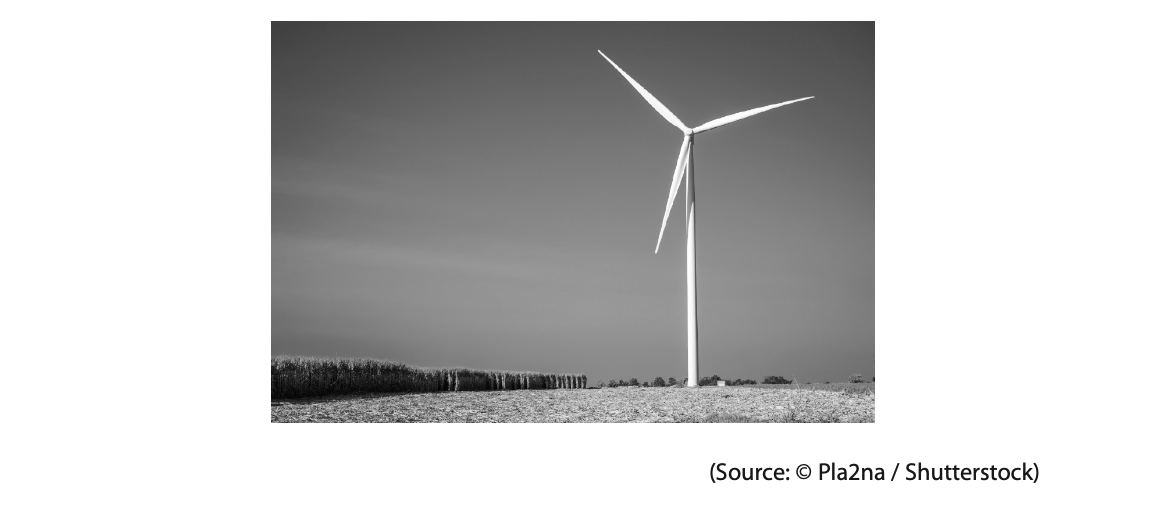
(a) (i) Describe a change in the turbine’s energy stores from when the turbine is at rest to when it is moving at full speed. (2)
(ii) Describe a change in the turbine’s energy stores when the wind is blowing but the turbine moves at constant speed. (2)
(b) (i) State the formula linking efficiency to useful energy output and total energy output. (1)
(ii) The wind transfers 1.2 × 10⁶J of energy to the turbine.
The total mass of the turbine blades is 16 000 kg.
The wind causes the turbine blades to accelerate from rest to an average speed of 7.6 m/s.
Calculate the efficiency of the turbine. (4)
efficiency = ……………………………………………………..
(Total for Question 7 = 9 marks)