IGCSE Physics Past Papers Exam Questions (Edexcel) 2024 on Electricity
We collated all the past papers exam questions on the topic of Electricity
For more past years exam questions on Electricity see below:
- IGCSE Physics Past Years Exam Questions: Electricity 2019-22
- IGCSE Physics Past Years Exam Questions: Electricity 2023-24
What you need to know
Use the list below as a quick recap for what you need to know before attempting the past year exam questions under this topic. This is based on Edexcel International GCSE in Physics (4PH1) specification with first teaching Sept 2017 and first examination June 2019.
Paper 1 and 2: (2) Electricity
Paper 1 covers the Electricity topics below except “Electric charge” while paper 2 covers all Electricity topics.
A. Units
- electrical units: ampere (A), coulomb (C), joule (J), ohm (Ω), second (s), volt (V) and watt (W).
B. Mains electricity
- use of insulation, earthing, fuses and circuit breakers.
- why current in a resistor results in transfer of energy and increase in temperature.
- power = current x voltage. P=I×V
- energy transferred = current x voltage x time. E=I×Vxt
- the difference between alternating (ac) and direct currents (dc).
- explain the use of parallel and series circuits
C. Energy and voltage in circuits
- how the current in a series circuit depends on the applied voltage and the nature of components in the circuit.
- describe and investigate how current varies with voltage in wires, resistors, filament lamps and diodes.
- describe the qualitative effect on current of changing the resistance in the circuit.
- describe the variation of light-dependent resistors with light intensity
- and thermistors with temperature.
- lamps and LEDs show the presence of a current in a circuit.
- voltage = current x resistance. V=I×R
- current is the rate of flow of charge
- current = current x time. Q=I×t
- electric current in solid metallic conductors is a flow of negatively charged electrons
- why current is conserved at a junction
- voltage across two components in parallel is the same
- calculate the currents, voltages and resistances of two resistive components connected in a series circuit
- voltage is the energy transferred per unit charge (joule per coulomb)
- energy transferred = charge x voltage. E=Q×V
D. Electric charge (paper 2 only)
- identify common materials that are insulators and conductors (metals and plastics)
- practical: how insulating materials can be charge by friction
- explain the charging of materials by the loss (+ve electrostatic charge) or gain of electrons (-ve electrostatic charge)
- that there are attractive forces between unlike charges and repulsive forces between like charges
- explain the potential dangers of electrostatic charges (fuelling aircraft and tankers)
- explain some uses of electrostatic charges (photocopiers and inkjet printers)
June 2024 Paper 1P Q7
7 The diagram shows a domestic lighting circuit.
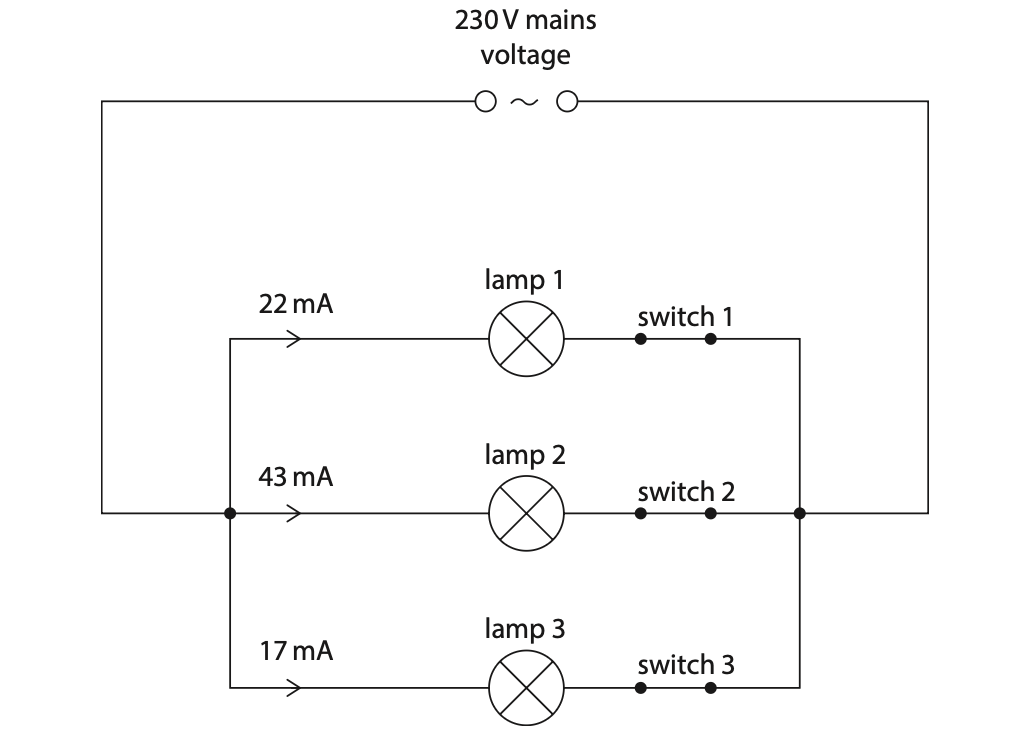
(a) Explain an advantage of using this circuit for domestic lighting. (2)
(b) When switch 1 is closed, the current in lamp 1 is 22 mA.
(i) Give the name of the charged particle that moves in an electric current. (1)
(ii) Show that lamp 1 has a power of about 5 W. (3)
(iii) Calculate the energy transferred by lamp 1 when it is on for 30 seconds. (3)
energy transferred = …………………………………………………….. J
(c) The circuit is connected to the mains supply. Mains voltage is 230 V.
(i) State what is meant by the term voltage. (1)
(ii) Switches 1 and 3 are closed, which turn on lamps 1 and 3.
Switch 2 is open.
Calculate the current in the mains supply.(2)
current = …………………………………………………….. mA
(Total for Question 7 = 12 marks)
June 2024 Paper 1P Q11
11 The photograph shows a power bank used to recharge the battery in an electronic device.
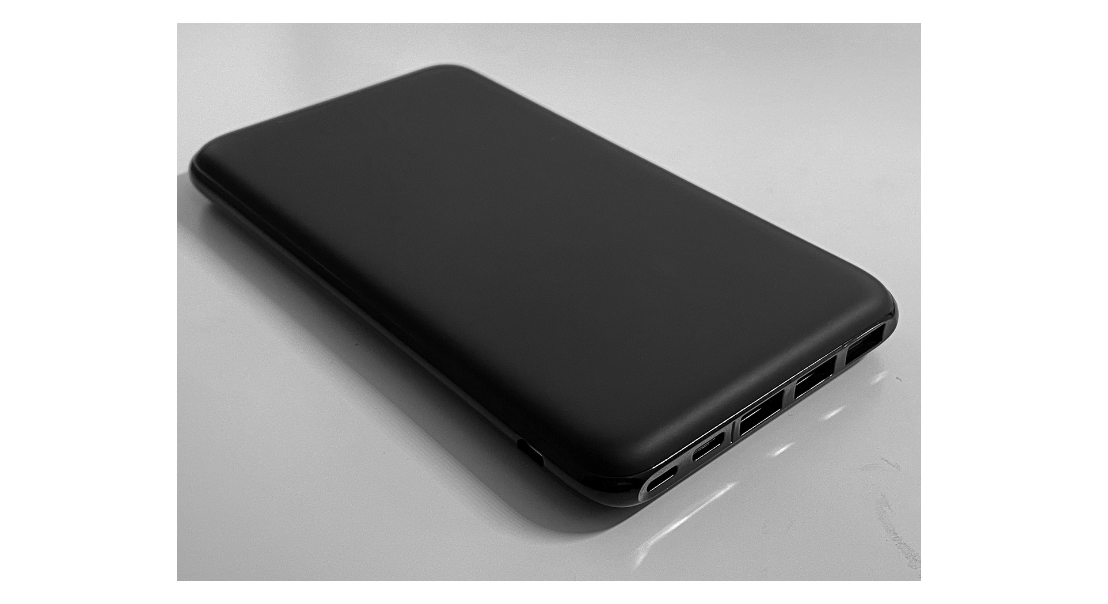
(a) The power bank stores charge.
The charge stored can be measured in amp-hours (Ah). 1 Ah is the amount of charge transferred by a current of 1 A in a time of 1 hour.
Calculate the charge stored in coulombs when the charge stored is 1 Ah.(2)
Use the formula
charge stored = current × time taken
charge stored = …………………………………………………….. C
(b) An electronic device is connected to the power bank.
Whilst recharging, the electronic device receives a constant current of 2.4 A and 3.8 × 10³C of charge is transferred.
(i) Calculate the time taken to recharge the electronic device.
Give your answer in minutes. (3)
time = …………………………………………………….. minutes
(ii)The electronic device is connected to the power bank using a long cable.
Suggest how using a long cable affects the time taken to recharge the electronic device when compared with a short cable. (2)
(c) A student owns three electronic devices. Each electronic device stores a different amount of charge.
The table gives some information about the charge stored by the electronic devices and how often they need to be recharged.
| Electronic device | Charge stored in Ah | Frequency of recharging |
| A | 2.4 | once every day |
| B | 4.2 | once during the week |
| C | 6.8 | once during the week |
The power bank stores a maximum charge of 26.8 Ah.
The student needs to take these three electronic devices on a school trip for one week.
Determine whether the maximum charge of the power bank is enough to recharge the batteries of the three electronic devices during the school trip. (4)
(Total for Question 11 = 11 marks)
June 2024 Paper 2P Q4
4 This question is about electrostatics.
(a) A polythene rod is rubbed with a cloth, which causes both the rod and the cloth to become charged.
(i) Which of these is the force that causes the rod and the cloth to become charged? (1)
A friction
B gravitational
C magnetic
D tension
(ii) The polythene rod becomes negatively charged. Which of these statements explains how the rod has become negatively charged?(1)
A the rod gains electrons
B the rod loses electrons
C the rod gains protons
D the rod loses protons
(b) A student has rods made from different materials.
The student rubs each rod the same way with a cloth.
The student measures the charge gained by each rod three times.
The table shows the results.
| Material | Charge in nanocoulombs (nC) | |||
| 1 | 2 | 3 | Mean | |
| glass | +35 | +38 | +36 | +36 |
| ebonite | –168 | –170 | –171 | –170 |
| polythene | –61 | –80 | –59 | |
| acetate | –20 | –20 | –18 | –19 |
(i) One of the readings for the polythene rod is anomalous.
Circle the anomalous result in the results table. (1)
(ii) State how the student should deal with the anomalous result. (1)
(iii) Calculate the mean charge for the polythene rod. (2)
mean charge = …………………………………………………….. nC
(iv) Describe how the student could use the rods to demonstrate that there are two different types of electric charge. (3)
(Total for Question 4 = 9 marks)
June 2024 Paper 2P Q8
8 The photograph shows a water bath that a technician uses to heat some water.
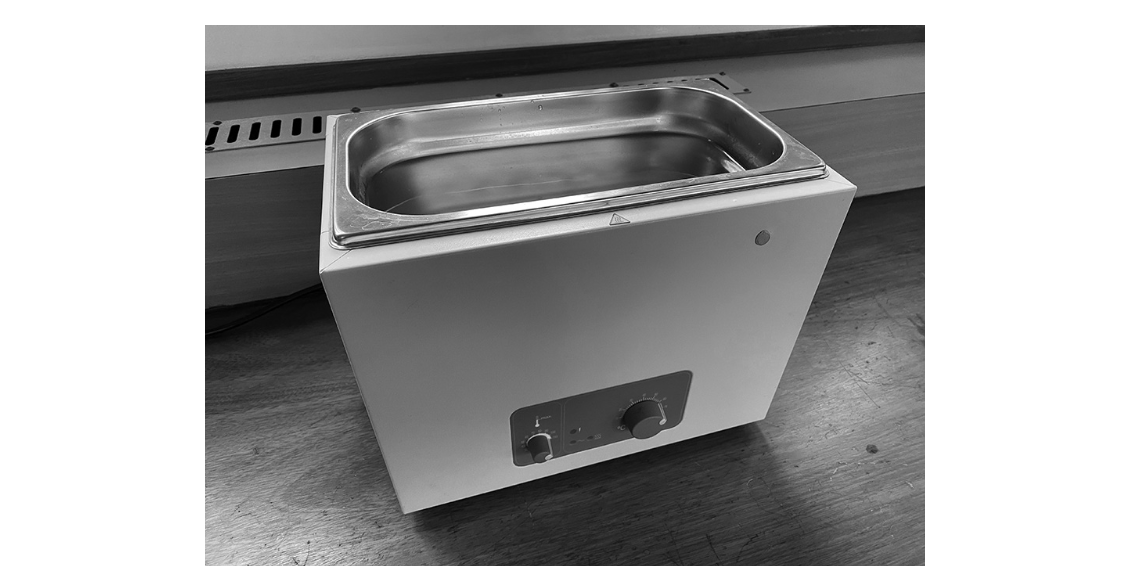
(a) The water bath is filled with water at an initial temperature of 15°C.
Calculate the initial temperature of the water in kelvin. (1)
initial temperature = …………………………………………………….. K
(b) The technician heats the water to a final temperature of 60°C.
(i) Describe how the energy of the water molecules changes as the temperature of the water increases. (2)
(ii) The table shows some information about the heating element in the water bath and the heating process.
| Initial temperature of water | 15°C |
| Final temperature of water | 60°C |
| Voltage of heating element | 230 V |
| Current in heating element | 1.5 A |
| Time taken to heat water | 45 minutes |
Calculate the energy transferred by the heating element in the water bath during the heating process. (3)
energy transferred = …………………………………………………….. J
(iii) Calculate the mass of water being heated.
Assume that all the energy is transferred to the thermal store of the water. (3)
[for water, specific heat capacity = 4200 J / kg°C]
mass of water = …………………………………………………….. kg
(c) Some water evaporates as a gas from the water bath.
(i) Describe the arrangement of particles in a gas. (2)
(ii) Describe two differences between evaporation and boiling. (2)
(Total for Question 8 = 13 marks)
June 2024 Paper 1PR Q2
2 The photograph shows an electric heater connected to the mains electricity supply.
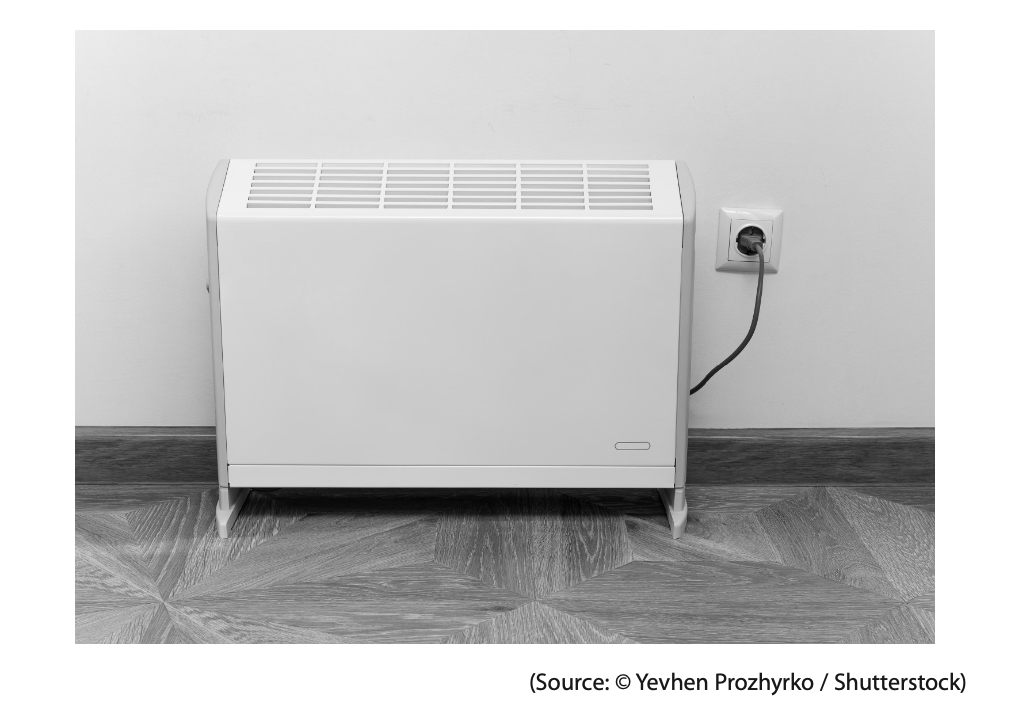
The circuit the heater is connected to is fitted with a circuit breaker, which breaks the circuit if the current gets too high.
(a) Give an advantage of using a circuit breaker instead of using a fuse. (1)
(b) The voltage of the mains electricity supply is 230 V.
(i) State the formula linking power, current and voltage. (1)
(ii) The normal operating current of the heater is 11 A.
Calculate the input power to the heater for this current.
Give your answer in kW. (3)
power = …………………………………………………….. kW
(c) The circuit breaker has a rating of 16 A.
Suggest a reason why the heater may switch off before it reaches its normal operating current. (1)
(Total for Question 2 = 6 marks)
June 2024 Paper 1PR Q7
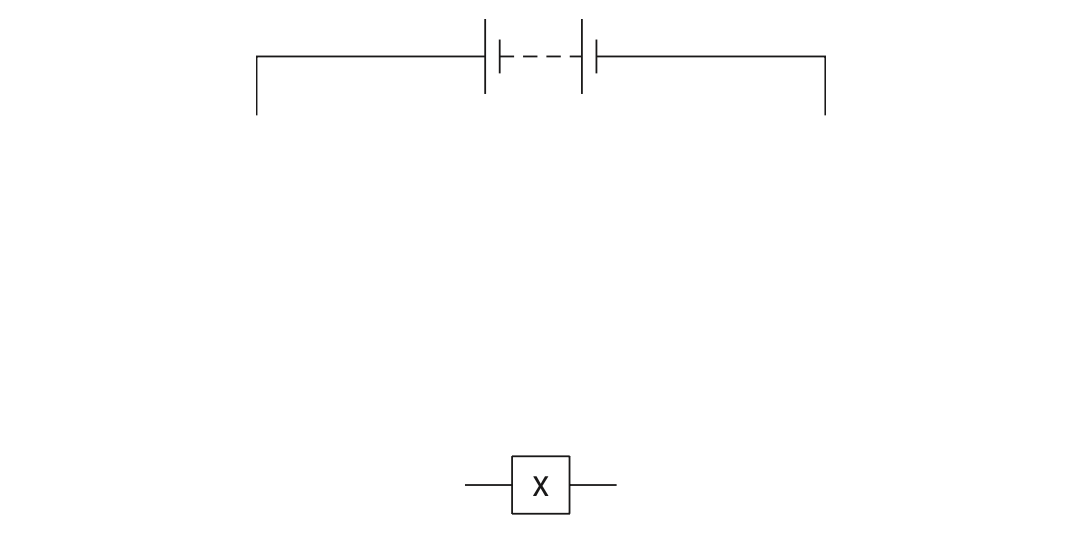
7 A student investigates the voltage-current characteristics of an unknown component, X.
(a) The student is given this equipment to investigate component X.
· battery
· variable resistor
· ammeter
· voltmeter
· connecting wires
The diagram shows an incomplete circuit containing the battery and component X.
Complete the diagram by drawing a circuit the student could use for their investigation.
(b) The graph shows the results of the investigation.
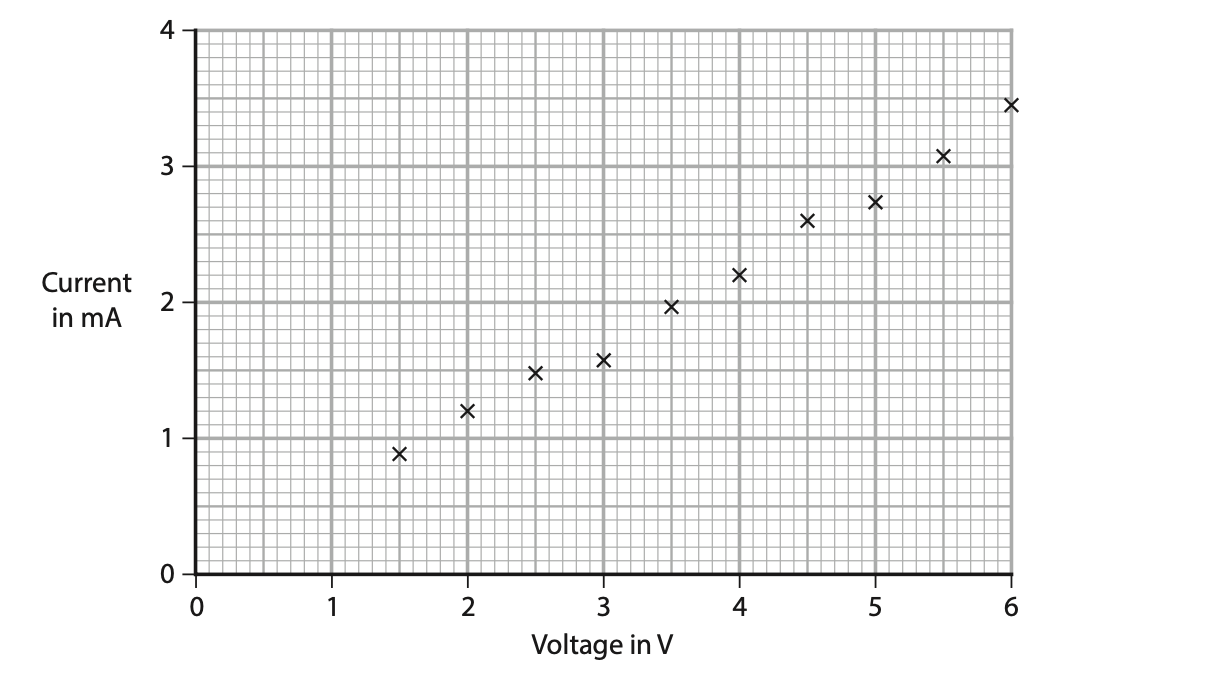
(i) Draw a line of best fit on the graph. (1)
(ii) Calculate the resistance of component X when the voltage is 4.2 V.
Give the unit. (5)
resistance = …………………………………………………….. unit …………………………………………………….
(iii) Which of these is equivalent to 4.2 V? (1)
A 4.2 coulombs per second (C / s)
B 4.2 seconds per joule (s / J)
C 4.2 joules per second (J / s)
D 4.2 joules per coulomb (J / C)
(iv) The student concludes that component X is a filament lamp.
Comment on the student’s conclusion. (2)
(Total for Question 7 = 13 marks)
June 2024 Paper 2PR Q4
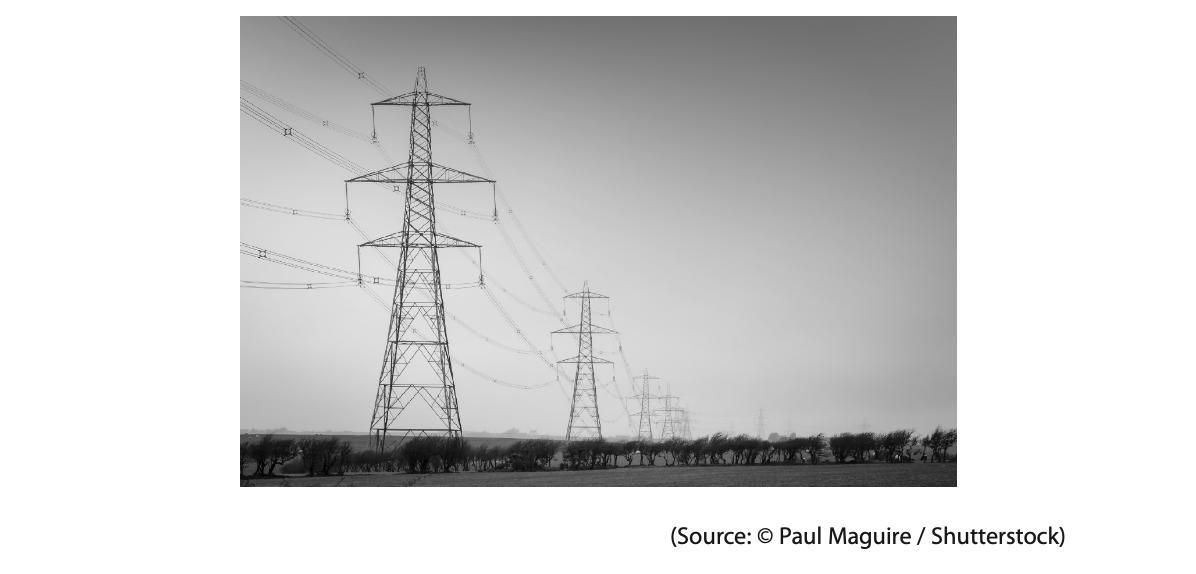
4 The photograph shows transmission cables used for long-distance transmission of electricity.
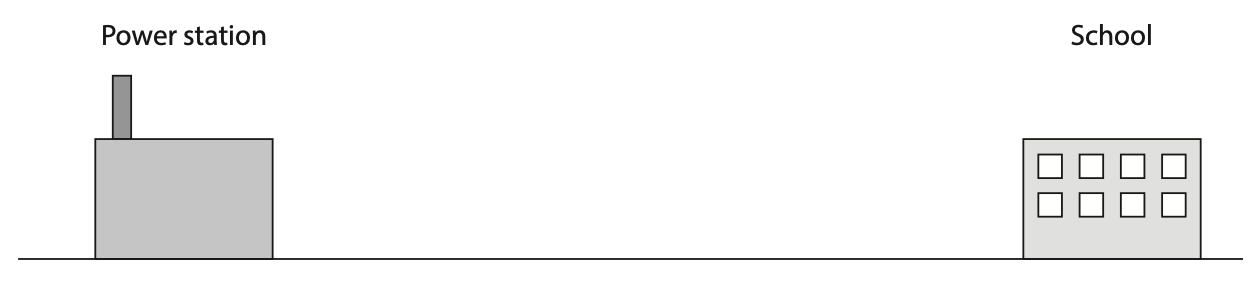
(a) The diagram shows a power station and a school.
Add to the diagram by drawing the structures needed to efficiently transfer energy from the power station to the school using electricity. (3)
(b) Explain how the amount of current in the transmission cables increases the efficiency of the transmission of electricity. (3)
(Total for Question 4 = 6 marks)
June 2024 Paper 2PR Q8
8 The diagram shows a machine that can be used to measure the speed of fast‑moving protons.
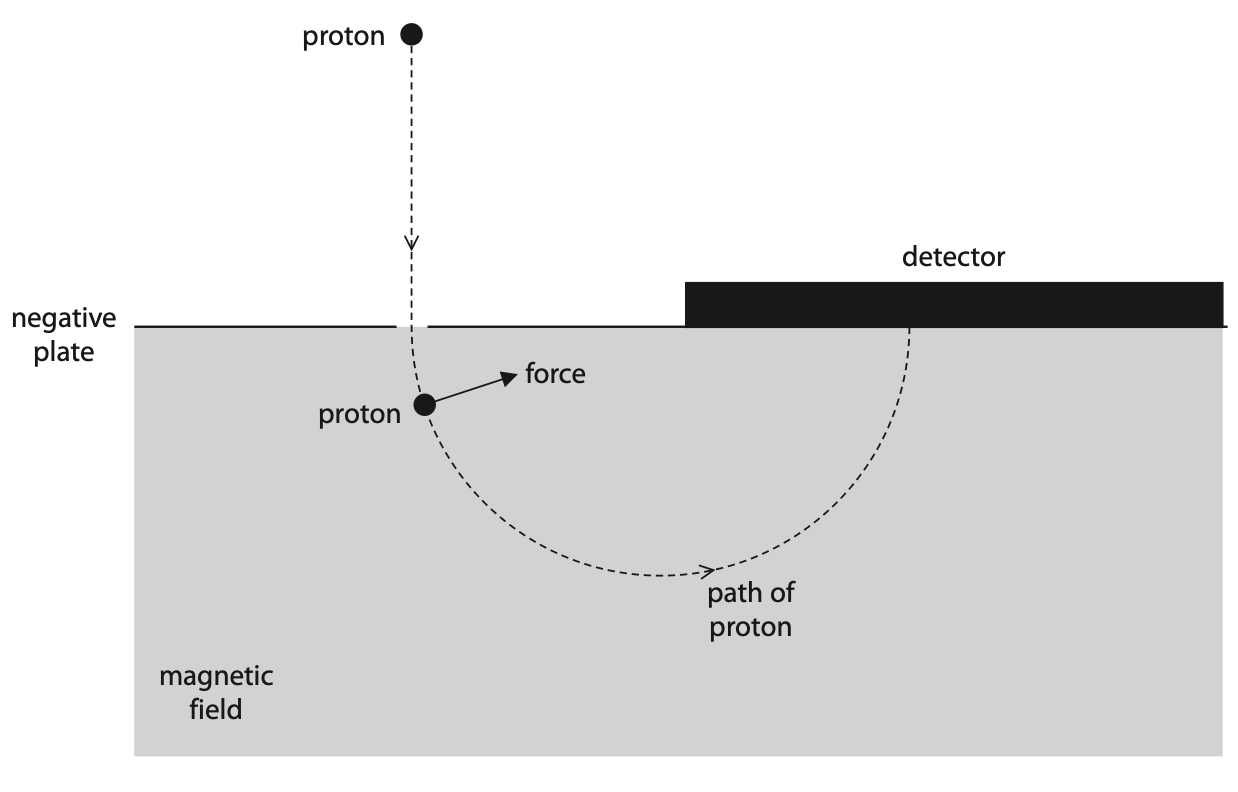
(a) At the start, the proton is attracted towards a negatively charged plate.
(i) Give a reason why the proton is attracted to the negatively charged plate. (1)
(ii) The proton accelerates at 1.90 × 10¹¹m / s2 from rest to a speed of 1.38 × 10⁵ m / s.
Show that the time taken for this acceleration is about 7 × 10⁻⁷s. (3)
(b) The proton passes through a hole in the negatively charged plate and enters an area where there is a magnetic field.
The magnetic field exerts a force on the proton, as shown in the diagram.
This force causes the proton to follow a circular path without changing speed.
(i) Give the direction of the magnetic field. (1)
(ii) Suggest how increasing the strength of the magnetic field will affect the proton when it is moving in the magnetic field. (2)
(Total for Question 8 = 7 marks)
November 2024 Paper 1P Q3
3 (a) Photograph 1 shows a power supply for some electrical equipment. The electrical equipment is connected to the mains supply.

Explain why the power supply is completely covered in plastic. (2)
(b) The electrical equipment is connected to the mains power supply of 230 V.
(i) State the formula linking power, current and voltage. (1)
(ii) The electrical equipment has a power of 350 W.
Calculate the current in the equipment when it is being used. (2)
current = …………………………………………………….. A
(c) Photograph 2 shows a circuit breaker.
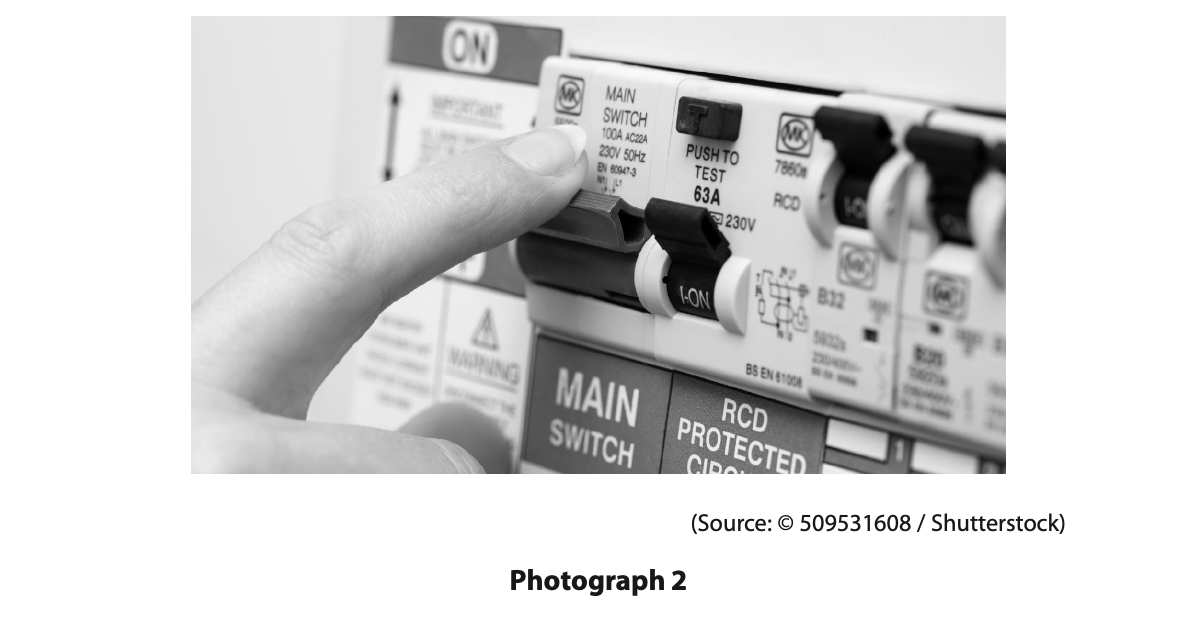
Explain the advantages of using a circuit breaker rather than a fuse. (2)
(Total for Question 3 = 7 marks)
November 2024 Paper 1P Q9
9 A student investigates different electrical components.
(a) The student first investigates how the voltage of a diode affects the current in the diode.
They use this equipment.
· diode
· cell
· variable resistor
· wires
· voltmeter
· ammeter
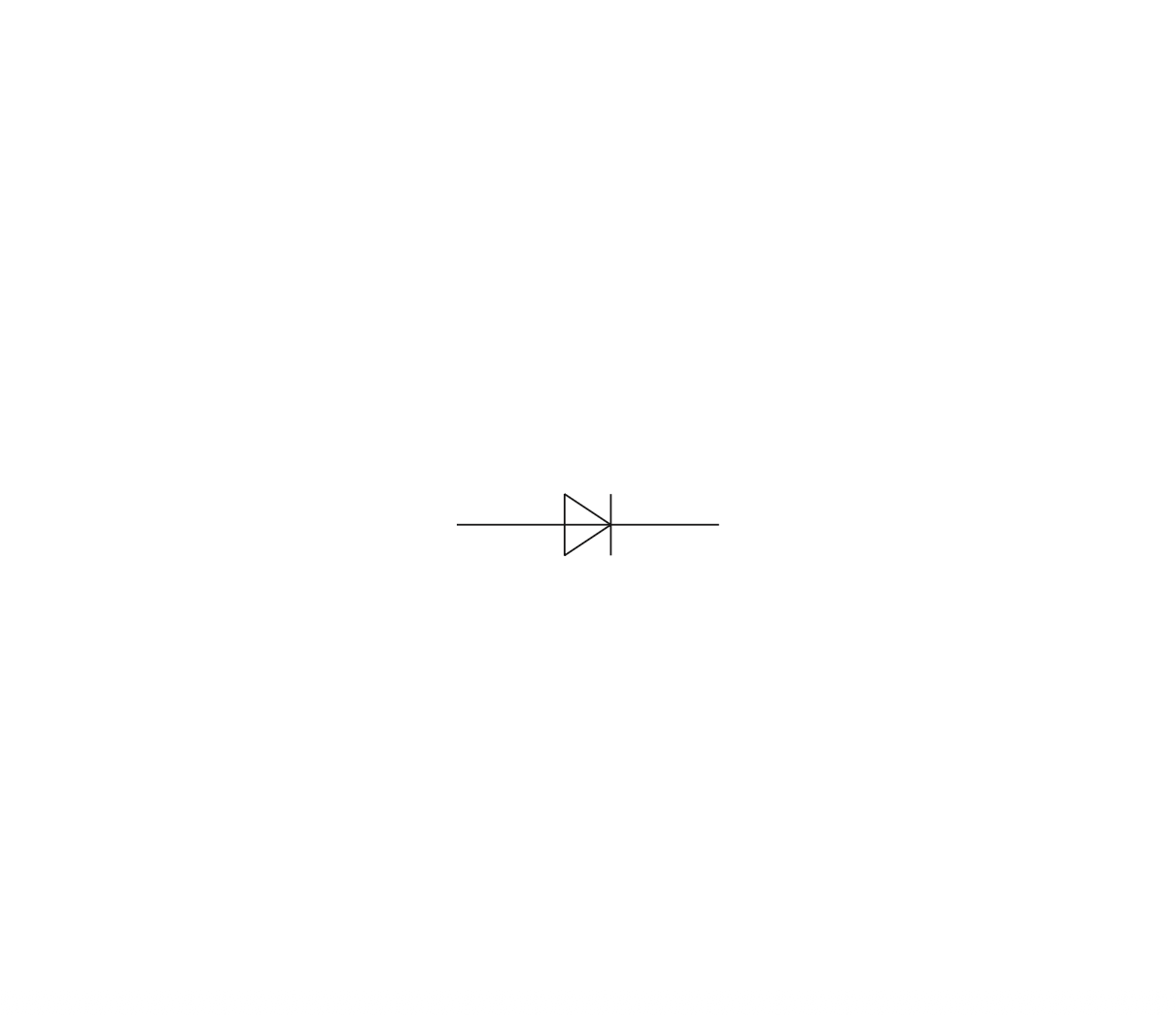
Draw a circuit diagram to represent a circuit the student could use.
The diode has been drawn for you. (4)
(b) In the second investigation, the student uses a circuit with two different resistors, A and B, and a battery with a voltage of 2.9 V.
Diagram 1 shows the circuit, and the current in each resistor.
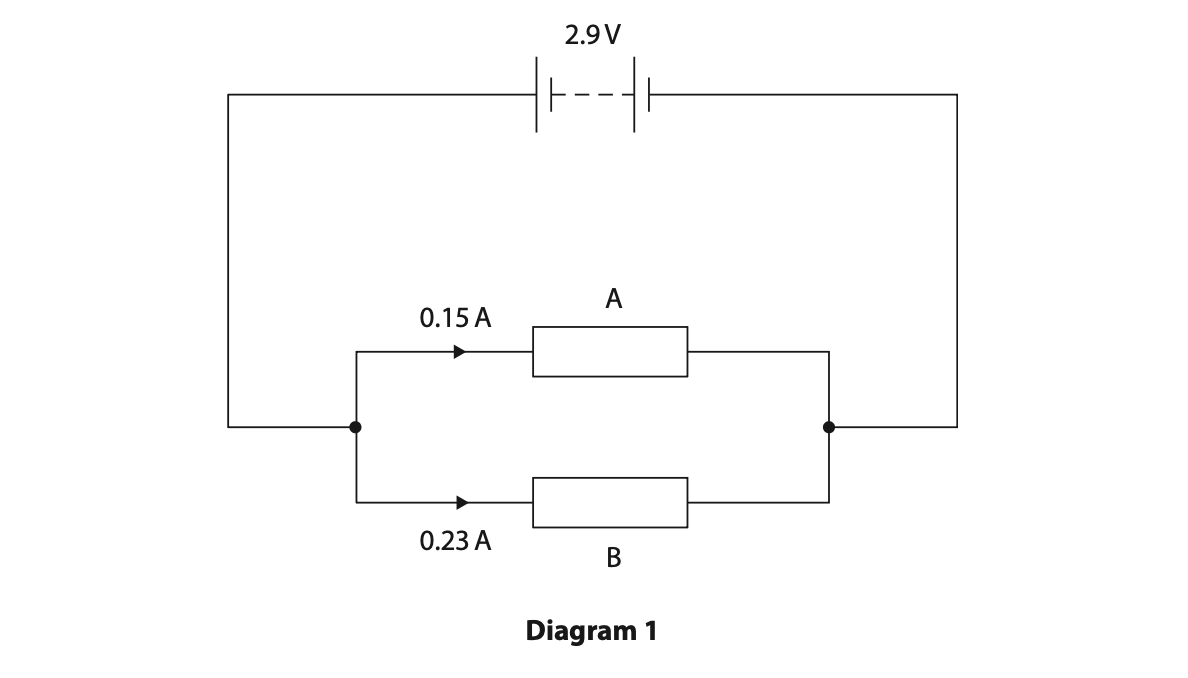
(i) Calculate the current in the battery. (1)
current = …………………………………………………….. A
(ii) State the formula linking voltage, current and resistance. (1)
(iii) Calculate the resistance of resistor A. (2)
resistance = …………………………………………………….. Ω
(iv) Diagram 2 shows the same three components connected in a different circuit.
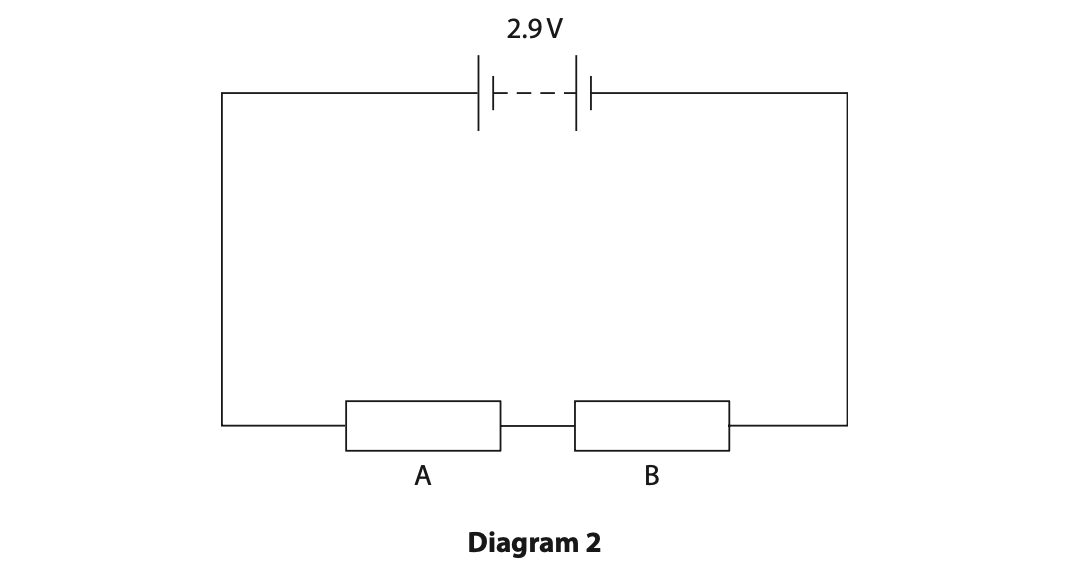
Resistor B has a resistance of 13 ohms.
Comment on the difference between the current in the battery in Diagram 2 and the current in the battery in Diagram 1.
Use calculations to support your answer. (4)
(Total for Question 9 = 12 marks)
November 2024 Paper 2P Q2
2 The diagram shows a rod and a cloth.
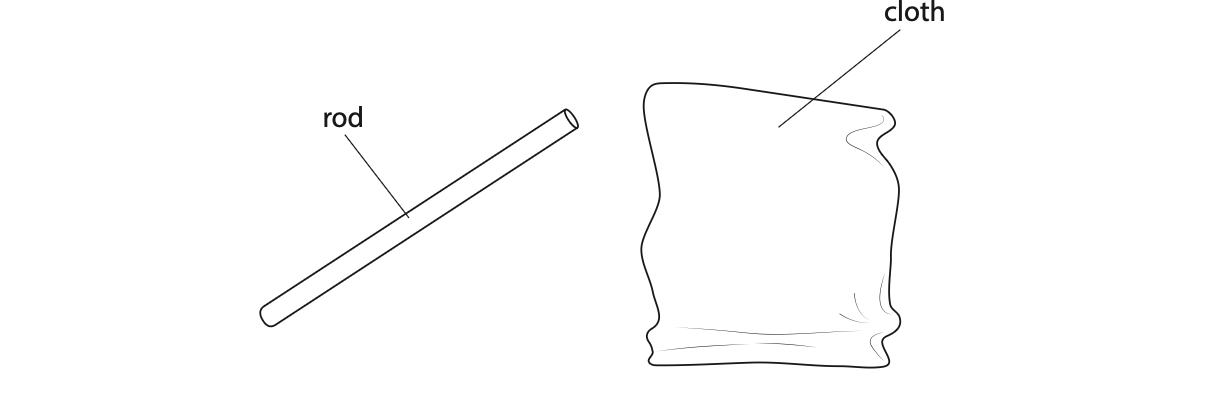
When the rod is rubbed with the cloth, the cloth becomes positively charged and the rod becomes negatively charged.
(a) Explain how the cloth has become positively charged. (2)
(b) The negatively charged rod makes contact with a metal object connected to the ground.
There is an ammeter in series with the object and the ground.
(i) Explain why the ammeter shows a current for a short time and then shows no current. (2)
(ii) State the formula linking charge transferred, current and time. (1)
(iii) The mean current displayed on the ammeter is 6.8 × 10⁻⁶ A.
The current lasts for 3.7 ms.
Calculate the charge transferred. (3)
charge = …………………………………………………….. C
(Total for Question 2 = 8 marks)